Portfolio  /  Medicine
Case · Medicine · Dentistry (Lumident)

Promoting a Dental Clinic

Lumident is a large capital-city dental clinic. A typical commercial YMYL project: a wide service structure, a large volume of content and a massive 'historical' link profile. We break down how, after update-driven declines, we stabilized and recovered organic traffic.

Medicine · YMYLTechnical rehabilitationContent + ScholarshipLong-term recovery
75,966visits/mo (2025)
×7recovery from the low (10K→75K)
1,200+referring domains
~64,000non-branded traffic
How it started

2. Initial problems

About the project

Lumident is a large capital-city dental clinic in Kyiv. From an SEO standpoint it is a typical commercial medical project of the YMYL category: a wide service structure, a large volume of informational materials, separate landing pages for different types of treatment, prosthetics and implantation, and a massive "historical" link profile.

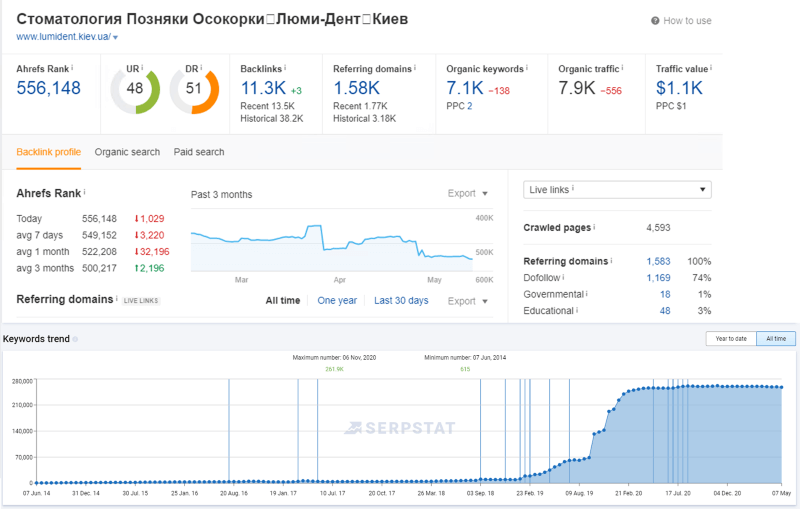
When Lumident approached SEOquick, it was already an established clinic with a strong brand, at the peak of awareness and traffic. But the paradox is that this very peak and years of work with different SEO contractors created fundamental problems: technical "debt", unmanaged content, traces of aggressive link building. After Google's updates for medical sites (YMYL and subsequent updates), this began to clearly affect visibility and the stability of organic traffic.

Google AnalyticsAfter Google's updates for medical sites this began to clearly affect visibility and the stability of organic traffic.

Our task was not to "pull the site up from scratch" but to rehabilitate a large medical project that is formally already in the tops but increasingly suffers from algorithmic changes and accumulated errors. And we succeeded. But more on that below.

The main specifics were that this site remained under the maintenance of another full-cycle SEO agency, which served their site the entire time throughout the whole cycle. But for SEO consulting they came to us.

Niche (context for assessing the result): a large medical YMYL project at the peak of awareness. Here the task is not to "grow from scratch" but to rehabilitate a big site that is formally in the tops but increasingly suffers from algorithmic updates and years of accumulated errors. Retaining organic traffic in such a situation is harder than building new traffic.

The very first comprehensive audit showed that the project had not one or two problems — they layered on top of each other.

First, Lumident fell into the zone of strict YMYL requirements. For a medical site this means heightened attention to content quality, transparency of information about the clinic and expertise. In practice it looked like this: some queries "sagged", CTR on a number of pages fell, and organic growth became unstable — especially against competitors who had managed to adapt better to Helpful Content and E-E-A-T.

Second, the technical audit uncovered years of accumulated "tech debt": problems indexing a large volume of pages, errors in AMP versions, slow response (INP) on mobile, heavy scripts and media, incorrect redirects and duplicates. For a site with hundreds of pages this meant that part of the content simply did not realize its potential in search.

  • irrelevant titles written for clicks rather than intent;
  • over-optimization in some texts;
  • chaotic internal link building;
  • technical "crutches" that broke after CMS updates.

Third, the content analysis showed that within the body of materials there are weak and sagging pages: texts were outdated, the structure did not meet current requirements (no clear H2/H3 hierarchy, few useful blocks), and on some URLs CTR dropped below 1%, even though the topic is clearly commercial and competitive. The metadata question stood apart: over the years, different contractors had formed titles and descriptions by their own rules, with no single standard.

Finally, the project had a powerful but uneven link profile. There were many links, but not all of them met the current level of requirements for the medical topic. Meanwhile the brand's potential — participation in educational initiatives, social projects, expert content — was not fully used.

Despite the clinic's enormous offline authority, the site did not receive enough:

  • niche mentions,
  • quality external links,
  • social trust signals.
The goal

The main challenge of the project

Problems layered on top of each other: strict YMYL requirements, years of accumulated tech debt (indexing, AMP, INP), an uneven link profile and traces of aggressive link building from past contractors. Additionally, the site remained on a full-cycle contract with another agency, while we were engaged for SEO consulting.

The solution: a "first stabilize and clean up, then strengthen" strategy — technical rehabilitation, targeted strengthening of 68 low-CTR pages (based on an audit of 110 competitor URLs), and three Scholarship campaigns for "white" .edu/.gov links that fit YMYL well.

What we did

3. Strategy

The strategy was built around a simple idea: first stabilize and clean up, then strengthen and scale. We split the work into several large directions, each of which supported the other.

First, we bet on technical rehabilitation: run a full technical audit, draw up a clear spec for the developer and separately break out the AMP and Core Web Vitals tasks. The goal — remove everything that interferes with indexing and worsens the user experience: heavy elements, layout errors, extra redirects, INP and load-speed problems.

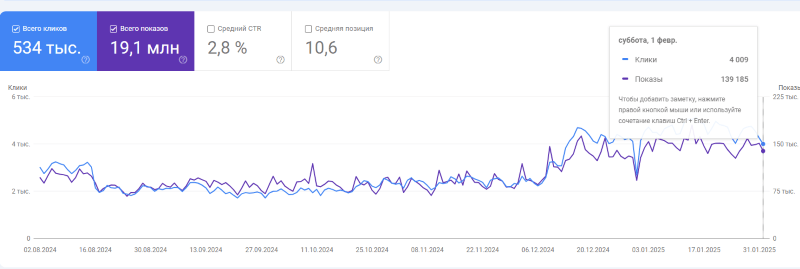
Second, we planned a reassessment and strengthening of content. For a medical topic it is not enough to just "write text": it is important that the page is structured, answers the patient's real questions, looks expert and accurately describes the service. So we checked pages for declines, rewrote metadata, drew up specs for refining materials and set up a process with a copywriter and editor so that texts were not just released but went through proofreading and refinement before publication.

Google Adswent through proofreading and refinement before publication

Third, we relied on competitor analysis. For key directions, competitors' pages were audited (110 URLs in total), 68 internal Lumident pages with low CTR were identified, and another 35 — with potential risk under aggressive optimization. The task — not to "rewrite everything" but to precisely strengthen the pages that are already in the visibility zone but under-receive clicks.

And finally, a separate pillar of the strategy was Scholarship work. Lumident entered Scholarship campaigns three times (the winter 2020–2021 launch, autumn 2023 and autumn 2024). For a large clinic this is not only a way to get .edu/.gov links and relevant mentions, but also a logical continuation of the clinic's real activity — education, participation in contests, socially significant projects. This gives a "white" link profile that fits YMYL requirements well.

Result

4. Work performed

4.1. Audits and task setting

At the start we went through the entire classic set of audits.

The technical audit described the baseline picture: where the site loses speed, which AMP pages render with errors, which blocks interfere with normal indexing, where there are problems with code and server response. Instead of abstract recommendations, these were concrete tasks for the developer: what to fix first, which fixes are critical for Core Web Vitals, which are secondary and can be done as the team's resources allow.

In parallel we ran a YMYL audit: we looked at how doctors, the clinic and legal information are presented on the site, how the contact and trust blocks are designed, how transparent the site is for a patient landing on it for the first time. For Google this is not a formal checkbox but part of the ranking logic for medical sites.

The third part of the diagnostics — a usability audit. We assessed how a user moves through the site: how quickly they can find the needed service, how the menus and filters are arranged, whether the person gets lost between informational and commercial pages, where they encounter "bottlenecks" — be it the booking form, a complex interface or an overloaded header.

The output was not just a report but task maps: what we fix at the code and speed level, what at the interface level, and what at the content and structure level.

4.2. Technical optimization and Core Web Vitals

After setting the tasks, we moved to implementation. The work went not in spot "patches" but in packages:

  • some tasks concerned AMP: we had to remove errors that interfered with correct page rendering and worsened the mobile experience;
  • a separate block — reducing INP and improving Core Web Vitals: optimizing scripts, reviewing heavy elements, working with images and fonts;
  • another important layer — indexing and cleanup: on such a large project, even a small share of "junk" pages or duplicates creates noise and consumes crawl budget.

The technical part is largely "invisible" to users, but it is precisely what provides the base on which content and links start working as intended. In Lumident's case this was especially noticeable against subsequent updates: the site survived the algorithm reshuffle without a catastrophic collapse and retained the potential for recovery.

4.3. Content, metadata and competitors

The next focus — content and how it looks in search results.

The analysis of content declines showed which pages lose traffic not because the topic is no longer interesting, but because the material is outdated, became less useful or loses to competitors in structure and depth. For these URLs we prepared update specs: where to add specifics, where to reformulate blocks, where to strengthen expertise and expand answers to typical patient questions.

A separate layer — metadata. We did not rewrite all titles and descriptions in a row, but worked by priority: first the pages that already have impressions but a CTR below 1%, then careful changes where any abrupt edits could harm. Plus aligning H1 and the H2/H3 structure with the patterns that proved effective during the audit of 68 competitor pages.

Work with competitors was not theoretical but practical: for each target page we looked at how strong players in Kyiv solve its type, and formed specs — which elements should appear, which content blocks to add, which accents to shift, so the page would not be "just another one" but the best in its cluster.

4.4. Scholarship and the link profile

Lumident is a rare case where a medical clinic fits organically into a Scholarship strategy. We entered Scholarship campaigns three times:

  • in the winter of 2020–2021,
  • in the autumn of 2023,
  • in the autumn of 2024.

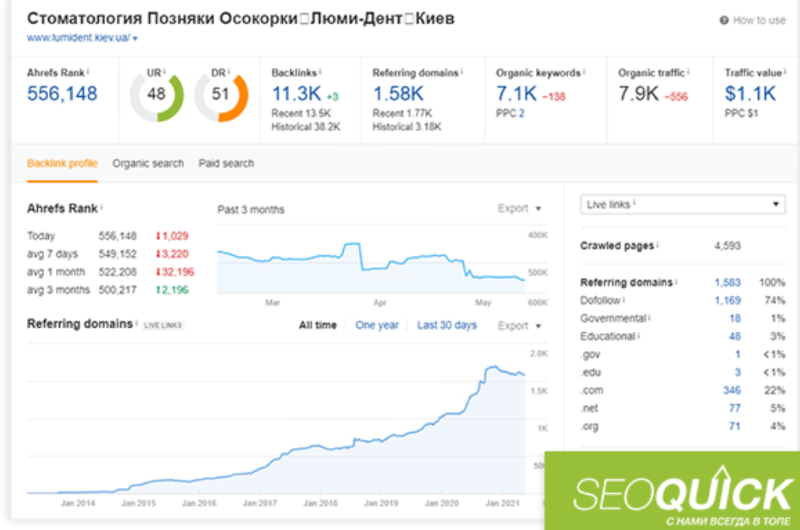
Google AdsScholarship and the link profile

The example of how Scholarship links affect the site's positions is clear.

In each period the clinic acted as a partner or organizer of a scholarship/educational initiative: pages with participation terms were created on the site, and then careful outreach to niche educational resources was launched.

The result — natural links and mentions from .edu/.gov and topical sites, without aggressive link building. For a large medical resource this is especially important: such links not only pass weight but also strengthen the perception of Lumident as a clinic that invests in education and the long-term development of the field.

In combination with the technical and content work, Scholarship became the factor that helped maintain the domain's high trust level, even when the algorithms seriously shook up the medical results.

Result

5. Result

StageOrganic traffic/mo
End of 2020~40,784
Low (June 2021, after updates)~10,456
Peak (September 2023)168,549
After adaptation (December 2025)75,966 (≈×7 vs the low), of which ~64,000 is non-branded

Source: Ahrefs data for the Lumident domain. Referring domains — 1,200+.
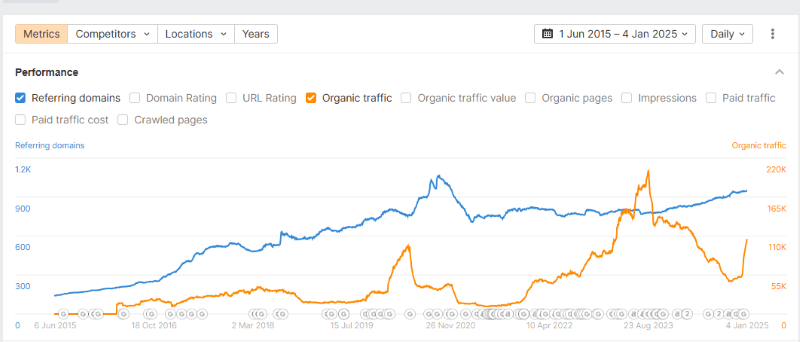
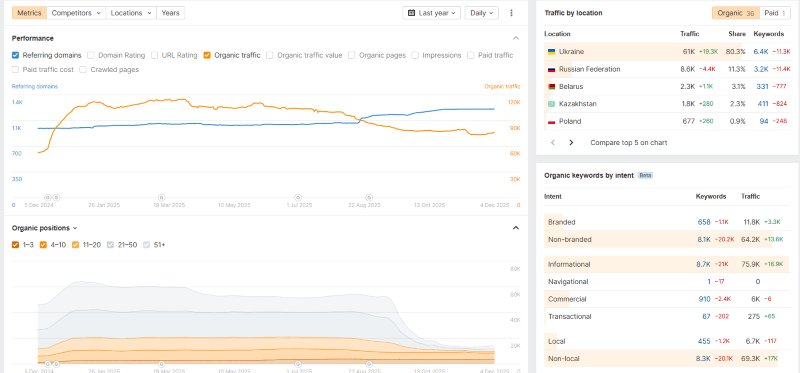
The project's dynamics are clearly visible in Ahrefs data: at the end of 2020 Lumident's organic traffic held at about 40,000 visits per month (on 01.12.2020 — 40,784). Then industry changes and the algorithm reshuffle led to a noticeable decline — in June 2021 traffic dropped to 10,456 visits per month, after which gradual recovery began. By the end of 2021 the site returned to around 35,000 visits, and by the end of 2022 grew to 81,000+.

Google AdsBy the end of 2021 the site returned to around 35,000 visits

By the autumn of 2023, when we entered a new active work period, the project was at its peak: as of September 1, 2023, organic traffic was 168,549 visits per month. But at exactly this moment the medical topic faced another wave of updates, and traffic began to decline. By the end of 2023 it dropped to 122,964, and by spring 2024 — to 114,920.

In the autumn of 2024, amid a global reshuffle of medical results, traffic was briefly recorded around 52,000 visits (on 30.11.2024 — 51,997). This is already significantly below peak values, but considerably above the minimum point of June 2021, when the site was only living through the consequences of the first harsh changes.

By the end of 2025 it is clear that the project not only "stayed afloat" but adapted to the new rules: as of December 4, 2025, organic traffic is 75,966 visits per month, with about 64,000 of them being non-branded traffic, while the Lumident brand accounts for a steady ~6,700 visits. That is, the site attracts not only those already familiar with the clinic but also new patients for queries about treatment, prosthetics, implantation and other services.

Google AdsBy the end of 2025 it is clear that the project adapted to the new rules

Beyond traffic volume, the breadth of visibility also grew. The number of queries in the top-1–3 and top-4–10 increased compared to the starting period, and most of these positions are commercial and local queries: patients searching for dentistry in Kyiv, implantation services, orthodontics, periodontitis treatment, etc. At the same time, DR and the number of referring domains grew to around 1,200+ domains, and the link profile became cleaner and more manageable — thanks to Scholarship and careful external work.

What also matters is how the clinic itself perceives the result. In the review, the director emphasizes that they already had experience with several well-known agencies, but only in this project did they feel a systematic approach: prompt audits, a clear plan, work "for the long term" rather than just short-term metrics. The open communication and willingness to explain what is done and why — rather than just "asking to wait because the niche is hard" — was separately noted.

In the bottom line, the picture is this: Lumident did not avoid the blows of YMYL updates and industry changes, but managed to get through them without a collapse, retain most of its organic traffic and partly recover positions, while strengthening the site's trust and quality. The project continues to develop: pages are being updated, work on content and Scholarship continues, and the site remains one of the strongest dental resources in Kyiv in organic search.

Promotion regionKyiv
Why SEOquick

Project team

The project was handled by the SEOquick team:

  • Nikolay Shmychkov — SEO strategy (Deputy Director)

Full team and roles — on the About page.

More cases

What's next

A similar medical case: SEO for a Clinic Website in Kyiv (FamilyHealth) — organic growth of more than 17x.

Have a large medical site under update pressure? The concrete next step is to get a YMYL audit and a rehabilitation plan.

Reviews

What clients say after a year together

Real reviews from Google Reviews and Freelancehunt.

★★★★★Google Reviews

Huge thanks to the SEOquick team for their professionalism and detailed analysis of our niche. If you're looking for a reliable partner in paid search who works for results — we confidently recommend SEOquick.

★★★★★Google Reviews

We've lived in the Czech Republic for years and haven't met specialists like SEOquick here. Their experience is off the charts — attention to detail on par with the best European agencies. Well done!

J
Jevhen Mohylenkomegastroj.cz
★★★★★Freelancehunt

Many thanks to SEOquick for the quality work. As soon as we fix the issues, we'll definitely come to you for promotion.

S
More reviews in the portfolio →

Your site can grow like this too

A traffic drop isn't a verdict — it's a diagnosis we know how to treat. Estimate your project's potential in a couple of minutes, book a free consultation, or instantly check your site with an SEO audit.