Portfolio  /  Medicine
Case · Medicine · Family clinic (FamilyHealth)

SEO for a Clinic Website in Kyiv

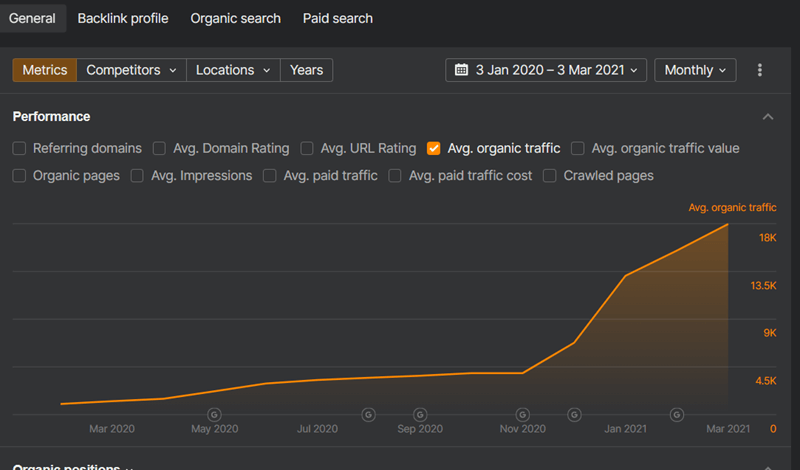
FamilyHealth.ua is a multidisciplinary family-format medical clinic. The project came with a volume of content but no systematic SEO. Over a year of work, organic traffic grew more than 17 times.

Medicine · YMYLFamily clinicTechnical + content SEONon-branded traffic
+1,674%organic over the year (×17)
1,013→17,971visits/mo
98→313top-3 queries
82→438top-10 queries
How it started

1. Initial problems: what was there at the start

About the project

FamilyHealth.ua is the website of a multidisciplinary medical clinic that works as a family center: appointments with doctors of various specialties, diagnostic and treatment services, with a focus on women's health, proctology and other sensitive topics.
Google Adsthe website of a multidisciplinary medical clinic

The project came with an already established volume of content, but without systematic SEO optimization: an important part of the pages did not work to attract new patients, while technical errors held back visibility growth.

Google AdsThe project came with an already established volume of content

The active work period — from February 2020. Below is how we built the strategy and what we achieved.

Niche (context for assessing the result): medicine is YMYL (Your Money or Your Life), where Google judges expertise, trust and content quality most strictly. Growth in this topic is harder, and any technical or content errors hit visibility harder than in ordinary niches.

At the start, the site looked alive and full: dozens of articles on diseases, services, patient reviews, FAQ sections, doctor cards. But in terms of SEO and tech, the picture was far less rosy.

The technical side
A detailed crawl revealed a set of problems classic for medical projects:

  • A large number of URLs with pagination parameters (?pg=2, ?pg=3, etc.) in the articles, reviews, FAQ and doctor-list sections. Such pages were indexed as separate, creating duplicates and "diluting" weight.
  • Chains and groups of redirects in the 30x block: http-to-https transitions and old addresses that were not fully brought to clean 301 redirects.
  • 40x errors — including on doctor cards and old content pages: some of them still had incoming links but returned 404.
  • Incorrect indexing handling:
    • important service pages could be blocked in robots.txt;
    • meanwhile service areas like /wp-admin/ still made it into the index.
  • Images without alt tags and some overly heavy images: this affected both speed and relevance for high/mid-frequency queries where illustrations matter (diagrams, schemes, procedure photos).

Content, structure and metadata
The project's substance was strong, but in SEO terms:

  • some pages had non-unique or templated title/description;
  • there were weak or duplicated H1s;
  • the FAQ and article sections were not tied to "question–answer" queries;
  • structured data was implemented partially and not used to the fullest (doctors, organization, articles).

User scenarios
A separate block — patient behavior scenarios:

  • the reviews section was insufficiently structured and did not always nudge toward booking;
  • recovery stories were not designed as a strong conversion element (no video, no thought-out scenarios);
  • the user's path from an article / FAQ to a specific service or doctor was long and at times non-obvious.

All this together led to a situation where even good content did not "pull" organic traffic: the site ranked but did not realize its potential.

The goal

The main challenge of the project

The project's paradox: there was plenty of content and the site "looked alive", but organic traffic did not realize its potential — held back by technical errors (pagination duplicates, 30x/40x, indexing) and the absence of a systematic SEO structure in the sensitive YMYL niche.

The solution: instead of spot-editing meta tags, we built three synchronous streams — technical cleanup and managed indexing, a structured semantic core with a mass metadata rework, and trust scenarios (reviews, recovery stories, video) that lead a patient from an informational query to booking.

What we did

2. Strategy: what we bet on

Instead of spot-touching the meta tags, we built a comprehensive strategy around three key directions:

  1. Technical cleanup and managed indexing
    Remove unnecessary pages from search, restore important URLs, align redirects and robots.txt, optimize images.
  2. A structured semantic core and mass metadata rework
    Distribute queries across services, diagnoses, symptoms, procedures, build a proper section tree and align meta and content to it.
  3. Engagement and trust scenarios: reviews, blog, YouTube
    Make it so a patient who came in on an informational query gradually moves toward booking an appointment: through articles, FAQ, recovery stories and video.
Result

3. Work performed

3.1. The first month: foundation — tech, semantic core and specs

In the first month we focused on on-page optimization and preparing a long-term package of tasks.

Main work blocks:

  • Semantic core and competitors
    Assembled the core by services, diseases, symptoms, procedures, additionally monitored competitors and identified queries that distinguish the Family Health clinic rather than just duplicating the general market.
  • The "question–answer" cluster
    Separately formed a cluster of question-form queries — for future FAQs and articles answering patients' specific fears and questions.
  • Specs for the blog and structured data
    Prepared a technical spec for the developer to create/refine the blog and implement structured data (organization, doctors, articles, FAQ, reviews) to get rich snippets in the future.
  • Technical audit + developer specs
    Based on a full technical audit, tasks were drawn up for the developers:
    • fixing pagination-parameter problems;
    • adjusting 30x/40x;
    • blocking service sections from the index;
    • work with robots.txt and sitemap;
    • image optimization and basic speed work.
  • Specs for the content manager
    Prepared a detailed task to fix meta tags and headings: bring title/description/H1 to a single standard, remove duplicates and "empty" tags.
  • Review pages and recovery stories
    An important block: specs to optimize review pages and scenarios for "recovery stories". The task — turn reviews into a strong conversion element, add emotion and trust, not just a set of texts.
  • YouTube and video content
    Formed a content plan for YouTube and scripts for videos with reviews and useful information, tied to existing articles and services.
  • Launch of the link strategy
    First stage — submitting: carefully placing information about the clinic on niche resources and directories.

By the end of the first month, the project had a clear plan: what the developer fixes, what the content person does, what gets filmed on video, and how it all comes together into a single SEO model.

Google AdsBy the end of the first month, the project had a clear plan

3.2. The second and subsequent months: scaling and reinforcement

Next the emphasis shifted toward mass optimization and growing authority.

Metadata and a repeat technical audit

  • We ran a large campaign to update meta tags: thousands of metadata items were brought to a single standard for query clusters.
  • After the first edits we did a repeat technical audit and formed an additional task list for the "tails": remaining duplicates, technical small stuff, not-fully-closed URLs.

Off-site promotion and blog

  • Prepared a technical spec for off-site promotion: a list of topics for article links, requirements for sites and content.
  • Began writing and placing articles on topical sites (the Miralinks format and similar platforms) with links to "thin" expert content on FamilyHealth.ua.
  • Developed a blog spec with a focus on low-competition informational queries: "what is…", "how is … treated", "symptoms…", "consequences…".
  • The clinic's author wrote articles for these queries, following the structure: H1 — the block topic, H2 — questions, text — detailed answers.

UX and scenario refinement

Although the user-behavior scenarios were moved into separate documents, their essence can be described as follows:

  • map out the patient's path from an article or FAQ to a specific service, doctor or booking form;
  • improve the visibility of CTA elements ("book an appointment", "get a consultation");
  • link reviews and recovery stories to the relevant services and diseases;
  • use video and review texts not only as "social proof" but also as a step toward booking.

Fixing technical "add-ons" for the developer

Based on a file with additional errors, we:

  • cleaned up long lists of URLs with parameters (reviews, articles, FAQ, doctor-list sections);
  • sorted out 404s on doctors and old pages;
  • optimized large images and added alt where it was critically missing;
  • adjusted indexing at the GSC level: unblocked the needed services and excluded undesirable service addresses from the index.
Result

4. Organic dynamics: what changed in numbers
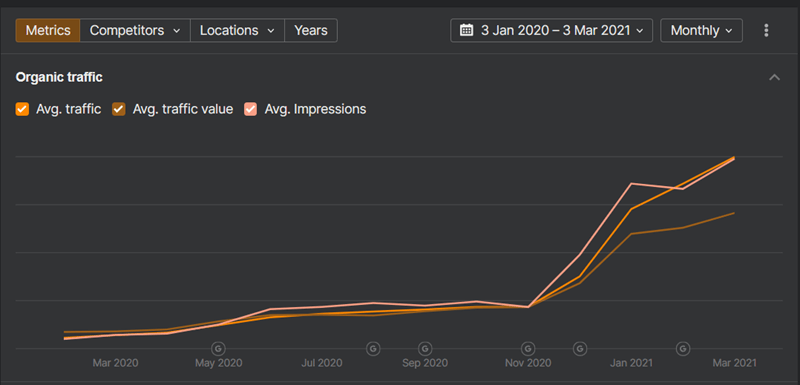
MetricBefore (Feb 2020)After (Mar 2021)
Organic traffic~1,013 visits/mo~17,971 visits/mo (×17, +1,674%)
Top-3 queries98313
Top-10 queries82438
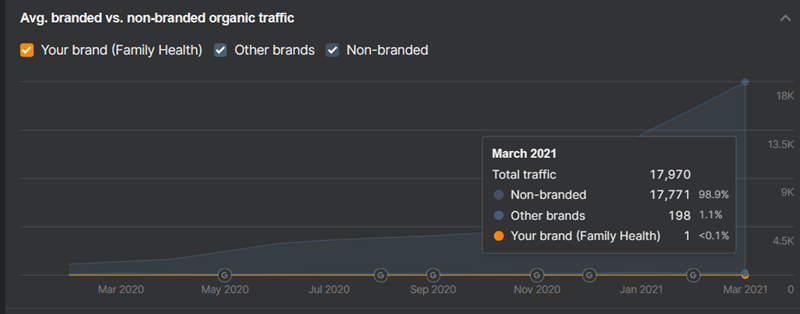
Growth typemostly non-branded traffic (new patients "off the street")

Source: Google Search Console / Serpstat data for FamilyHealth.ua, February 2020 — March 2021.

Google AnalyticsOrganic dynamics: what changed in numbers

4.1. Six months of active work (February-July 2020)

Over the first six months of promotion:

  • Average organic traffic grew from about 1,013 visits in February 2020 to 3,269 visits in July 2020.
    That is +2,256 visits and an increase of about +223% — more than 3 times.
  • The number of queries in the top-3 increased from 98 to 136.
  • The number of queries in the top-10 — from 82 to 201.

So within just six months the project reached steady growth and began holding more positions for commercial and informational queries simultaneously.

Google Adswithin just six months the project reached steady growth

4.2. The yearly perspective (February 2020-March 2021)

If we look at a slightly wider period, up to March 2021, the dynamics are even more telling:

  • Average organic traffic grew from 1,013 to 17,971 visits per month.
    That is +16,958 visits and growth of about +1,674% — effectively more than 17 times.
  • Queries in the top-3: from 98 to 313 (a threefold growth in "first-line" coverage).
  • Queries in the top-10: from 82 to 438 (more than a fivefold increase).
  • Queries in the top-20: from 214 to 726, which shows an expansion of the "working field" for further optimization.
  • By intent groups:
    • commercial queries in visible positions (up to top-50) became noticeably more numerous (per the export — growth from ~219 to ~448 positions);
    • transactional ones — roughly doubled (from ~46 to ~90+), i.e. queries like "book", "clinic", "price", etc.

Google AdsThe yearly perspective

Separately important is that the main growth came precisely from non-branded traffic: while branded inquiries barely changed, non-branded traffic (by diagnoses, symptoms, treatment methods) increased many times over. This means the clinic began attracting new patients "off the street", not just working off the already-familiar brand.

Why SEOquick

Project team

The project was handled by the SEOquick team:

  • Nikolay Shmychkov — SEO strategy (Deputy Director)

Full team and roles — on the About page.

More cases

What's next

A similar medical case: Promoting a Dental Clinic — the same YMYL + UX + Scholarship approach.

Have a medical site? The concrete next step is to get an audit against YMYL criteria and assess growth points, not a generic service order.

Reviews

What clients say after a year together

Real reviews from Google Reviews and Freelancehunt.

★★★★★Google Reviews

Huge thanks to the SEOquick team for their professionalism and detailed analysis of our niche. If you're looking for a reliable partner in paid search who works for results — we confidently recommend SEOquick.

★★★★★Google Reviews

We've lived in the Czech Republic for years and haven't met specialists like SEOquick here. Their experience is off the charts — attention to detail on par with the best European agencies. Well done!

J
Jevhen Mohylenkomegastroj.cz
★★★★★Freelancehunt

Many thanks to SEOquick for the quality work. As soon as we fix the issues, we'll definitely come to you for promotion.

S
More reviews in the portfolio →

Your site can grow like this too

A traffic drop isn't a verdict — it's a diagnosis we know how to treat. Estimate your project's potential in a couple of minutes, book a free consultation, or instantly check your site with an SEO audit.