Initial problems
About the project
"The Aesthetic Dentistry Clinic" is a private dental center in Kyiv with over 20 years of history. The clinic works in the premium segment: patients come not only from Ukraine but also from Europe, the USA and Canada.
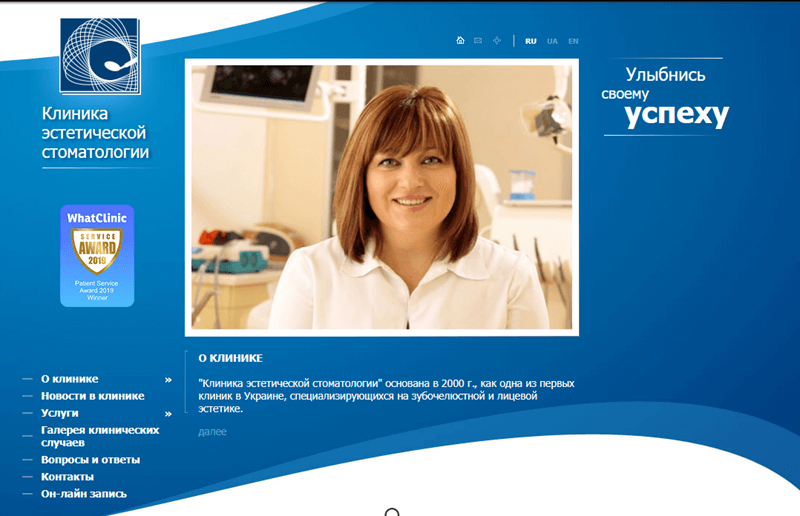
At the start of cooperation in 2020, the clinic had an old HTML site that noticeably lost to competitors in design, usability and SEO. The clinic's director already had experience with several large agencies, but with substantial budgets the changes in organic traffic were minimal, and basic errors had to be found and pointed out by the client herself.

The pandemic and lockdown only worsened the problem: organic traffic dropped and dependence on paid ads became critical. So the task was not just to "improve something" but to fundamentally rebuild the promotion approach and restore a steady flow of inquiries from search.
The site analysis and usability audit showed that the homepage and key interface elements did not meet modern user expectations. The header looked outdated: a vertical rubricator, small icons, barely noticeable blocks with the address, working hours and phone, and no bright CTAs or directions map.
Even the elements that were formally "in place" worked inefficiently:
- the "address", "working hours", phone and CTA blocks were present but unnoticeable and did not draw attention;
- the footer lacked important sections: FAQ, careers, additional CTAs and contact details;
- there was no online chat and/or clear entry points for a first inquiry.
In terms of SEO and behavior:
- the bounce rate stayed above 70%, which directly indicated the inconvenience and irrelevance of some pages;
- according to the report, part of the traffic went to pages with incorrect titles (for example, the implantation page ranked for the query "dental implantation kyiv reviews forum" only because of the word "forum" in the title, even though the page itself did not meet the user's expectations).
A separate risk zone is the YMYL topic (health and medicine). For such projects Google is especially demanding about:
- the quality and structure of content;
- transparency of information about the clinic and doctors;
- the level of trust and expertise.
Meanwhile, the site looked and felt "old", which did not match the clinic's real level and the target audience's expectations.
The main challenge of the project
The clinic came after several failed attempts with large agencies: with big budgets, growth was minimal, and basic errors had to be found by the client. The old HTML site lost on design and UX, and the pandemic crashed organic traffic and increased dependence on paid ads.
The solution: a combination of three directions — audits (YMYL + usability + technical) → redesign and patient convenience → SEO with a focus on trust, and Scholarship for "white" links that strengthen E-A-T.
Strategy
Given the topic, the site's state and strong competition in the dental market, we built the strategy around three key directions:
- Audits and fundamental fixes
In the first stage we focused on comprehensive diagnostics: a YMYL audit, a usability audit and a technical audit. The task — to identify all the weak points that prevent the site from showing the clinic's real level: from basic structure and design to errors in metadata and the display of contact information.
Google Ads
- Redesign and improved patient convenience
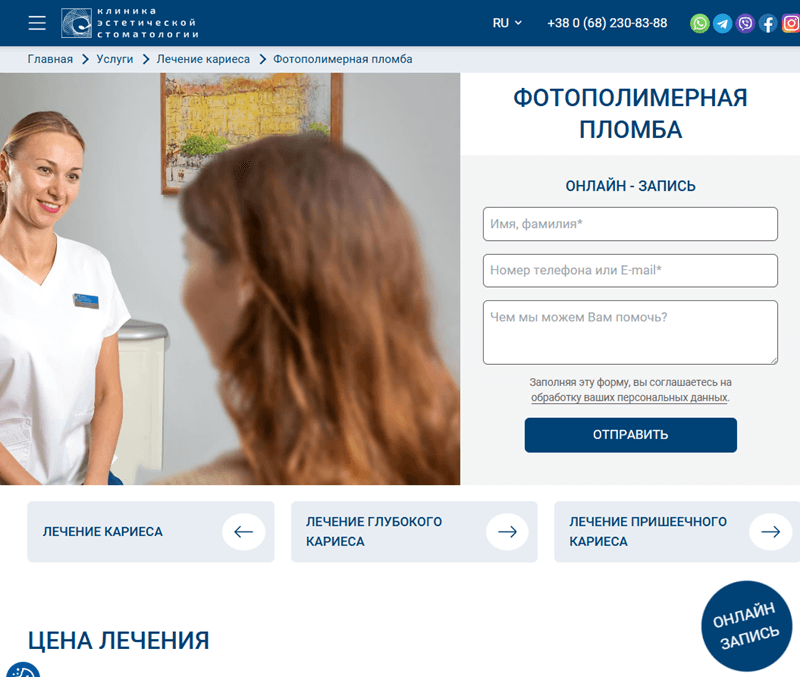
Given that in 2020 the site was on "bare" HTML and visually very outdated, we built into the strategy a gradual transition to a modern interface and a rework of key pages: header, footer, service pages, the "About the clinic" section, the blog. The main guideline — a clear structure and quick access to services, contacts and booking.
Google Ads
- SEO promotion with a focus on trust and conversions
For the medical topic it is critical not only to collect semantics and optimize pages, but also to build trust in the site. So the plan included:- fixing errors with titles and metadata;
- strengthening content for important services;
- gradually expanding visibility for high-frequency queries (implantation, prosthetics, periodontitis treatment, etc.);
- work on the link profile and separate Scholarship-format activities already used in SEOquick cases for other projects.
Google Ads
The strategy was built with a "years ahead" margin: first put the foundation in order (usability and basic SEO), then grow traffic and conversions through systematic work rather than one-off campaigns.
Work performed
On this project we did not limit ourselves to on-page edits only. The work went in several directions that complemented each other and gradually moved the site from an "old HTML project" into a stable channel for attracting patients.
Audits and task setting
We started with comprehensive diagnostics:
- YMYL audit — we checked how well the site meets Google's requirements for medical resources: completeness of information about the clinic and doctors, transparency of contacts, presence of legal sections, reviews, etc.
Google Ads
- Usability audit — we examined the header, footer, service pages and blog in detail. We recorded the outdated look, the vertical rubricator, the barely visible blocks with phone, address and schedule, and the lack of strong CTAs and a directions map.
- Technical audit — we checked indexing, multilingualism, basic SEO settings, speed and correctness of metadata. We separately highlighted the problem of irrelevant titles and a high bounce rate.
The results of these audits formed the basis of a month-by-month plan: what to fix on-page first, which sections to relaunch, which pages to refine as a priority.
Improving UX and site structure
Next we addressed what users see and feel first:
- reworked the header — made the phone numbers, address and working hours more noticeable, added clear entry points for booking and consultation, shifted the focus from a "pile of links" to the user's key actions;
- strengthened the footer — added useful sections (FAQ, careers, additional contacts and CTAs) so the user always sees where to turn and what to do next;
- refined the "About the clinic" section, service pages and blog in terms of presenting expertise: real experience, complex procedures, work with foreign patients — all of this became clearer and more structured for visitors and search engines.
In parallel, the clinic began work on a new site, relying on our recommendations, to move away from the limitations of the old HTML engine.
SEO optimization and content work
Once the UX problems were recorded and partially fixed, we switched to SEO:
- fixed metadata — went through the key pages, removed extra words in titles (like "forum" on the implantation page), aligned headings with users' real intents, brought the description and H1 to a clearer structure;
- strengthened content for priority services — using the semantic core, we boosted the pages for implantation, prosthetics, microscopic dentistry, periodontitis treatment, hygienic cleaning and other areas, thanks to which the site began growing for queries like "periodontitis treatment", "hygienic teeth cleaning", "dentist implants near me", "dental prosthetics kyiv price", etc.;
- continued tracking bounce rate and engagement to see how changes in text and structure affect the behavior of real users.
Scholarship work
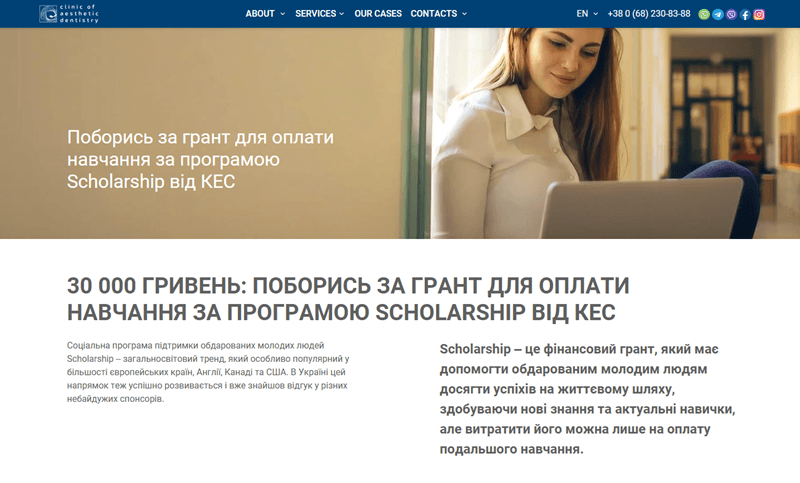
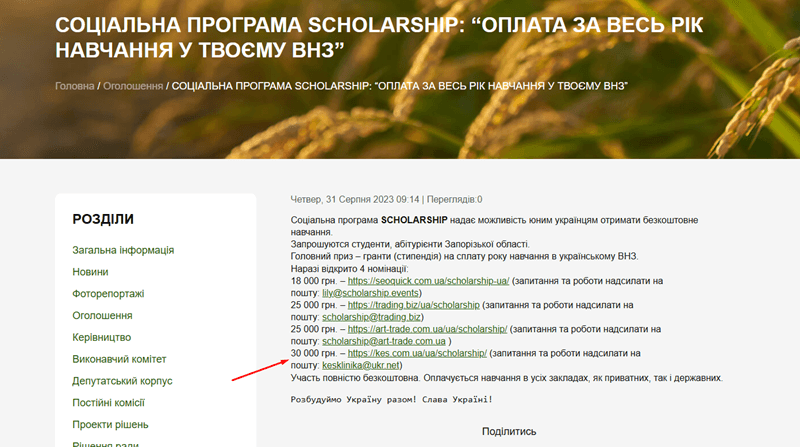
A separate direction was Scholarship work, which complemented classic SEO and strengthened trust in the clinic. Within the portfolio, this block for kes.com.ua sits alongside the YMYL, usability and technical audits, which emphasizes its significance for this very project.
In essence, the clinic joined SEOquick's social program: through scholarship/educational activities we earned mentions and links from authoritative resources — educational and specialized sites. For a medical project this is especially valuable:
- such links look natural and do not conflict with the requirements of the medical niche;
Google Ads
- they strengthen E-A-T (Expertise, Authoritativeness, Trustworthiness) and help Google perceive the clinic as a reliable provider of information and services;
- Scholarship mentions organically complemented the overall link profile, which was otherwise formed from topical medical and near-medical sites.
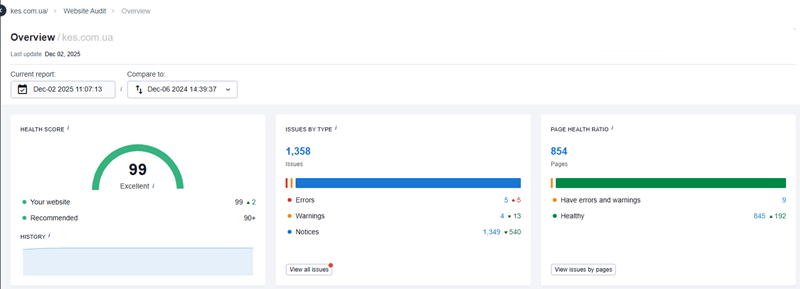
As a result, the external work (links + Scholarship) began to support the changes we made inside the site: the improved UX and content started receiving more "trust signals" from outside.

Result
| Metric | Before | After |
| Users (July 2021) | 876 (June 23–30) | 3,177 (July 1–22) — ×3.5 |
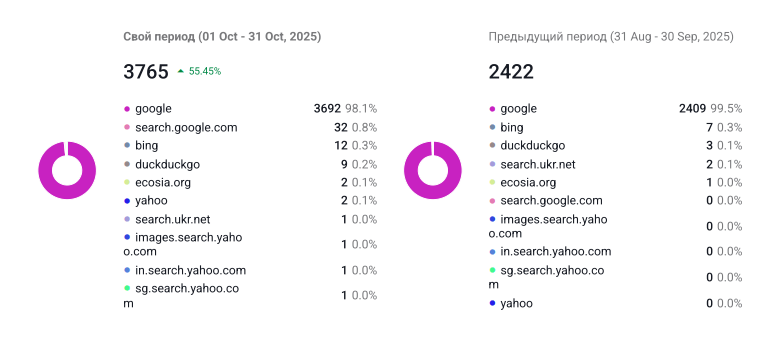
| Organic traffic (Oct 2025) | — | 3,765 sessions, +55.45% |
| Conversions (bookings/requests) | — | 27/mo, +50% |
| Search visibility | — | 6–11%, including English-language queries |
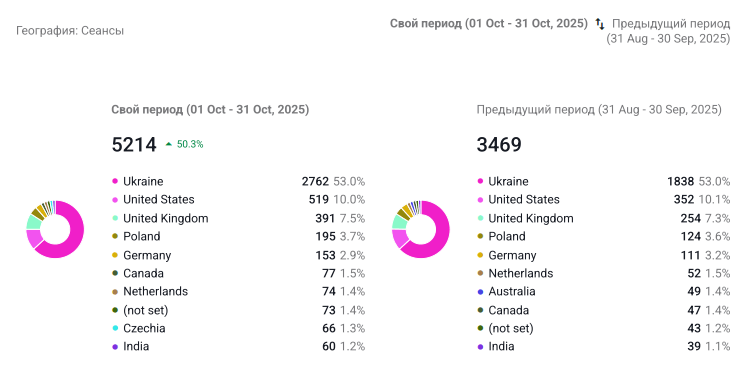
Source: monthly reports for the kes.com.ua domain (GA4). A notable share of sessions comes from the USA, the UK, Poland and Germany.
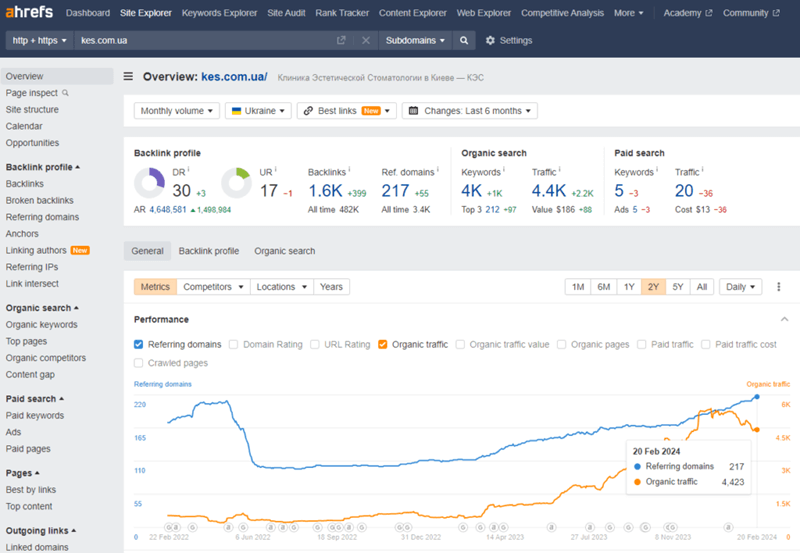
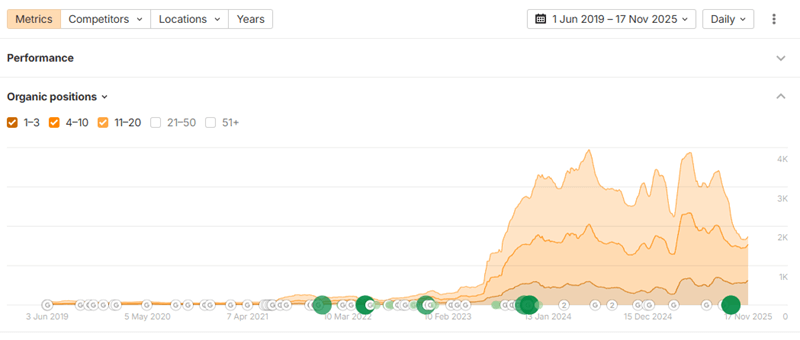
The cumulative effect of all the work — audits, UX refinements, SEO optimization and Scholarship — showed up in both short-term and long-term dynamics.

Already from the July 2021 report you can see that the site stopped "standing still": the number of users grew from 876 (June 23-30) to 3,177 (July 1-22), i.e. more than 3.5 times, and the number of queries in the TOP-3 increased from 38 to 55. The report also notes a drop in bounce rate and improved audience behavior — users began returning more often and interacting more deeply with the site.

Further systematic work cemented this effect. The monthly report for October 2025 records steady growth across almost all key metrics:
- sessions — 5,214, growth +50.3% on the previous period;
- organic traffic — 3,765 sessions, an increase of +55.45%;
- page views — 6,837, growth +37.73%;
- conversions (bookings and requests) — 27 per month, which is 50% more than before;
- the site's search visibility holds in the 6–11% corridor, and for a number of commercial queries (implantation, periodontitis treatment, all-on-4, prosthetics, etc.) the site is confidently in the top positions, including for English-language ones.

Growth comes not only from Ukraine: the reports show a noticeable share of sessions from the USA, the UK, Poland, Germany and other countries, while engagement and traffic-quality metrics stay high.

Importantly, these figures match how the client describes the cooperation: after several failed attempts with other agencies, the clinic saw for the first time the chain "clear audit → concrete plan → tangible growth". According to the director, thanks to this work they got through 2020 calmly, continue developing the new site and regularly see the effect of the implemented changes — both in inquiries from new patients and in the project's overall stability in organic search.
Project team
The project was handled by the SEOquick team:
- Nikolay Shmychkov — SEO strategy (Deputy Director)
Full team and roles — on the About page.
What's next
A similar medical case: Promoting a Dental Clinic (Lumident) — rehabilitation of a large YMYL project.
Have a clinic or a medical brand? The concrete next step is to get a YMYL and UX audit and a growth plan.