A finance project that hit the WordPress ceiling
BeCoin is a financial markets project: forecasts, broker reviews, tools for traders. The ambitions were global — dozens of languages, seven market categories, live data. The technical foundation, however, was a classic WordPress site with fragile templates, weak content and a dependency on an external blog feed.
Every new page took manual work. Every new language would have multiplied that manual work. Crawlers kept choking on legacy /wp-content/… paths, rendering under bot load was slow and unstable, and releases were made "live" — no staging, no rollback, no automated checks. In a YMYL niche, where Google is especially demanding about quality and reliability, that's a dead end.

Betting on organic search in this niche is justified — search remains the main and most cost-effective channel, while videos bring the project a significant additional audience:
Below is the path from a fragile blog to a platform with 10,681 validated URLs: architecture, localization, SEO automation and a release pipeline.
Four reasons the site couldn't grow
Before building anything new, we broke down exactly what was dragging the project down. All four problems are typical for content-driven WordPress projects that have outgrown their platform:
Weak content, fragile structure
Uneven content quality and templates that broke with any edit. In a YMYL niche — a direct risk of losing Google's trust.
Scaling by hand only
Dozens of languages and thousands of market pages on WordPress would have meant a linear growth of manual work — economically impossible.
Technical SEO debt
Legacy /wp-content and /cdn-cgi paths in crawl reports, dependency on an external wp feed, slow and unstable rendering for bots.
Releases without a safety net
No staging, no rollback, no automated SEO validation: any update could silently break metadata, translations or entire sections.
The conclusion was obvious: patching the theme was pointless. The project needed an architecture where pages, languages and data are generated by a system — and every release passes automated checks before users and Google ever see it.
The plan: leave WordPress, grow into a platform
We didn't rewrite everything in one "big bang". The architecture evolved with the business: first fast static publishing instead of WordPress, then a full product with live data, subscriptions and tools.
Strategy and information architecture
Designed the page families (forecasts, brokers, tools, pricing, blog) and the "market × asset × language" matrix — the skeleton of the future thousands of URLs.
PlanningLeaving WordPress: static-first publishing
Moved content off the fragile WP base onto a fast static publishing model — stable rendering for people and crawlers, with no legacy template dependencies.
MigrationEvolution into a Next.js platform
Once live quotes, accounts, payments and tools were needed, static wasn't enough: we built a custom platform on Next.js + TypeScript with mixed static and dynamic rendering.
ProductMultilingual architecture: 44 locales
Localized routing, dictionaries, fallback chains (yue/wu → Chinese, ar-eg → Arabic, pnb → Urdu), translations generated at build time.
i18nSEO automation
Template-driven metadata and canonicals, schema markup, locale-aware sitemap indexes and hreflang — all generated and validated automatically on every build.
SEORelease pipeline
Staging-first process, blue/green deploys with a permanently live rollback, a guarded deploy script, canaries and production monitoring after every switch.
DevOpsMarket data
7 categories · 213 assets in the catalog · reserve: 5,300 stocks, 2,600 ETFs, 1,000 crypto assets · live quotes and tables
Page templates
186 components · forecasts, brokers, tools, pricing, account, blog · 63 API routes · 10 tools · 21 converters
Localization · 44 locales
localized routing · dictionaries and fallback chains · 5,377 strings in the translation cache · automated rendered-page audits
SEO layer
metadata and canonicals · schema · sitemap indexes (10,681 URLs) · 57,070 hreflang alternates · validation on every build
Releases · blue/green
staging-first · guarded deploy · rollback always live · canaries · production monitoring · 16/16 post-release checks
Has your site hit its platform ceiling too?
Get tasks, timelines and growth points for your specific project — in a couple of minutes.
One template — thousands of pages in 44 languages
The main lever of this case is programmatic generation. Instead of publishing pages by hand, we built a system: a catalog of 213 assets across seven market categories (crypto, forex, stocks, commodities, indices, ETFs, bonds) is multiplied by 44 locales and a set of page families. The result — thousands of unique, relevant URLs with no manual work:
Page families the platform generates:
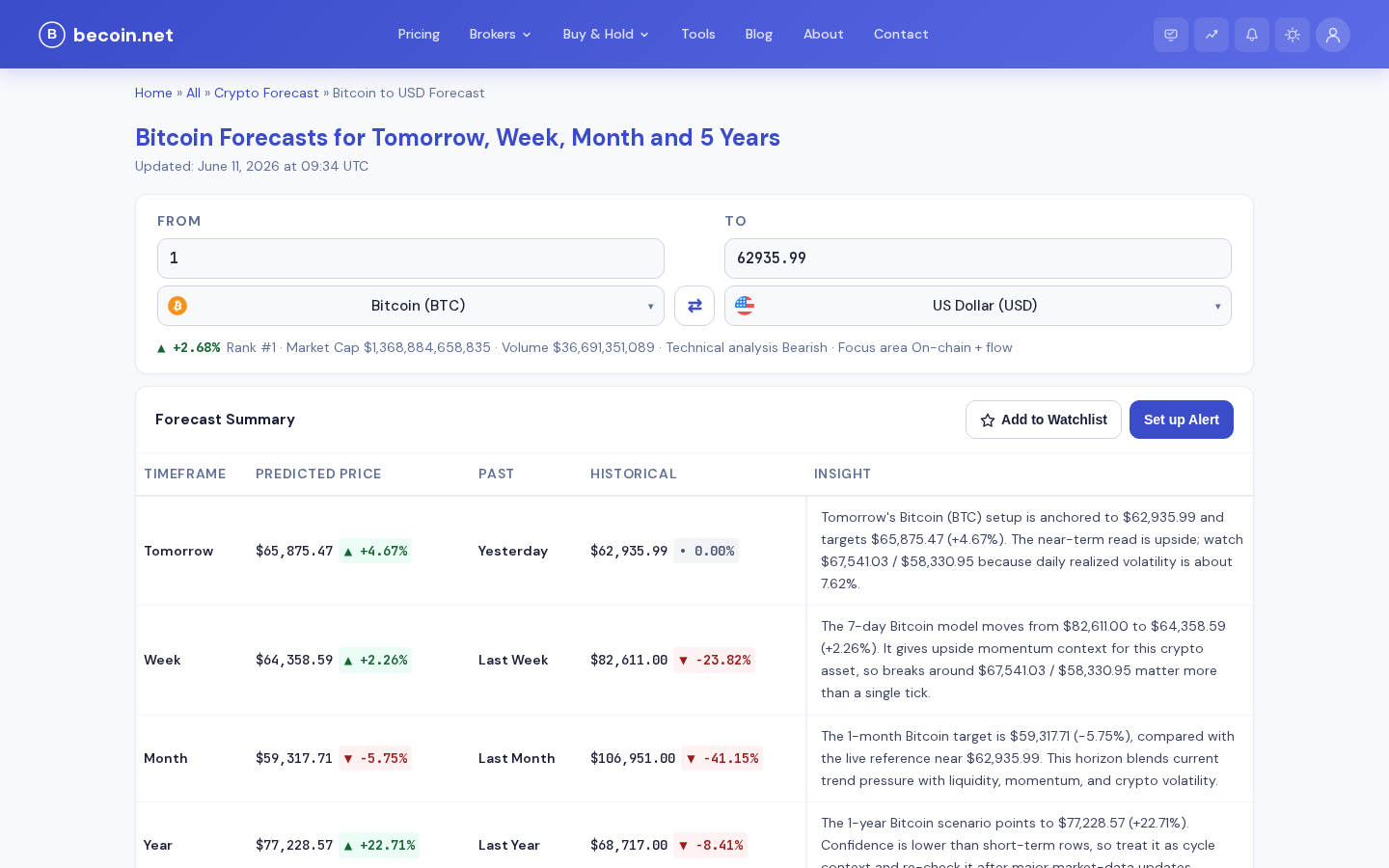
- Market forecasts — /forecast/bitcoin, /forecast-stock/apple, /forecast-forex/eurusd, /forecast-commodity/gold, /forecast-indices/sp500, /forecast-etf/spy, /forecast-bonds/us-10y.
- Brokers and tools — a broker catalog, a currency converter (21 pairs), "what if I invested" and 10 trader tools: from a DCA calculator and risk/reward to a trading simulator.
- Product pages — pricing with Stripe checkout, account area, watchlist, alerts, affiliate program, white-label.
Under the hood — 186 page components and 63 API routes: live market tables, authentication and password recovery, TOTP security, Stripe checkout and webhooks, alerts, a blog feed with a fallback mode. And the asset catalog is ready to keep growing: 5,300 stocks, 2,600 ETFs and 1,000 crypto assets are already waiting in the generated "market universe".
Data for 7 markets — instantly, from 10+ APIs
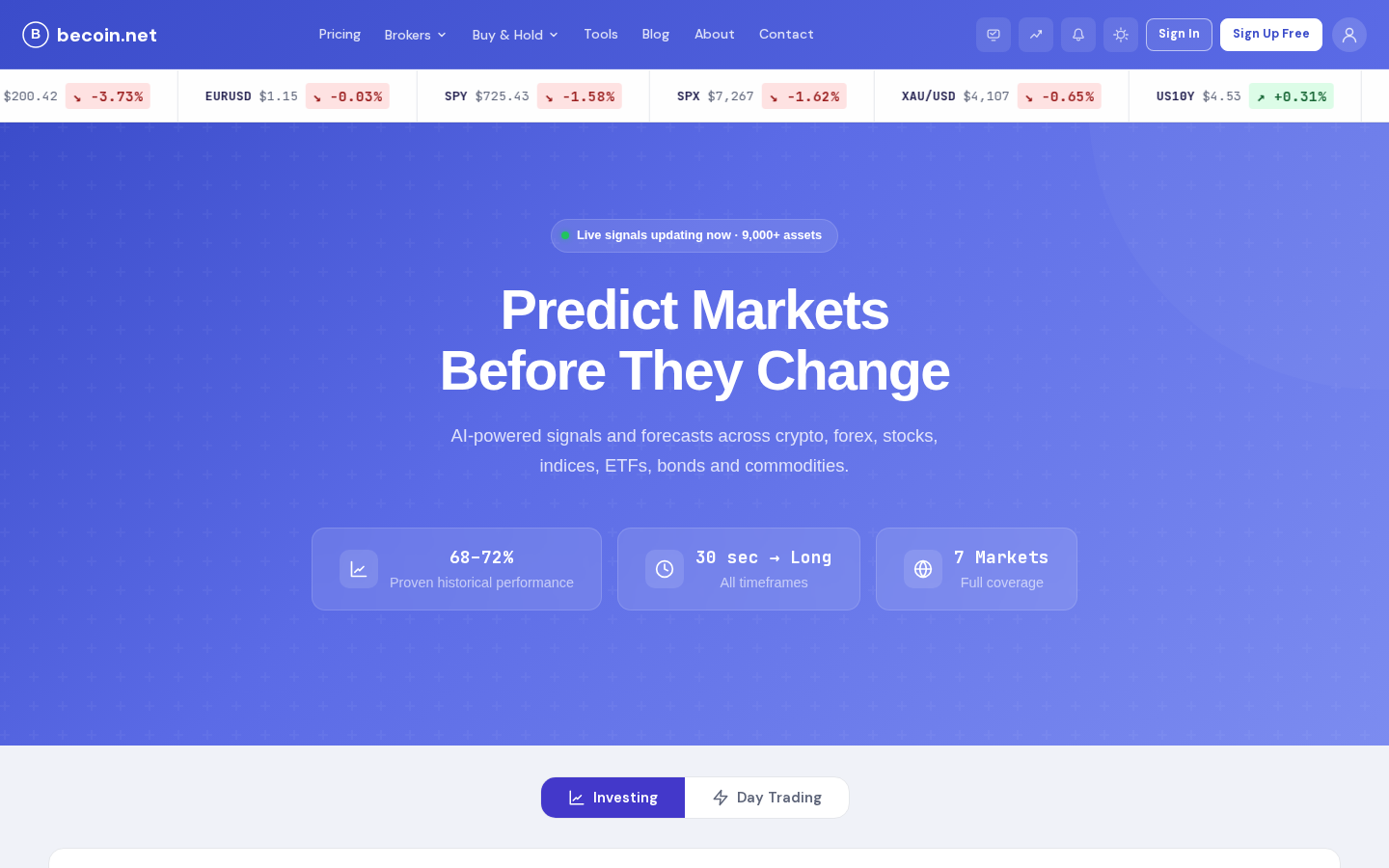
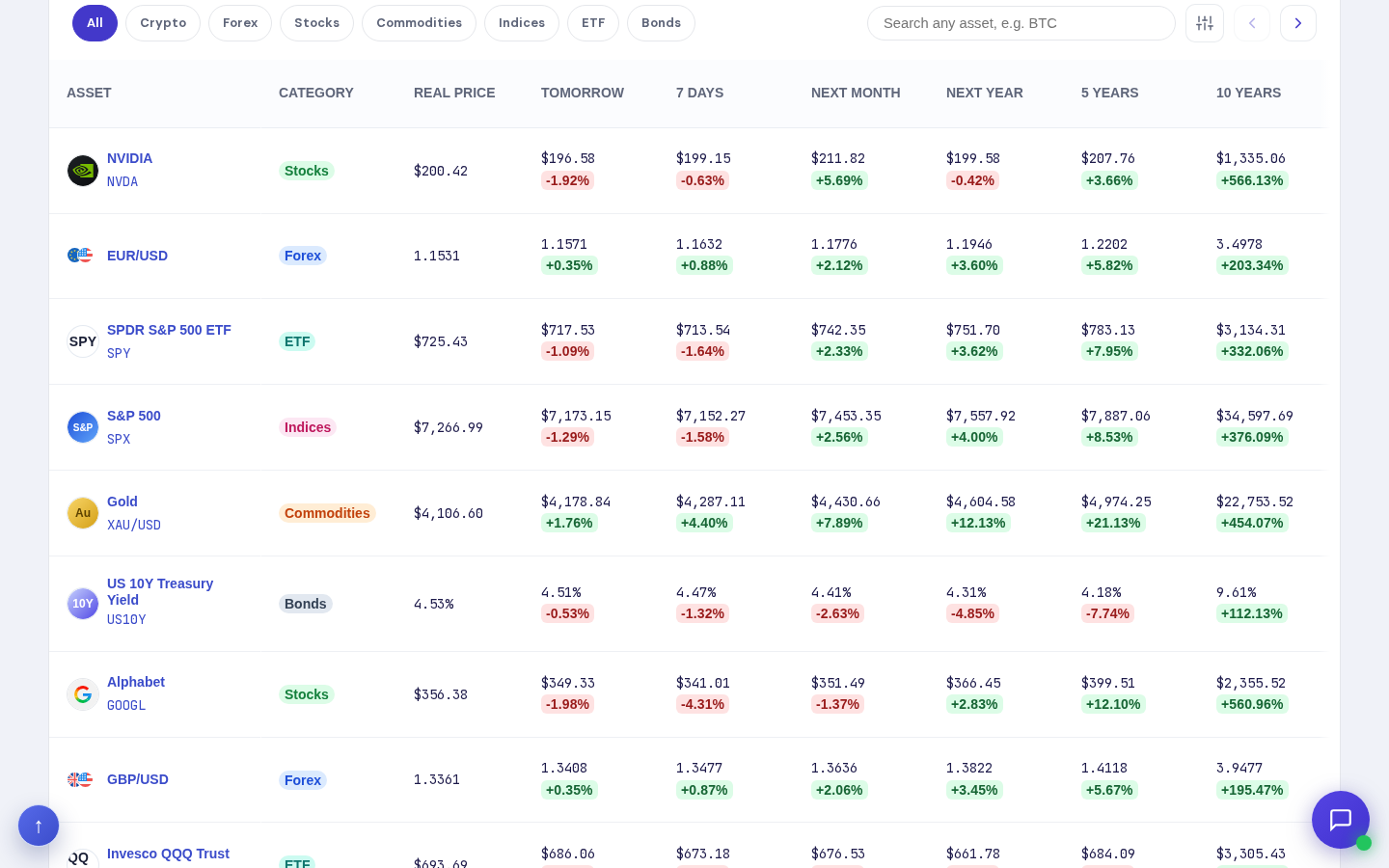
A finance site dies when its quotes "think". So live data comes from 10+ API sources with automatic failover: if one provider slows down or goes dark, the platform instantly switches to the next — and the user never notices. A persistent cache with freshness markers (fresh / recent / bucketed) serves tables for all 7 markets instantly — no spinners, no empty cells — while priority warming keeps the most-visited routes hot even under crawler load. A dedicated homepage verifier catches fake placeholder values before a release ever ships.
Forecasts built on 300+ signals
The forecasts aren't "numbers out of thin air". For each of the 213 assets, the forecasting model recalculates using 300+ signals: price and volumes, volatility, momentum, trend and technical indicators, market context. Every asset gets horizons for "tomorrow, 7 days, a month, a year, 5 and 10 years" — and every page honestly shows historical values next to the forecast, so the reader sees context, not just a promise.
44 languages — without blind "Google Translate" quality
This is not a one-language redesign passed through machine translation. The platform needed routing, dictionaries, fallback chains, static and runtime translations, rendered-page checks and hreflang validation — across dozens of languages at once. Otherwise, at the scale of 10,000+ URLs, localization errors inevitably creep across the index.
Dictionaries + fallback chains
Cantonese and Wu Chinese fall back to Chinese, Egyptian Arabic to Arabic, Punjabi to Urdu: not a single "hole" in the translations.
Localized routing and lang
Every locale lives on its own prefix with a correct <html lang> — including rare cases like pnb and yue.
Translations as a build artifact
A static cache of 5,377 strings is generated on every build — translations are versioned with the code, not living in an admin panel.
Rendered translation audits
Automated tests open real pages and check texts, long-word layout and RTL/LTR — before the release, not after complaints.
10,681 URLs — and zero validation errors
At the scale of tens of thousands of hreflang links, manual checking is impossible. So validation is built into the release itself: a build doesn't reach production until sitemaps, hreflang, canonicals and schema pass the automated audit. The latest production validation results:
Crawlers from SEO tools — Semrush, SE Ranking, Google Search Console, PageSpeed — are wired into the engineering cycle as a source of tasks. A fresh SE Ranking report breakdown shows how it works:
- 23/23 live pages from the sample return 200 — all the old 5xx errors and timeouts (10/10) are fixed.
- 5/5 pages with a wrong language and 5/5 with missing titles — fixed and confirmed on the live site.
- Crypto asset icons were switched to an internal /api/symbol-logo proxy — /forecast no longer has external URLs that returned 403 to crawlers.
In all honesty: the work continues. The current priorities are the speed of broker and forecast detail pages on some locales, query parameter canonicalization and cleaning up the remaining legacy WordPress crawl noise. The difference from the past is that every such task now goes through the system: fix → automated test → release → monitoring.
From a one-language blog to a platform in 44
The main outcome isn't a single number — it's a change of category. BeCoin stopped being a content site that's scary to touch and became a product platform that grows systematically: new assets, languages and tools are added through configuration, not manual page-building.
Releases you're not afraid to ship
A separate result is operational maturity. Every release follows the pipeline: staging → guarded deploy → canaries → blue/green switch → production monitoring. The previous version always stays live and ready to take traffic back within seconds.
- Scale without manual work — 10,681 validated URLs in 44 languages are generated and validated by the system; new assets and languages are added through configuration.
- Monetization built in — Stripe subscriptions, pricing plans, an affiliate program and white-label run on the same platform as the SEO pages.
- The audience is retained by tools — 10 trader tools (calculators + a simulator), converters, watchlist and alerts give people a reason to come back.
- SEO fixes are protected — every fix from Semrush/SE Ranking/GSC is locked in by an automated test and doesn't "fall off" on the next release.
- Releases are safe — staging-first, blue/green, a permanently live rollback and monitoring after every switch.
What about AI search? The platform is ready for it too
BeCoin's architecture is exactly what visibility in AI Overviews, ChatGPT, Perplexity and Gemini requires. Structured forecast pages with live data, schema markup, clean hreflang links in 44 languages and proprietary tools — these are machine-readable, citable sources. As search increasingly answers directly, the winner is whoever's data and tools become the source of the answer.
What in the platform already works for AI visibility:
The platform approach is the foundation of visibility both in classic Google and in AI search: one architecture serves both worlds.
Behind the result is the SEOquick team
A project like this isn't built by "a designer and a copywriter". SEOquick has been in search marketing since 2008 and combines what's usually split across contractors: strategy, content, development, localization, SEO automation, deployment and monitoring — in one team and one process.

Nikolay Shmichkov
18 years in digital, 500+ SEO articles and podcasts. Leads strategy, priorities, and final quality control of implementations.

Anatolii Ulitovskyi
Founder of SEOquick and unmiss.com. Specializes in AI search, GEO, programmatic SEO, entity markup, and visibility growth analytics.
Similar growth stories
If this case resonated — see how we solved similar problems in other niches and regions.
Binary options site: from a Google filter to 40,000+/mo.
Programmatic SEO across 50,000+ pages and link building in a financial YMYL niche.
View case study →US weight-loss blog: 100K → 700K/mo.
Content and link building in the health YMYL niche with sevenfold growth.
View case study →English-language site: recovering from the Panda filter
Traffic recovery after an algorithmic filter on a Western market.
View case study →BB.LV — the organic traffic leader in the Baltics
Content and a technical foundation that took a news portal to the top of its niche.
View case study →A furniture e-commerce store in Poland
International SEO: GEO adaptation, content and link building.
View case study →Promoting a medical website
Growth in the health niche with a focus on E-E-A-T, a content plan and links.
View case study →Data sources
- BrightEdge — organic search drives ~53% of site traffic (paid ~15%): brightedge.com, searchengineland.com, channel report.
- BeCoin platform metrics — factual data from the automated validators and production monitoring of the 06/10/2026 release: sitemap (10,681 URLs, 336 XML files), hreflang (57,070 alternates, 0 errors), translations (5,377 strings, 13,062 phrase checks), post-deploy checks (16/16 routes — 200).
- Google Search Central — official requirements for hreflang and localized page versions: localized versions, sitemaps.
- web.dev (Google) — Core Web Vitals and the impact of speed on users and rankings: web.dev/vitals, page experience.
- Backlinko — CTR by position (analysis of 4M SERPs): CTR stats, First Page Sage.
- AI search — AI Overviews, the zero-click share, ChatGPT and Perplexity audiences: SE Ranking, Superlines.
Project metrics (44 locales, 7 markets, 213 assets, 10,681 URLs, 57,070 hreflang alternates, 186 components, 63 API routes, 10+ data API sources, 300+ forecasting model signals, audit and monitoring results) are factual data from BeCoin.net's build system and production validation. "Before" screenshots — the live WP blog wp.becoin.net and the Wayback Machine archive; "after" screenshots — the live becoin.net, taken 06/11/2026. Industry figures are benchmarks that illustrate the patterns the strategy was built on.