The main challenge of the project
About the project
ART-Trade is a company supplying retail equipment for shops, pharmacies, boutiques and sales floors. The core of its range is racks, shelving, metal structures, display cases and visual-merchandising components. The products serve retail of any scale: from small retail islands to large chains.
Despite a strong product and extensive industry experience, the project came to us at a moment when organic traffic had begun to gradually decline, and competitors from other regions of Ukraine had strengthened their search positions. This created the risk of losing market share and limited the company's expansion beyond the Kyiv region.
The main goal was to:
- recover and strengthen SEO traffic,
- expand presence across all of Ukraine,
- build a steady flow of clients through organic search, without dependence on paid ads.
At the time of contact, ART-Trade had a decent foundation — assortment, structure, catalog. However, the technical side, content and link profile were in a state that limited growth.
1) Loss of positions and an organic dip
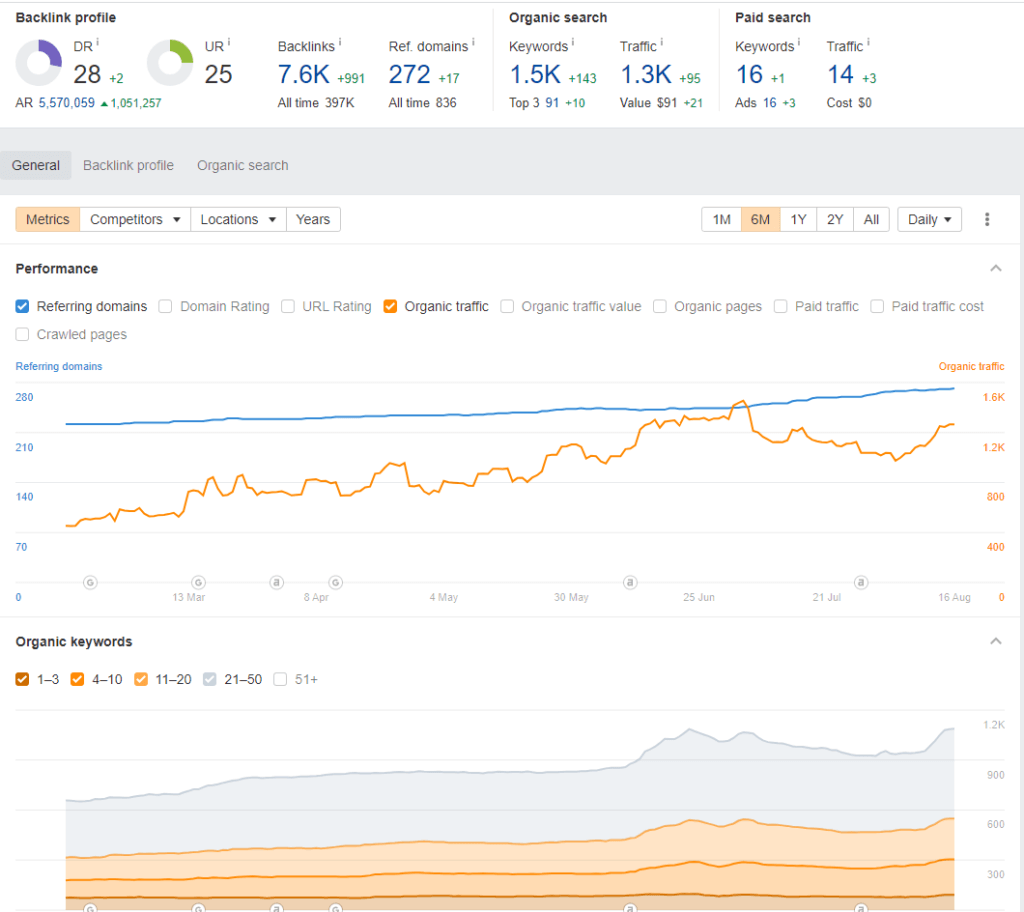
In the months before work started, traffic was unstable and declining. The most telling figure is daily visits: about 214 users per day, even though the niche is fairly wide and demand is constant.
The drop was related not to external factors but to the site no longer meeting Google's expectations:
- thin pages;
- outdated texts;
- weak metadata;
- no up-to-date structure for commercial queries.
2) Structural errors and irrelevant pages
The catalog was built logically for the client, but not for the search engine. Some pages lacked key elements of commercial landing pages; on others, queries were distributed incompletely and overlapped, leading to cannibalization.
3) Content was outdated and didn't reveal the product's advantages
In the retail-equipment niche, a key role is played by descriptions of structures, sizes, materials, mounting options, advantages and use cases.
ART-Trade's texts were short, without structured blocks, and lost out to competitors who had increased their informational component in recent years.
4) Weak link profile
Low domain growth before work began. For a competitive B2B niche this is critical: the lack of fresh mentions lowers trust and makes ranking for commercial queries in the regions harder.
5) Insufficient regional coverage
Although the company worked across all of Ukraine, SEO visibility was concentrated mainly in Kyiv — other regions were not systematically worked through semantically and structurally.
We needed to:
- rework the semantic core by equipment groups and regional queries;
- create new entry points for each intent;
- write structured, technically accurate and commercially strong content for all product categories;
- translate the texts into Ukrainian and adapt them for regional audiences.
6) Strengthening brand authority
To enter the Ukrainian market, it was important to strengthen the site's external environment. The strategy included:
- adding the company to industry directories, local resources and review sites;
- careful link building through publications and topical resources;
- launching a Scholarship campaign as a way to earn natural, quality mentions.
So these directions formed the basis of comprehensive promotion: first restore the technical state, then strengthen content, and after that build trust and reach.
The site had a decent foundation, but organic traffic was declining while competitors from other regions were getting stronger — there was a risk of losing market share and staying a "Kyiv-only" player.
The non-standard solution: we rebuilt the semantics by equipment groups and regional queries, translated and adapted the content into Ukrainian, created separate entry points for each intent and strengthened trust via directories and Scholarship — so the site would rank across all of Ukraine, not just Kyiv.
Work performed
The work was carried out consistently, covering all the key zones affecting the site's visibility and commercial effectiveness.
1) Technical work
Based on the audit, we:
- fixed indexing and URL-structure errors;
- updated the sitemap and removed duplicate pages;
optimized metadata for commercial queries; - brought the site's internal architecture to a clear and logical model.
This created conditions for correct growth and easier crawling of pages by search engines.
2) Content modernization
For each product group, a separate technical spec was created:
descriptions became more structured and informative, reflecting the products' real advantages. We:
- prepared texts for all commercial categories;
- reinforced them with technical parameters, use-case examples and structural advantages;
- translated and adapted them into Ukrainian;
implemented thoughtful internal linking between pages.
As a result, each category gained a full-fledged product-solution landing page.
3) Work on structure and semantics
After redistributing the semantics:
- new entry points were created for individual equipment types;
- overlaps between pages were eliminated;
- pages were optimized for Ukraine's regions;
- the catalog structure was improved.
This allowed the site to expand reach and strengthen positions for commercial queries.
4) Off-site promotion
To strengthen the site's authority, we:
- registered the company in leading directories and on industry sites;
- placed the brand on forums and review platforms;
- prepared articles for external placements;
- ran a Scholarship project — outreach, publications, reporting.
These activities strengthened trust in the site and increased its visibility.
5) Ongoing analytics and adjustments
Throughout the promotion period we:
- tracked positions for key queries;
- optimized pages showing weak dynamics;
- adjusted metadata and block structure on pages;
- updated content in response to growing competition in the niche.
So the project developed not "in waves" but steadily and predictably.
Result
| Metric | Before | After |
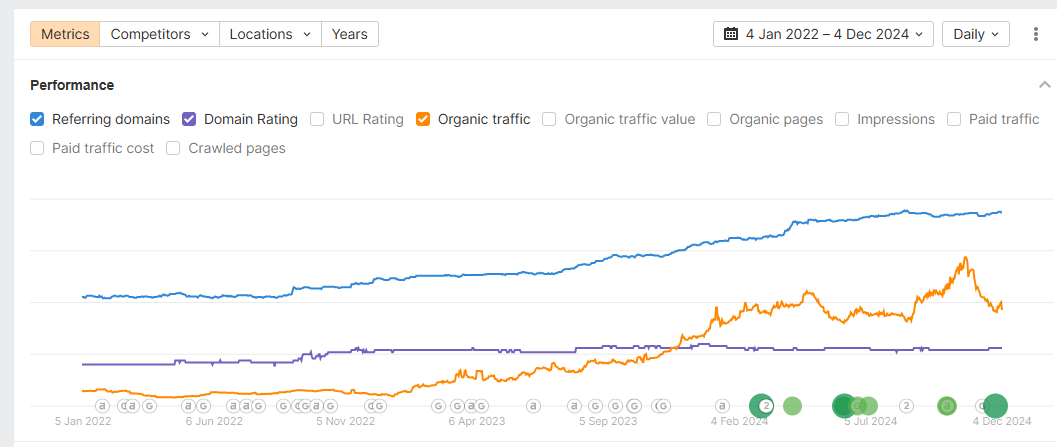
| Average daily traffic | ~214 users/day | 450+ users/day (×2) |
| Organic share | — | more than 70% of all users |
| Geography | mostly Kyiv | traffic and inquiries across Ukraine |
Source: web-analytics data for ART-Trade, work period — 6 months.
Work on the project lasted six months and delivered a stable, measurable result that was the outcome of comprehensive efforts, not one or two one-off optimizations.
Traffic growth
Average daily traffic grew:
- from 214 users per day
to - 450+ users per day.
That is more than a twofold increase, which is especially notable for the B2B segment, where traffic is not as massive as in e-commerce.
A strong organic share
More than 70% of all users arrive at the site from search engines.
That is, organic search became the key sales channel, and the company became less dependent on advertising.
Expanded regional visibility
Thanks to the structure update and publications on regional resources, ART-Trade began receiving traffic and inquiries not only from Kyiv but from other regions too — exactly the effect the company could not achieve on its own.
Strengthened reputation and trust
Registration on industry sites, external placements and the Scholarship project increased the number of brand mentions online. This raised trust in the site and strengthened its positions for competitive queries.
The site began working as a full commercial tool
After updating content and structure:
- user interaction with pages improved,
- browsing depth increased,
- the conversion rate of commercial sections rose.
The project gained a solid foundation for further scaling and can keep growing across all product groups.


| Engagement period | 6 months |
|---|---|
| Promotion region | Ukraine |
Project team
The project was handled by the SEOquick team:
- Nikolay Shmychkov — SEO strategy (Deputy Director)
Full team and roles — on the About page.
What's next
A similar case about entering a new market: Promoting an Online Store in Poland — where we likewise built structure and content for an unfamiliar region.
Promoting B2B or want to expand beyond your region? The concrete next step is to get an audit and a growth plan for your niche.