Text Spam Level in 2026: Over-Optimization, Keyword Density and Google Penalties
We break down what text spamminess and keyword density mean in 2026, why chasing a perfect percentage is outdated, and how to write natural content that users, Google, and AI search engines all love.

Spamminess (over-stuffing) is the excessive repetition of keywords and their word forms in a text, which makes it sound unnatural and lose value for the reader. In 2026, Google does not penalize a specific keyword-density percentage: its spam policies and helpful-content systems punish the manipulation itself — the attempt to cram a page with keywords for rankings rather than for the user's benefit. Below we explain how spamminess works, what over-optimization risks, which tools check it, and how to write relevant content without sliding into spam.
Years ago you could reach the top with text made up almost entirely of keyword phrases — especially for commercial queries. It read like a tongue-twister about "a meaningless thought on the meaning of meaninglessness." Value to a human: zero. But machines considered such garbage relevant and pushed it up.
Those days are long gone. Search engines have learned to assess meaning, context, and user behavior, and manipulating keywords now brings penalties: lower rankings, lost traffic, and in severe cases removal from search. All of it serves one goal — to make content genuinely useful for a real person searching for something.
So what is spamminess today, and how do you write a relevant text without over-optimization? Let's break it down step by step.

What, again? Traffic dropped and no sales? Then SEOquick will help you get it all back
We'll attract organic SEO traffic to your site from the Google and Bing search engines.
We'll carry out internal optimization and SEO promotion. We'll improve reputation and content. We'll perform an audit and build up your backlink profile.
No black magic – only white-hat SEO methods!
What Is Text Spamminess?
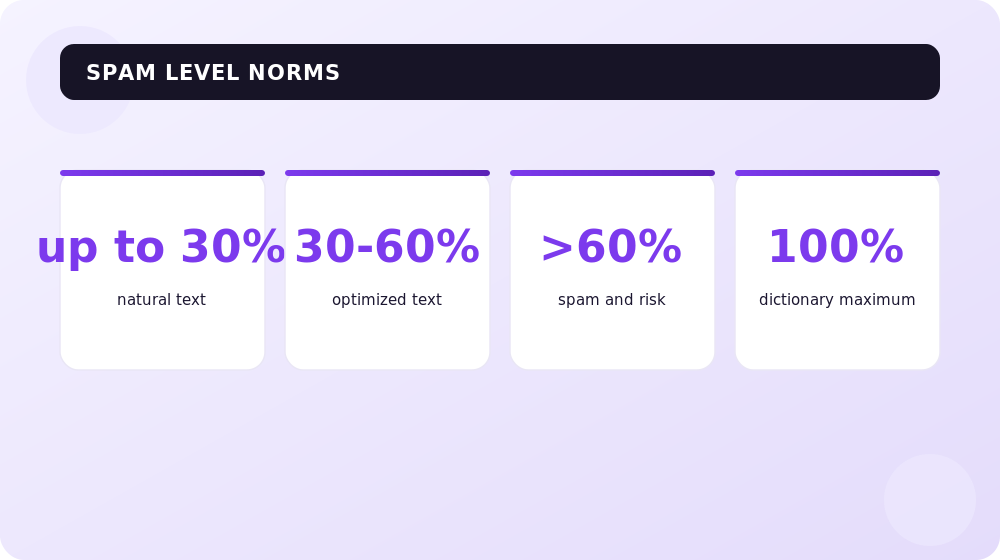
Spamminess is the overuse of repeated words and word forms relative to the total volume of text. In an SEO context, it means using keywords over and over, jammed into an article or other content until they start getting in the way of reading.
Historically, SEO tools settled on a simple formula: take the number of times a keyword repeats and divide it by the total word count. For example, in an article about SEO promotion the word "optimization" appears 25 times across 800 words — about 3% "density" for a single keyword.
People used to think that above 3% for one keyword meant an almost guaranteed "filter." But in 2026 you can no longer look at the topic that way. Google publishes no "safe percentage" for keyword density, and search itself works not with a word counter but with an assessment of meaning and usefulness. So percentages from tools are a signal of "does the text sound natural," not a threshold beyond which a ban automatically follows.
Density and Keyword Saturation
What matters is not only frequency but also placement density — the distance between keywords. The more evenly keywords are distributed across the text, the more natural it reads. If keywords sit too close together (a classic example: "buy windows, windows buy, windows Kyiv cheap"), it looks like spam to both a human and an algorithm.
Keyword saturation ("nausea") is a broader analogue of spamminess. It accounts not only for all grammatical forms of a keyword but also for related words from its semantic environment. For "optimization," that might be "SEO," "technical," "site." There is classic saturation (based on the single most frequent word) and academic saturation (based on the share of repetitions in the whole text).
What Google's Spam Policies Say
Google explicitly classifies keyword stuffing as spam. Its spam policies for Google Search describe it as "filling a page with keywords or numbers to manipulate rankings": lists of cities and regions, repeating the same phrases so often that the text sounds unnatural, piling up keywords out of context. Importantly, over-stuffing applies not only to visible text but also to anchors, meta tags, descriptions, and hidden text.
The key message of the 2026 updates: if content is built to manipulate search results rather than help the user, it can be demoted or removed from search entirely. This is no longer about a "spam percentage" but about intent and quality. The same principle underlies the helpful-content systems built into the core algorithm: pages written "for robots" lose positions, while pages written for people win.
The Spam-Level Norm in 2026
The honest answer: there is no universal "percentage norm." Even Matt Cutts, the former head of Google's anti-spam team, said there is no "ideal" keyword density — and in 2026 that is truer than ever. Old benchmarks like "under 2% is safe, above 3% means a filter" are merely hints from specific tools, not Google rules.
A practical 2026 approach looks like this:
- Write naturally — the way you'd explain the topic to a real person.
- Use the keyword and its synonyms where they fit the meaning, not "according to a plan."
- Place the main keyword in valuable spots — the H1, the first 100 words, the title and URL — instead of smearing it across the whole text.
- Read the text aloud: if the repetitions grate on the ear, that's over-stuffing, regardless of the percentage.
- Treat tool percentages as a "warning light," not a goal.
Text Filters and Search Engine Penalties
In 2026, most over-optimization penalties are not separate "named filters" but part of Google's core algorithm and spam systems. Still, understanding the logic helps.
Over-Stuffing and Keyword Stuffing
The most common reason for a demotion is text in which keywords repeat unnaturally often. Google treats this as spam and can both algorithmically demote a page and apply a manual action reported in Search Console. In 2026 Google rolls out spam updates faster than before — some wrap up in just 24 hours and hit low-quality, keyword-saturated content first.
Over-Optimization and Anchors
Over-optimization is not only about on-page text but also about link anchors. Too many exact-match commercial anchors pointing to a single page is a classic trigger for suppression tied to link-spam systems (a Penguin legacy). According to an Ahrefs analysis of 384,000 pages, the average exact-match anchor share among top-ranking pages is close to zero. Practitioners advise keeping exact-match under 5% of the profile: when the share of exact commercial anchors to one page climbs above 8%, a ranking drop often follows within one to three months. More on links and anchors in our piece on search promotion.
Helpful Content Systems
Helpfulness signals built into the core algorithm demote pages created primarily for rankings rather than for people. Over-stuffing is one of the clearest markers of such content.
Panda and Quality Assessment
The historic Panda update (2011) was launched specifically against low-quality content with repeated keywords. Today its logic is part of an ongoing quality-assessment system: thin, keyword-saturated text loses value in the eyes of search.
How to Check Spamminess and Over-Optimization
Tools don't replace common sense, but they help you spot problem areas. Combine text "hygiene" (clean language) with modern semantic checks.
Readability and Language-Cleanliness Checks
Services like Hemingway Editor and Grammarly don't count a "spam percentage," but they neatly highlight what usually comes with over-stuffing: clunky sentences, intrusive repetition, and bureaucratic filler. If the text lights up "red" for difficulty, it almost certainly reads hard and sounds unnatural.
SEO Platforms with Content Analysis
Surfer SEO, SE Ranking, Semrush, and Ahrefs analyze not bare density but the completeness of topic coverage: which subtopics and related terms the leaders use and what you're missing. That's far more useful than a "magic percentage" — you optimize for meaning, not for a word counter.
Modern Semantic Checks
In 2026, what matters is not the "percentage" but the completeness of topic coverage and the naturalness of the language. We've gathered our own work in this area in our AI tools section, and proper work with keywords is best started from a well-built semantic core: when the core is built cleanly, over-stuffing barely arises on its own.
How to Reduce Spamminess and Keep Relevance
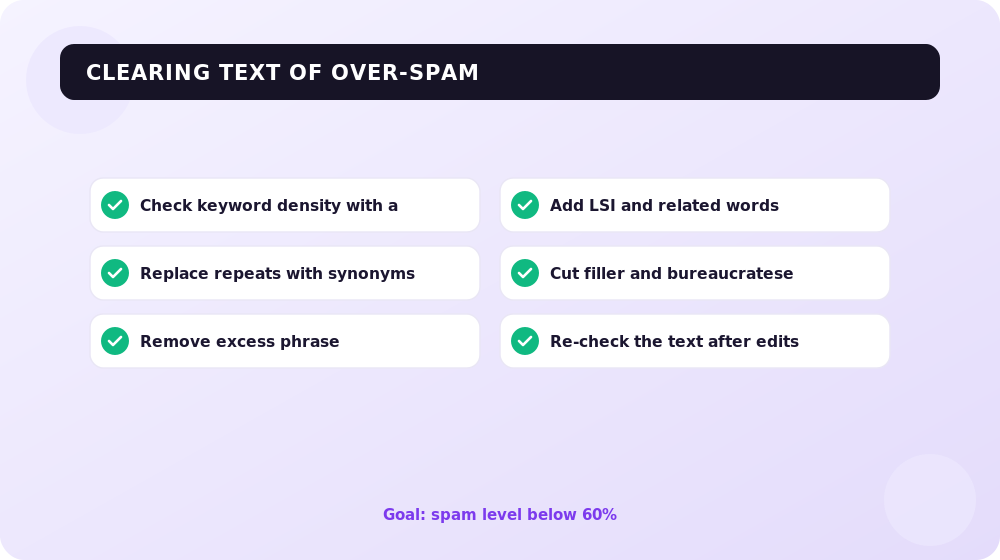
The good news: removing over-stuffing doesn't mean sacrificing relevance. On the contrary — natural text usually ranks better. Here are the working techniques.
Synonyms, Pronouns, and LSI
Instead of the tenth "SEO site optimization," use synonyms ("promotion," "work on the site"), pronouns, and semantically related words. This reduces repetition while expanding the semantics — exactly what modern algorithms and AI systems value above keyword density.
Less Is More
Remove keywords that carry no meaning. If a phrase can be dropped without losing clarity, drop it. Quality matters more than the number of occurrences. Often an online store in Kyiv is better off writing "delivery across Ukraine from UAH 250" once, honestly, than cramming "cheap delivery" ten times.
Spread and Separate
Distribute keywords evenly across the text; don't dump them into one paragraph. Break up long sentences, use subheadings, lists, and paragraphs — that way both humans and algorithms can read the meaning more easily.
Deep Rewrite and Rewriting
If a fragment is completely "clogged" with keywords, don't edit word by word — rewrite the idea from scratch, starting from the user's question. Often it's easier to delete the over-stuffed chunk and write it anew in "human" language.
Write for Humans and for AI
In 2026, your text is read not only by people and Google but also by LLM systems. AI Overviews now appear in over 25% of searches (up from 13% in early 2025), and ChatGPT Search and Perplexity work alongside them. These systems parse meaning, not keyword frequency: they recognize over-stuffing and demote it, while they readily cite self-contained blocks with facts, figures, a clear structure, and links to sources. So the best way to reduce spamminess is to write expertly, on point, and naturally.
Frequently Asked Questions About Text Spamminess
What are spamminess and keyword saturation in simple terms?
Spamminess is the share of repeated words and word forms in a text. Saturation is a broader metric that also accounts for semantically related words. Both show how "overloaded" with keywords a text is and how unnatural it sounds.
What spam-level percentage is considered normal in 2026?
There is no universal norm. Google publishes no "safe percentage," and the numbers in tools are just a reference point. The main criterion is naturalness: if the text reads easily and without intrusive repetition, the formal percentage is secondary.
Can you get a Google penalty for over-stuffing?
Yes. Keyword stuffing is explicitly listed in Google's spam policies as a violation. The consequences are lower rankings, lost traffic, and with a manual action, a flag in Search Console.
What can I use to check a text for spamminess?
Start with readability (Hemingway, Grammarly), then check topic coverage and semantics in Surfer SEO, SE Ranking, Semrush, or Ahrefs — they compare your text with the leaders in search results. And always reread the text aloud: the ear catches over-stuffing better than any counter.
Does anchor over-optimization affect rankings?
Yes. An excess of exact-match commercial anchors to one page is a typical over-optimization signal and can lead to suppression via link-spam systems. Top-ranking pages keep their exact-match share close to zero; keep yours under 5% of the profile.
How do AI search engines treat over-stuffing?
LLM systems assess meaning and usefulness, not keyword density. They recognize saturated text and cite it less often. Content with facts, statistics, and links to sources, on the contrary, is cited noticeably more often.

Stop Words in SEO Texts in 2026: Myths, Reality, and How to Write Naturally
What stop words are and whether they hurt SEO in 2026. We break down the myths about keyword density and over-optimization, their effect on titles, URLs and anchors, and how AI and LLMs handle noise words.
Read →
Website and domain history: what to check before SEO, purchase, or redesign
5 reasons to check domain history: indexation, penalties, redirects, backlinks, old content, and risks before promotion or migration.
Read →
How to Detect AI-Written Text: Language Markers, Code-Level Evidence, and Detection Tools
An AI-text detection system from the creators of the Unmiss AI detector: GPT phrase markers, machine logic, special-character evidence in code, tools, and a 7-step checklist. Plus what Google thinks about it.
Read →Want to apply this to your site?
We will review the current situation, find the first growth levers, and suggest a practical working format.