Targeted Advertising: What It Is and How to Set It Up
How to properly set up and successfully launch an ad campaign? What are the components of successful targeting, and how to run traffic arbitrage through targeting.


Today any homemaker can launch ads for her Instagram store in a single click with the "Promote" button, and you no longer have to pay anyone for this simple task.
Social networks have become the most popular websites on the internet. There are a few dozen of them in the world today, but only a handful stand out as worth investing in.
Roughly speaking, social networks can be split by popularity into three categories:
- by the average age of the audience;
- by content type;
- by geography of distribution.
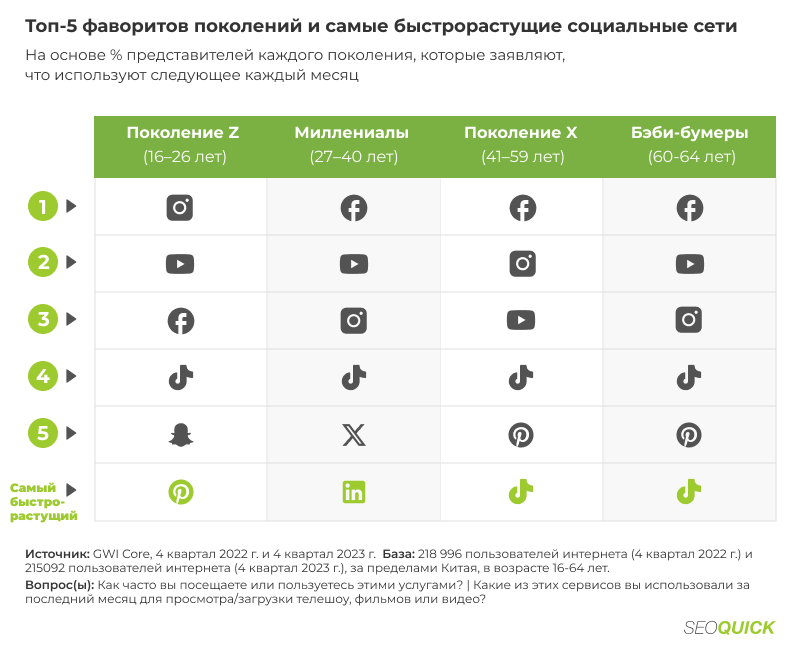
If you look at the first point — every social network is popular within certain age groups of the population. In the chart below, the social networks are ranked by priority from 1st to 5th place depending on age.
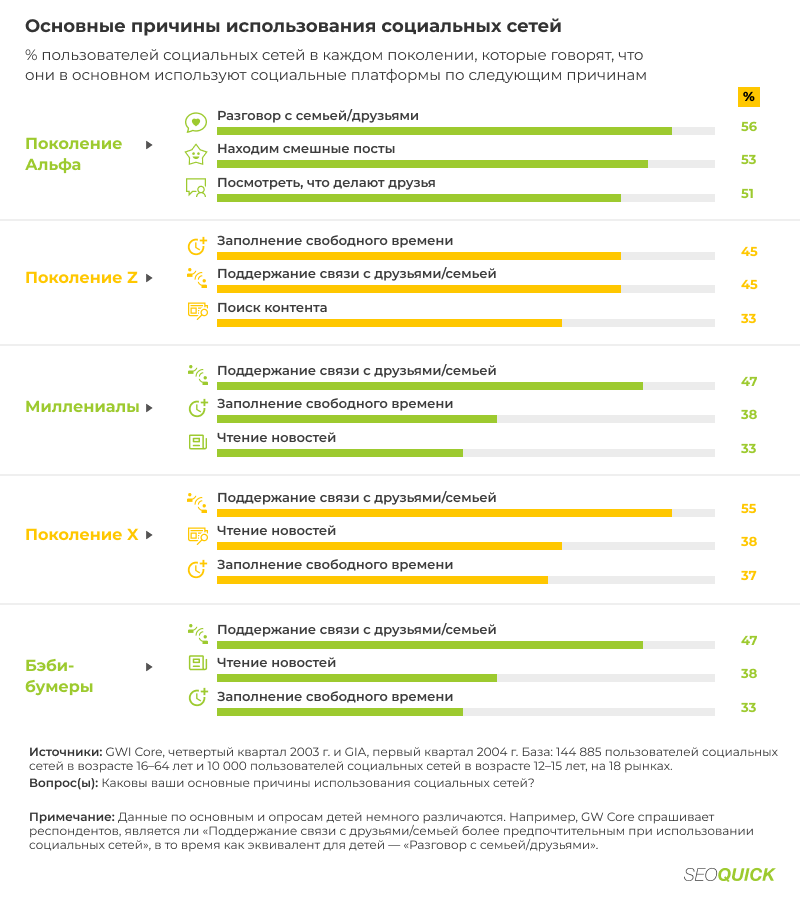
According to GWI, the reasons social networks are popular in 2026 are as follows:
- Keeping in touch with family and friends.
- Self-entertainment.
- Seeing what friends are up to.
- Finding interesting content.
- Reading the news.
Priorities for consuming different types of content on a given social network depend on the audiences.
You can't see it yet, but it's there! Find out how SEOquick brings you traffic
We'll set up your context advertising on Google AdWords the right way — with fat traffic and a high return on investment.
We'll precisely pick the ad type that's relevant to your business and delivers profit.
Our targeting always hits the bullseye!
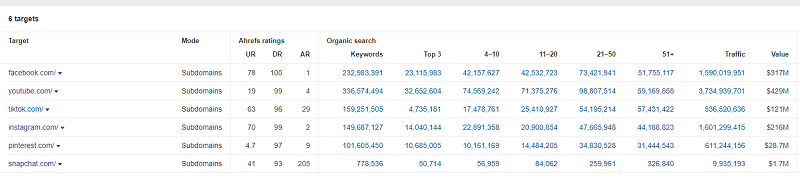
The traffic of modern social networks beats the records of every website in the world. According to Ahrefs, social networks together concentrate more than 5 billion in search traffic!
So today social networks are a fairly serious argument in favor of taking them into account, and there aren't that many ways to attract traffic to your projects on them. Among them you can single out organic promotion on social media, funneling traffic in from other channels, and targeted advertising.
What is targeted advertising?
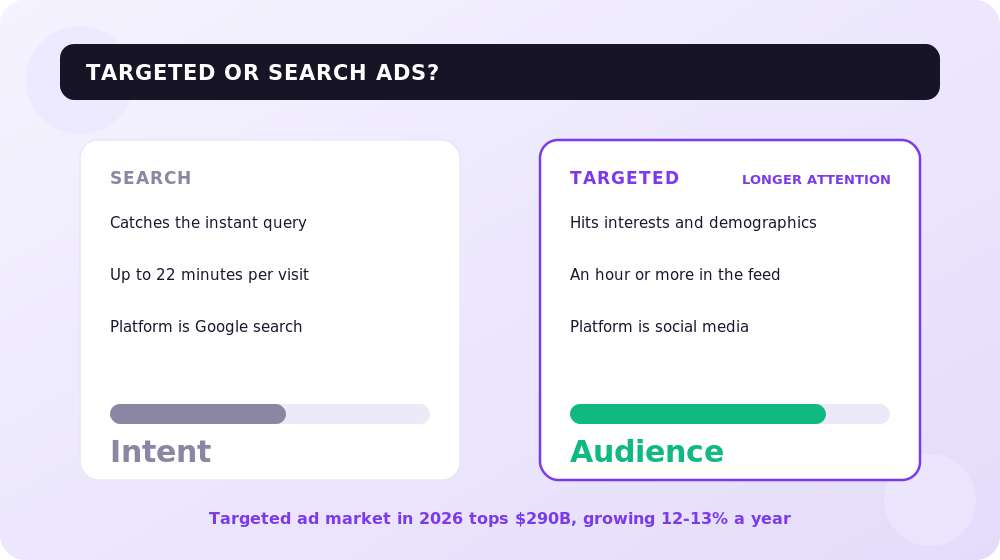
Targeted advertising is a type of paid online advertising aimed at pre-selected groups of users, based on their interests, interactions with your content (and content across the network), and selected demographic data. Unlike contextual search advertising, which is shown to an audience focused on search queries, targeted advertising aims at users without taking their immediate intent into account.
Targeted advertising first appeared on social networks, but recently it can also be seen in Google Ads in the form of special ad types (ads on networks and in Performance Max campaigns). So you should distinguish targeted advertising depending on the platform.
The platforms for displaying ads are social network sites and partner sites.
- The size of Facebook's audience is 1.28 billion active users, compared with Google's 2.6 billion active audience.
- But at the same time, retention on Facebook is much higher — on average, all the world's users view 1 trillion Facebook pages per month! Whereas, on average, everyone "googles" about 180 billion queries a month.
It turns out that for every Facebook user there's another Google user who isn't registered on Facebook. But at the same time, every Facebook user spends 5 times more time there than in a search engine!
More time means more focus on advertising. After all, in search advertising Google doesn't have much time to catch the user. They can spend more than 22 minutes per visit on Google, according to Statista, whereas on social networks that time can exceed an hour.
The targeted advertising market is still growing rapidly: according to estimates by the Business Research Company, in 2026 its volume exceeds $290 billion and, at an average annual growth rate (CAGR) of around 12-13%, will pass the $450 billion USD mark by 2030. It's worth noting separately that a significant share of this growth in recent years has come from automated, machine-learning-driven formats — Advantage+ campaigns in Meta and Performance Max in Google.
To make things clearer going forward, let's go over a simple glossary.
| Term | Definition |
| Ad set | A set of ads within a single campaign that share common targeting and budget settings |
| Campaign | A collection of ad sets united by a common goal and promotion strategy |
| Reach | The number of unique users who saw your ad |
| Engagement | A measure of user activity, including likes, comments, clicks, and other interactions |
| CPM | Cost Per Mille — the cost per thousand impressions of your ad |
| Placement | The location where your ad is displayed, for example in the news feed, stories, or sidebar |
| Format | The type of ad, for example an image, video, carousel, etc. |
| Audience | The group of users your ad is aimed at, selected by various criteria |
| Lead | A potential customer who has shown interest in your product or service |
| Subscription | The process by which a user subscribes to your content, newsletter, or channel |
| Budget limits | Restrictions on ad campaign spending, set to control costs |
How targeted advertising works
The goal of any ad campaign is to reduce the cost of attracting the right visitors to your product or service, without sacrificing the sales of that service or product.
Targeted advertising, like any other, has a classic chain. Before you start your targeting work, you need to write it out in your project brief:
| Task | Task description |
| Targeting condition | Provide a clear description of who we want to set up ads for |
| Platform | We choose which sites and apps we want to show our ads on |
| Format | We decide which ad format we'll use. Unlike products and listings, targeted ad types offer a much wider range |
| Creative | We need to clearly picture what we'll show our potential consumer |
Targeted advertising works on the following principle:
- You create a targeting audience.
- You create an ad creative for promotion.
- For the chosen creatives, you allocate a platform to display the ads.
- You set the budget and the ad delivery methods.
Unlike search advertising, here you focus not on a search query, but on a selected audience. The marketer's task is to guess the intentions of the chosen audience and skillfully pick the ad creative.
How to create a targeting audience?
The first stage of setting up targeted advertising is precisely creating the target audience for your project.
A target audience is a group of people clearly defined through social, demographic, and behavioral criteria, which may be of interest to your business.
To set up an ad campaign, you need to clearly assemble audiences based on the following criteria:
- Gender.
- Age (age ranges).
- Geography of residence or movement.
- Life events (which exist and could have existed).
- Interests (which groups might interest this audience).
- Marital status.
- Income level.
All audiences are narrowly sliced groups of people that you segment your ads across.
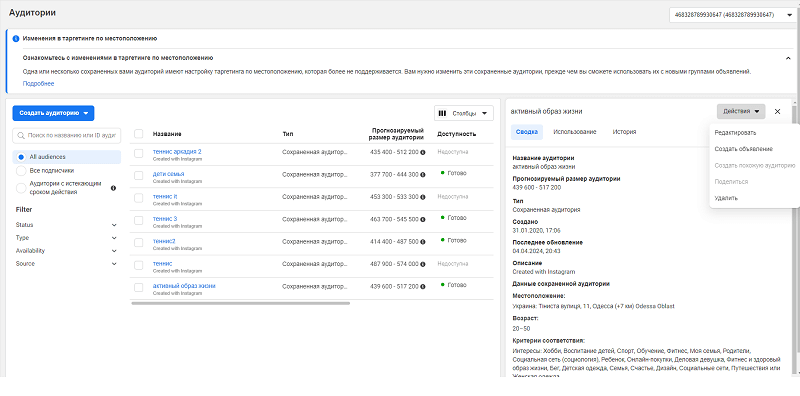
For convenient segmentation, you can build audiences using Mark Sherrington's methodology (or 5W).
Our main specialization right now is promoting websites in the trading niche.
Let's try to build a trader audience.
| Question | Target audience example 1 | Target audience example 2 |
| What | Visitors looking for information and first steps in trading cryptocurrency on binary options | Visitors who already have experience trading cryptocurrency on binary options, looking for advanced strategies and analytics |
| Who | Men and women aged 18-35, students and young professionals interested in investing and extra income | Men and women aged 25-45, working professionals, entrepreneurs, financial analysts who actively engage in trading |
| Why | Looking for ways to improve their financial situation, want to learn the basics of cryptocurrencies and binary options, strive for financial independence | Looking for new trading strategies, want to improve their profitability, interested in analytical tools and market forecasts |
| When | Actively search for information and visit sites in the evenings and on weekends, when they have free time to study and learn | Regularly visit sites during the workday and in their free time, when they can analyze data and follow the market |
| Where | Mostly from cities with high internet penetration and access to financial services, such as large cities and capital regions | Globally, with a focus on financial centers and regions with active cryptocurrency trading, such as the USA, Europe, Asia |
Audiences like these are a great fit for setting up targeted ads for you.
I covered target audiences in more detail in this video.
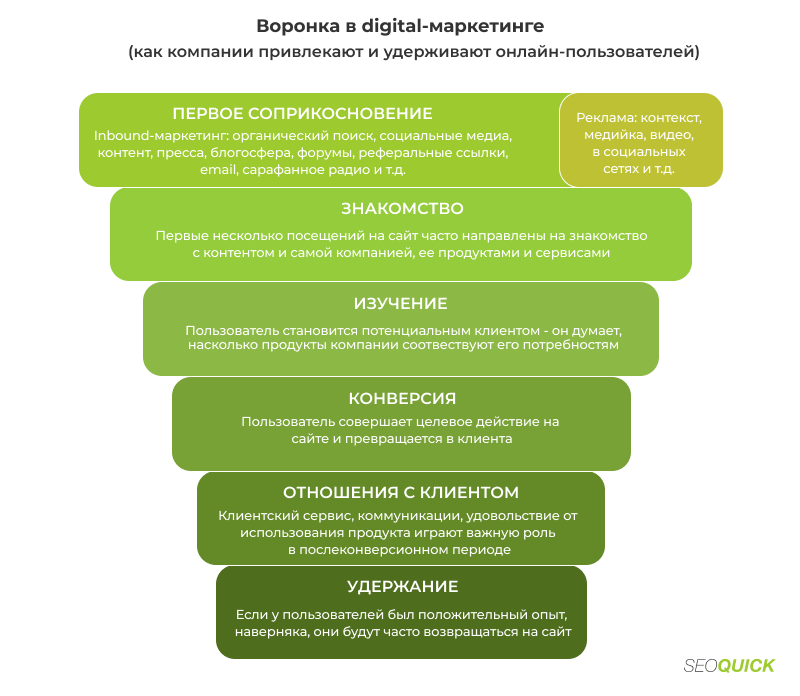
In targeted advertising there's a clearer concept of audience funnels. Here you can build multi-level campaigns that are usually ignored in search advertising.
A marketing funnel is the sequence of attracting an audience into your project and business. This funnel is built in several stages — from interaction with your brand and content (getting acquainted with the product), and then over several stages it moves toward contact for the sale of your services and products. The principle of the funnel is that the first stages gather a much larger audience, whereas at the bottom of the funnel there are far fewer buyers.
For example, you can funnel traffic in the binary options niche, as we do for our projects, to sites that teach the basics of trading and methods of buying and selling currencies.
Yes, there are moderation problems, and this is exactly where multi-level ad campaigns help.
Compared with classic sales funnels, the funnel in targeting has significant differences:
- Social networks let you attract an audience through the "friends of friends" mechanic.
- Social networks let you set up ads to a lookalike audience.
- Customers can share your product's posts, comment on them, and thus immediately bring a more loyal audience into your product.
That is, while in Google Ads everything ended at conversion, after which the contacts went to sales reps to retain them via chatbots and email newsletters, here you have a much larger arsenal for working with the audience.
Platforms for setting up targeted advertising
Given that you won't be able to funnel traffic to these areas directly, you'll have to build deeper funnels for moving traffic from one social network to another.
There aren't many large advertising platforms for setting up ads:
In this article we'll talk in more detail about how they work.
Setting up ads in Facebook Ads
To set up ads in Facebook Ads, you're recommended to create an ad account. By default, one is tied to the payer's personal page, or if you have a business profile — you can create up to four accounts for a business profile.
To set up the account, follow this link. If you don't have one, you'll be prompted to register a business profile and connect your business pages and Instagram accounts.
An important clarification. In the Facebook account you can only set up ads for the following types of objects:
- Facebook business pages (a personal profile page cannot be converted into a business page).
- Instagram business accounts (a regular account can be converted into a business one).
- WhatsApp business accounts.
As additional goals, targeting can be set up for the following actions:
- Websites (yes, traffic can simply be funneled straight to landing pages or your other projects).
- Product catalogs.
- Mobile apps.
- Leads (collecting customer data via instant forms).
- Calls.
Your ad can be shown on:
- Facebook — in the feed, stories, reels, messages.
- Instagram — in the feed, stories, reels, messages.
- Mobile apps — banners, skippable video.
At the same time, you cannot set up ads for:
- Personal Facebook pages.
- Personal Instagram accounts.
- Facebook groups (regardless of whether they're closed or not).
Setting up ad campaigns in Facebook Ads
To create an ad campaign, follow this link to the campaign manager and click the "CREATE" button.
When setting up an ad, the following goals are available:
- Awareness — this includes ads related to increasing reach, brand awareness growth, and video views.
- Engagement — among the goals available are calls and interactions with messengers on Instagram, FB Messenger, conversions, video views, post engagement.
- Traffic — among the goals available are link clicks, landing page views, calls, and interactions with messengers on Instagram, FB Messenger, and WhatsApp.
- Leads — this includes conversations on Instagram, FB Messenger, calls, and conversions.
- App promotion — a special campaign for setting up app installs or in-app events.
- Sales — suitable for direct catalog commerce, messengers, calls, and conversions.
Given the confusing wording, here's what I'll say. The first two options work out cheaper, and here's why.
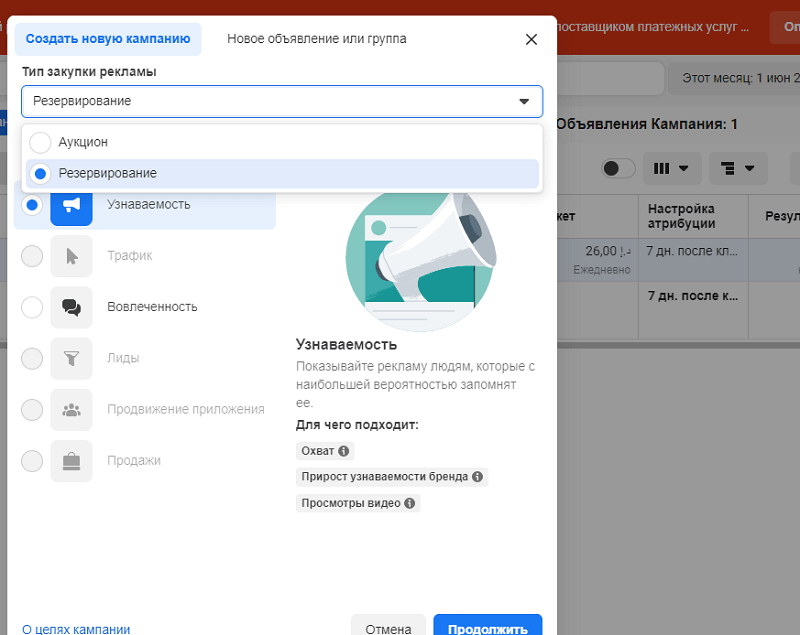
When setting up an ad, the following types are available to us:
- Auction (lets you set up ads for all types of goals).
- Reservation (lets you set up only for awareness and engagement).
You can see the details of how not to make a mistake with the campaign type in the video.
When setting up an auction, bids can be dynamic, and the cost per click and per impression can vary greatly. Whereas with reservation, you get a stable traffic spend for the money you put in.
When building the first funnel for audience collection through targeting (for example, our trading projects), it's profitable to promote posts and videos and set up targeting for them.
In some cases you won't need to go through moderation. But remember — you need to specify a real payer number, with their documents, when ordering targeted advertising.
Advertisers do not need written permission to run ads that promote:
- tax services for cryptocurrency companies;
- events, education, or news related to cryptocurrencies and blockchain technology, if they don't offer cryptocurrency and related goods and services;
- goods and services based on blockchain technology that are not virtual currencies (for example, non-fungible tokens, NFTs);
- cryptocurrency wallets that allow storing cryptocurrency but don't include additional services such as buying, selling, exchanging, or staking crypto assets.
Source: Facebook Meta
That is, we have the opportunity to create accounts for real bloggers who will report news from the world of cryptocurrencies, and you'll be able to fully legally promote their posts in ads. The key difference will be the absence in the content of what's described below.
Advertisers will need to obtain written permission to publish ads that promote:
- Cryptocurrency trading or exchange platforms. Platforms, software applications, or products that allow people to exchange cryptocurrencies for money and vice versa. This includes, among other things, spot trading, margin trading, futures trading, and other trading instruments using crypto assets.
- Crypto loans and lending. Platforms, software applications, or products that allow people to borrow or lend cryptocurrency.
- Cryptocurrency wallets with additional services. Devices or software that allow secure storage of cryptocurrency and include additional services such as: buying or selling; exchanging one cryptocurrency for another; staking or acquiring and holding coins to earn interest income.
- Cryptocurrency mining. Hardware or software that enables mining of crypto assets.
Source: Facebook Meta
To pass moderation confirming you have the right to conduct activity related to cryptocurrency trading, fill out the application at this link. One submission is allowed per ad account.
The account structure is built on a simple scheme. There are several content levels:
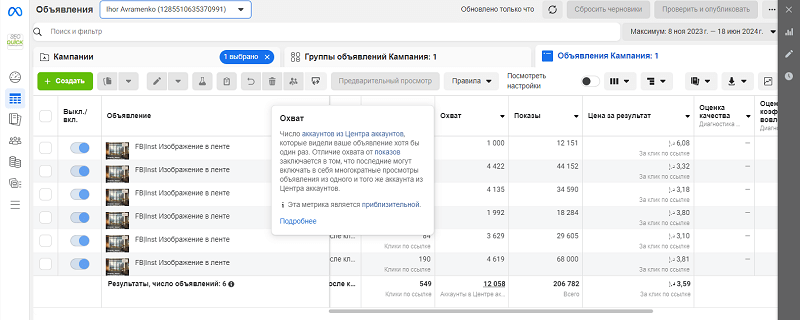
- Campaign. It usually defines the type of strategy and what kind of content will be advertised in this campaign.
- Ad set. It accounts for the audience chosen for targeting. Different ad sets can use different audiences. But you can't add more than one audience to a single set. A campaign can include many ad sets. Each of them can have its own budget. Within each set there can be a different placement (where the ad is shown).
- Ads. A single ad set can hold up to 50 ads. They can even be identical (but you shouldn't do that). Within one campaign, a single ad set cannot contain ads of different types.
When setting up audiences on Facebook, you choose between the interests your audience has interacted with.
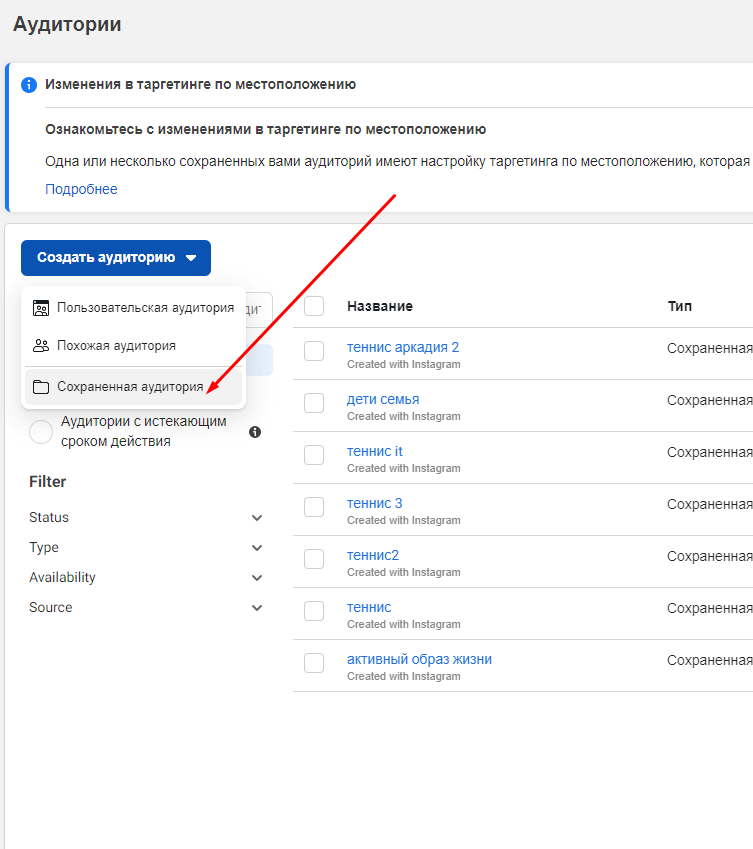
There are several types of audiences on Facebook: custom, saved, and lookalike. The most popular are precisely saved audiences, which are set up manually by chosen criteria.
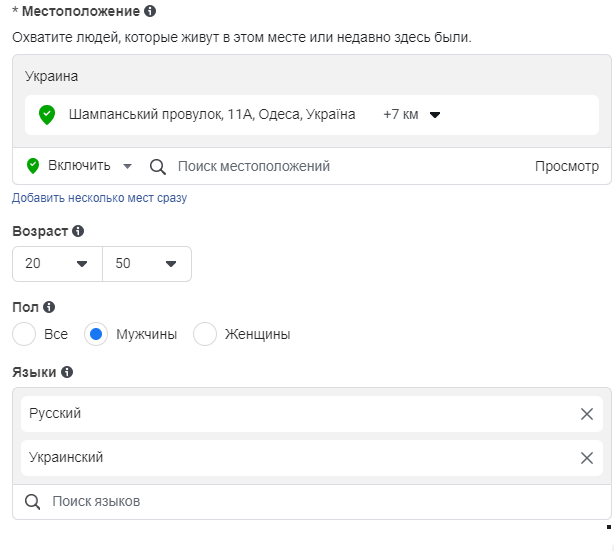
Among them are things like geography, gender, age, and language settings.
It's worth mentioning Advantage+ audiences separately. This is a mode in which you only set starting hints by interests and geography, and then Meta's algorithm itself expands the reach, testing adjacent segments and automatically reallocating the budget to where conversions are cheaper. In our experience, on broad funnels (the top stage, audience collection) Advantage+ often performs cheaper than manual saved audiences because it doesn't squeeze impressions into an artificially narrow segment. But at the lower stages of the funnel and in sensitive niches, manual control of interests and exclusions still delivers a more predictable result.
In the interest settings, you choose which queries users entered in Meta's apps, what content they interacted with, and even listened to what you say!
So in the detailed targeting section you have categories:
- Demographic interests.
- Behavior.
- Interests.
And everything you specify here will be taken into account when building audiences!
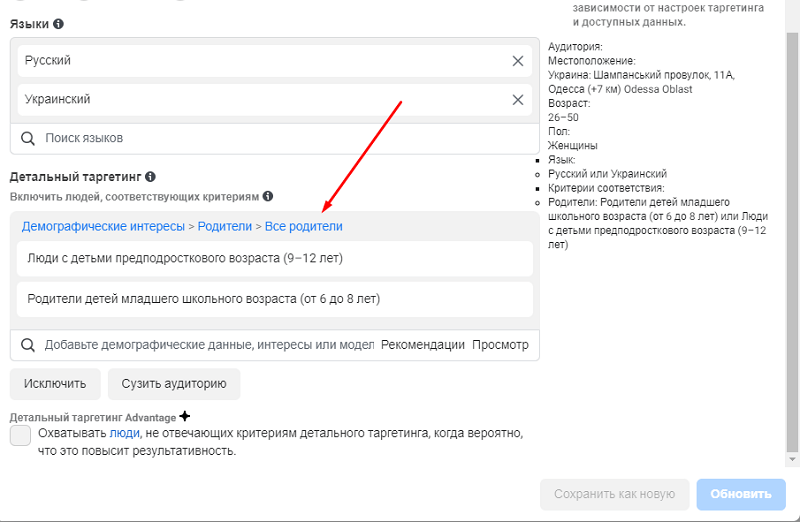
The interests themselves are presented as a fairly branched tree.
If you have products and services that fall neatly into separate groups, this can be used to create micro-audiences based on a specific attribute.
Here you can create fairly creative seasonal campaigns or ones tuned to a precise audience.
The audience functionality lets you do the following:
- Adding interests to one group. Works like the logical operator "OR". That is, when you select "Sports" and "Healthy lifestyle" — both groups will be included in your selection.
- And then. Or you narrow audiences. Works like the logical operator "AND". That is, when you select "Sports" and narrow to "Healthy lifestyle" — only the intersections of this group (those that fall into both criteria) will be included in your selection.
- And there's exclude. Works like the logical operator "NOT". It's simple here. You cut one audience out of another. That is, when you select "Sports" and exclude "Healthy lifestyle," you'll have the Sports audience minus those who were interested in healthy living.
If you selected the interest "cryptocurrencies," it doesn't mean the user typed "cryptocurrencies" into the Facebook search.

It means that over some limited period of time (up to 28 days) the user asked similar questions, visited similar groups, liked or studied similar posts from accounts classified under these interests.
For 2 days I deliberately and actively liked, commented on, and viewed posts related to lip Botox, and within the first hour my feed was already plastered with ads and organic content on this topic. And it lasted for 28 days; toward the end the intensity faded out.
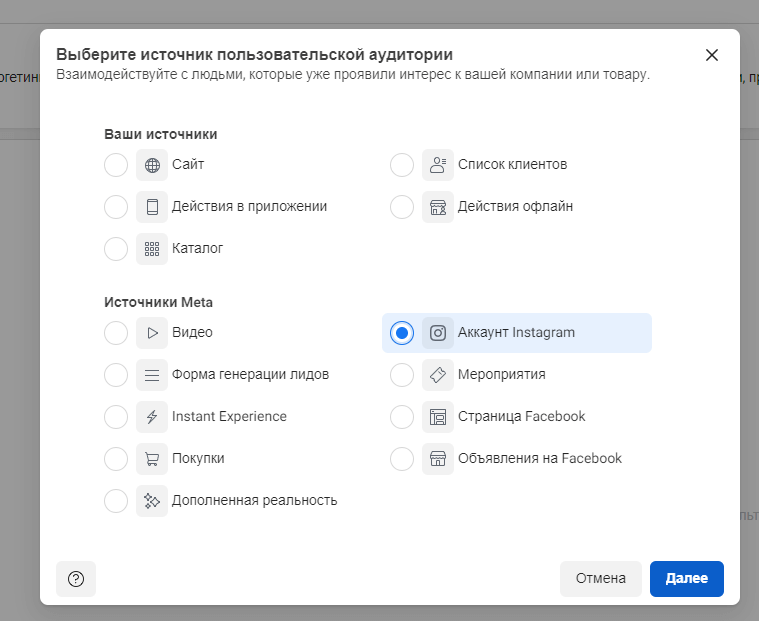
Another type of audience is custom.
In this video, Alena Polyukhovich explains audience setup methods in detail.
Setting up Facebook targeted advertising through the mobile app
And yes, the social network itself has a simple interface for launching these ads through the Instagram or Facebook app interface. You just select the post you want to advertise and tap the "Create ad" button.
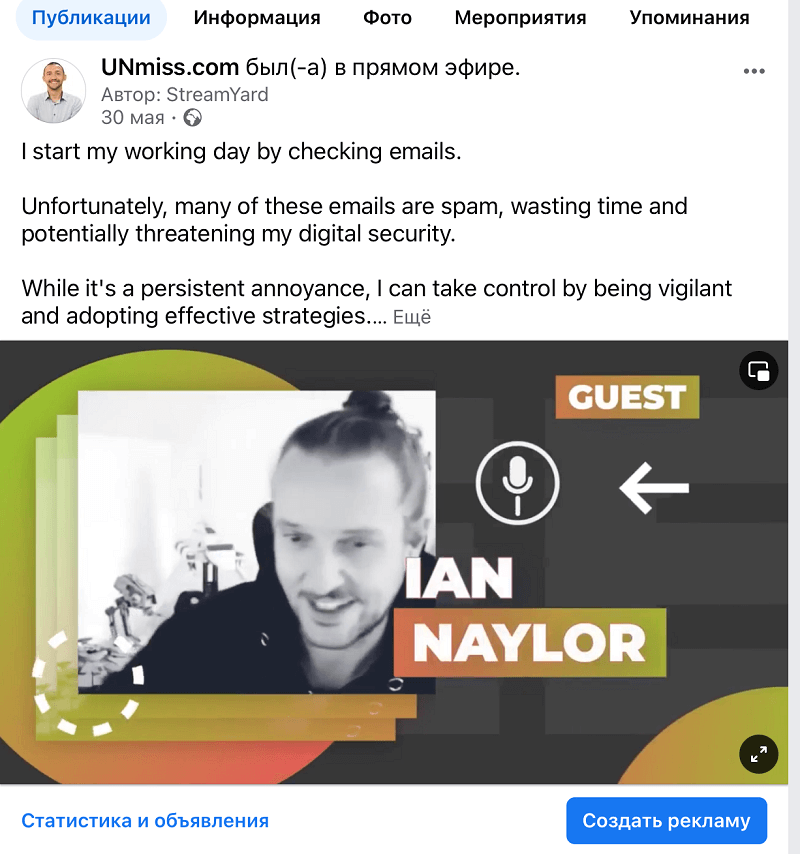
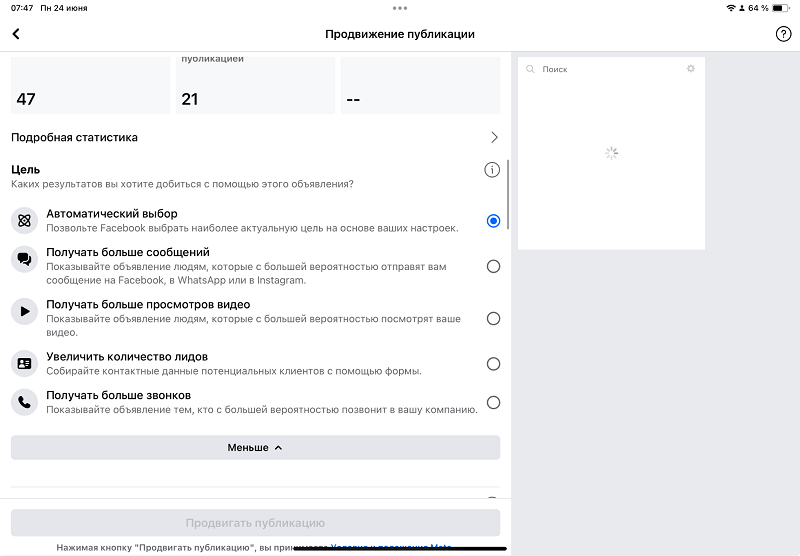
Next you need to decide on the ad goal:
- Getting messages.
- Getting more video views.
- Collecting leads.
- Collecting calls.
Next you can set up the type of button on the ad post.
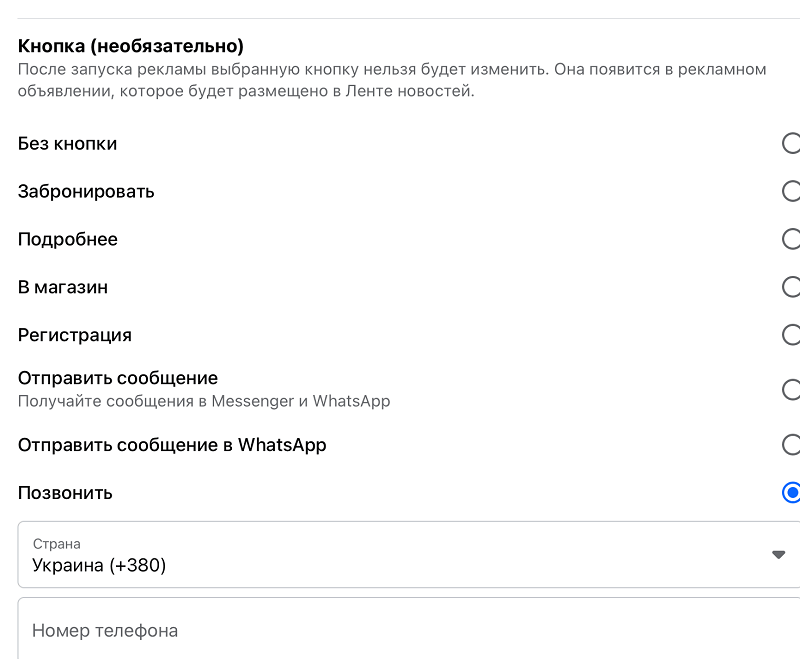
- Learn more.
- Book now.
- Shop now.
- Sign up.
- Send message.
- Call now.
The "Advantage Creative" checkbox lets you enable adapting the current creative to other ad placements, change and add music, add effects to video, and change text.
Next you can choose the audience settings and the special ad category type.
On Facebook, ads for loans, employment, real estate, elections and politics, and social ads have restrictions — you need to pass business verification, and in targeting you can't change age and gender (they're set as broad as possible).
When selecting audiences, you can load previously created audiences or edit an existing one on the fly.
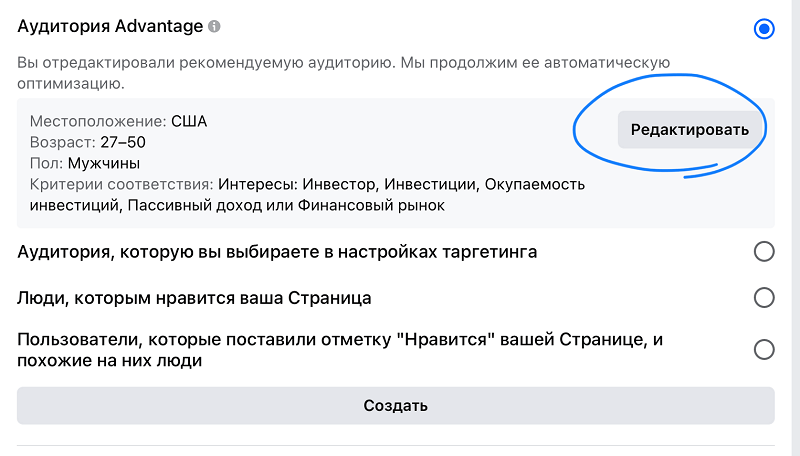
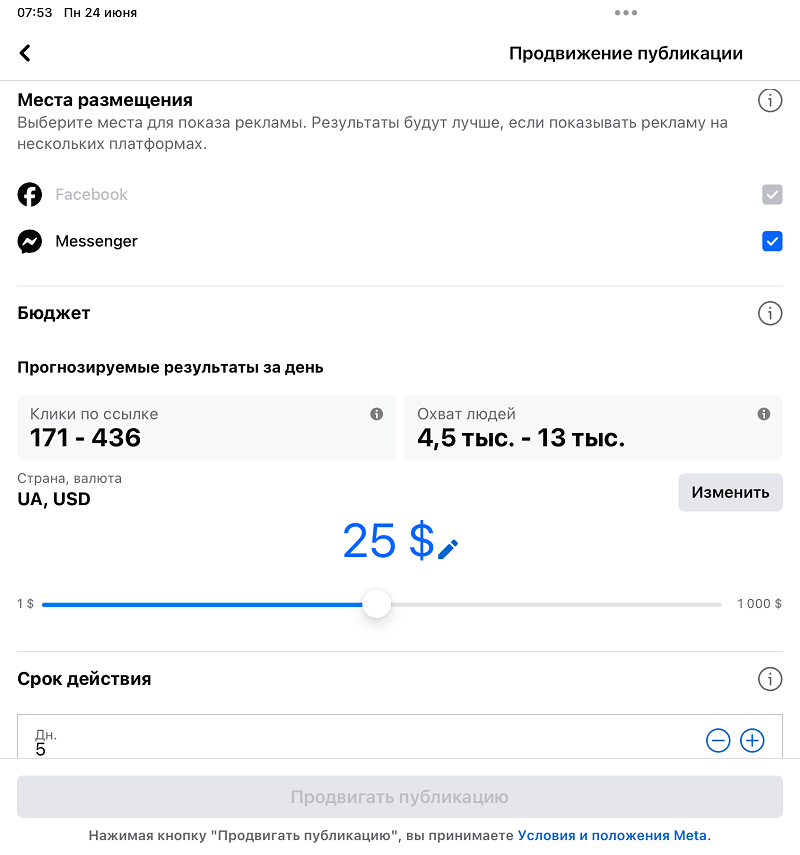
Next you choose the placement, i.e., where the ad will be shown (placement locations). By default this depends on the chosen platform.
And then you specify the ad budget and duration.
Setting up targeted advertising through Instagram
On Instagram the interface is similar — you need to select the desired post and tap the "Promote" button.

After your account is verified, you'll be prompted to choose the ad goal:
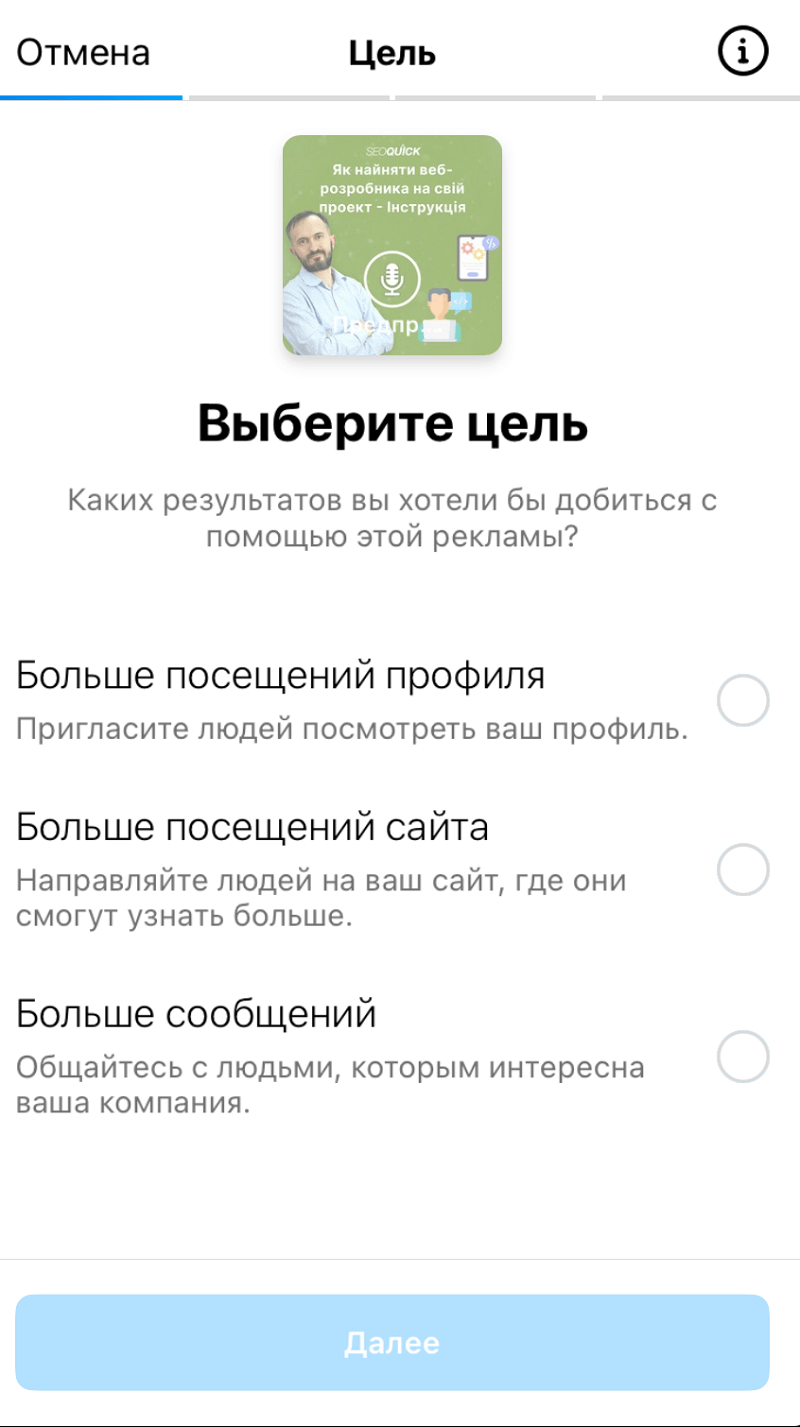
- More profile visits.
- More website visits.
- More messages.
This will affect how the bottom part of the ad post looks.
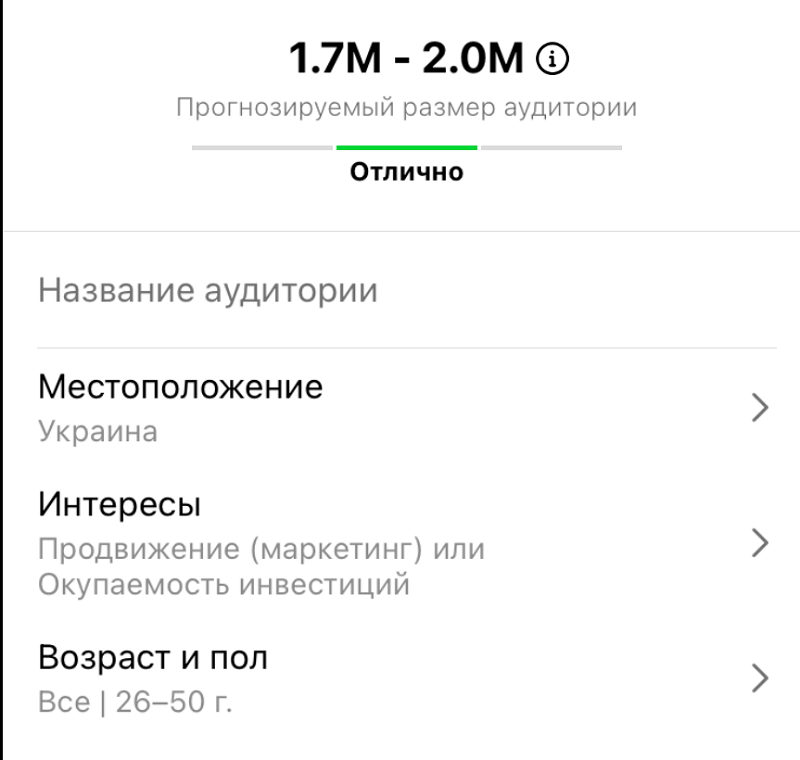
Next you create audiences as usual:
- we choose regions (country level or the radius of the audience's real location). This interface exists only in the Instagram mobile app — choosing the specific region where the audience lives.
- We specify interests — here you should only specify those you're genuinely interested in. Interests here are which pages your audience likes and views and which search queries it entered (or said out loud). Yes, yes, Meta watches us, and very successfully. Use that.
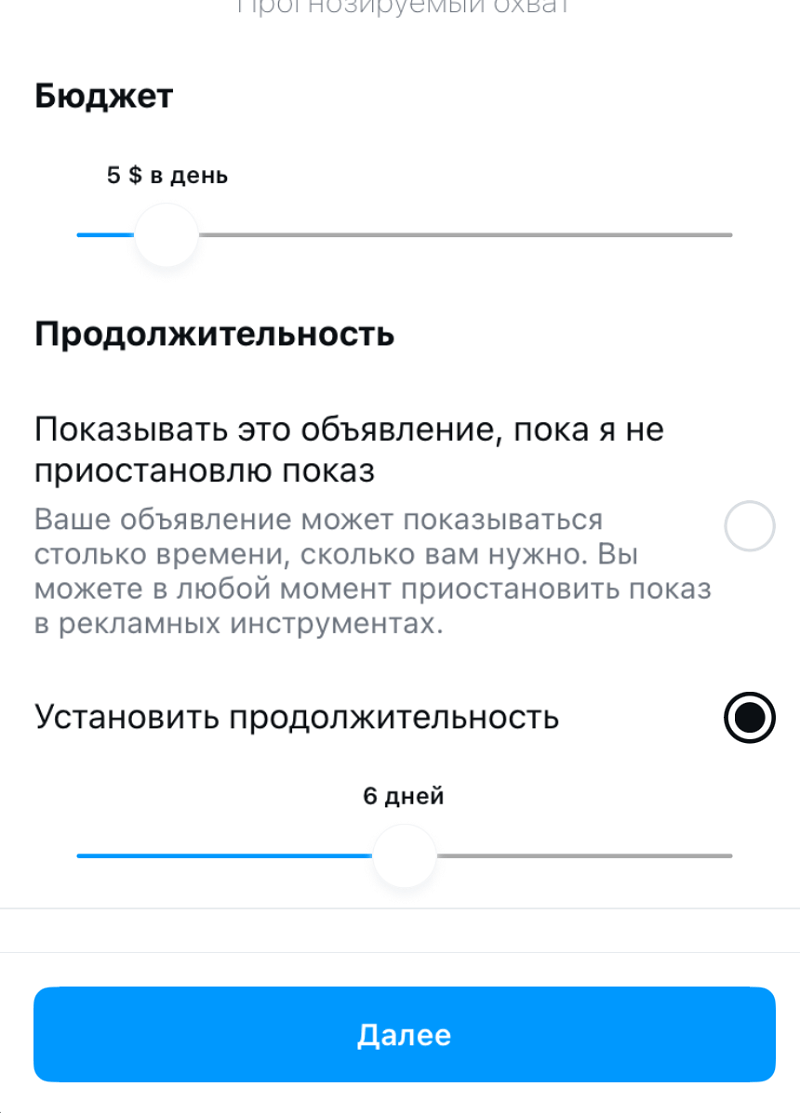
Next you need to choose the budget and duration of your ad for the desired target audience and launch it.
Today this is the simplest way to launch ads — it requires minimal skills. And everything depends only on what content and what text are used in the ad.
Setting up targeted advertising on TikTok
TikTok similarly has such a system. You create a business account to which you can attach a certain number of ad accounts.
The ad accounts themselves exist separately from the profiles.
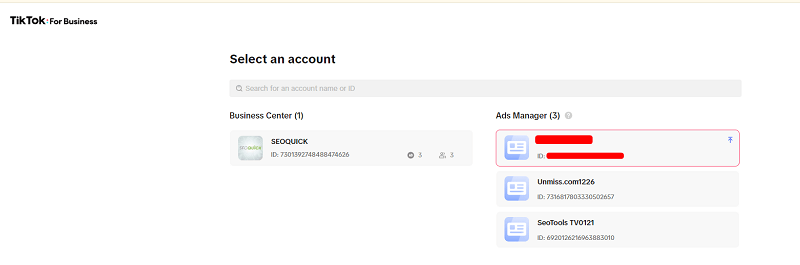
The ad account looks very familiarly similar to the analogous account on Facebook.
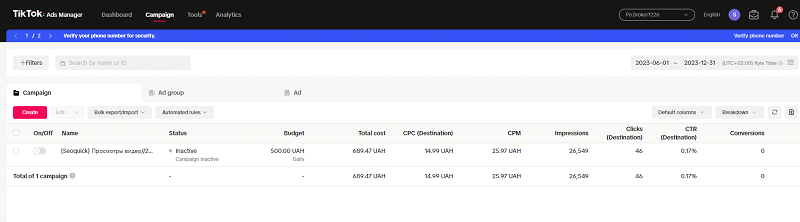
The same hierarchy of ad setup is used as on Facebook.
- Campaign — lets you combine several ad sets. The strategy and budget are configured,
- Ad set — here the targeting conditions are configured (audiences and spending limits).
- Ads — here there can be separate videos for advertising. This is where you choose one creative or another for the ad.
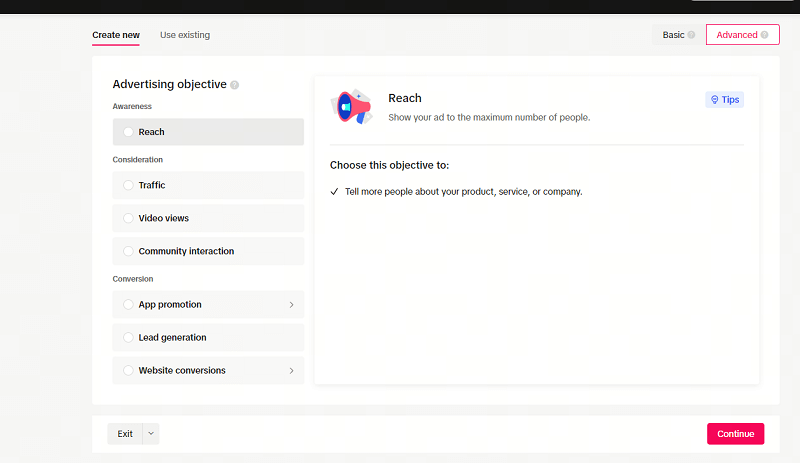
The ad campaign goals on TikTok are as follows:
- Reach — showing the ad to the largest possible audience.
- Video views — showing it primarily to those who watch the video to the end.
- Traffic — focusing on repeat impressions to get clicks to the site.
- Account engagement — slightly more expanded than views. It focuses on those who more often subscribe, go to the profile, and interact with the links in your ad.
- App promotion — aimed at app installs and repeat returns to perform actions in apps.
- Lead generation — through instant forms in TikTok and also collecting forms on your site.
- Website conversions — a campaign analogous to Google Performance Max, aimed at conversions on your site.
In the trading sphere we were only interested in the first three. After all, our goal was to grow a loyal audience of subscribers to our videos.
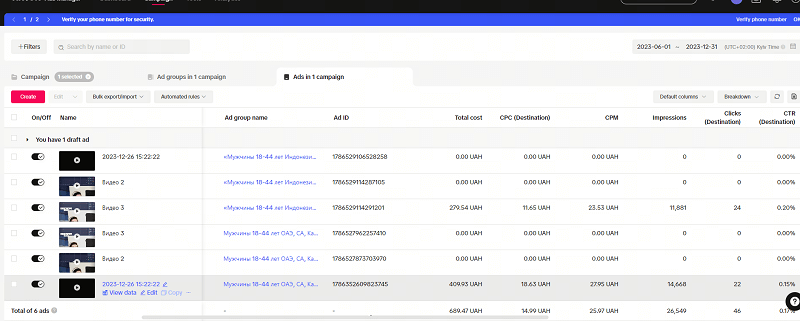
But we quickly realized that the blocking in many countries differs seriously, and the only country where it worked was Qatar. Forex, binary options, crypto trading are blocked almost everywhere on TikTok, and you won't be able to advertise this directly before getting blocked.
For this, we recommend creating simple educational content and running it in ads, while publishing content related to your main niche irregularly on the channel, and then "hiding" it. Or motivating users to move to another platform, where you already teach trading to your audience.
Setting up targeted advertising in Google Ads
Yes, targeted advertising exists in Google Ads. In fact, it's several ad types you can set up:
- ads on the Google Display Network (GDN);
- video advertising (In-stream and Discovery).
The principle of operation is no different from setting up targeted ads on Facebook and Instagram. To set things up, you'll definitely need to register an account in Google Ads and confirm your payment profile.
Do you need sales?
Fill out the form below and I'll help you set up a context advertising sales channel for your site!
How to create ad creatives for promotion?
For convenience, businesses create customer avatars. A customer avatar is a random slice of audience metrics, to make it easier to position your ad for a specific user. After all, it's easier to imagine a creative's design when you understand a specific persona.
Here are examples of two avatars for the previous target audiences:
| Avatar examples | Beginner in trading cryptocurrency on binary options (India) | Experienced cryptocurrency trader on binary options (Spain) |
| Age | 24 years old | 34 years old |
| Gender | Female | Male |
| Name | Anvi Sharma | Alex Gonzalez |
| Occupation | Final-year student of the economics faculty | Financial analyst at an investment company |
| Location | Bangalore, India | Madrid, Spain |
| Education | Higher education (in progress) | Higher education (economics) |
| Interests |
|
|
| Behavior |
|
|
| Goals and motivation |
|
|
| Pains and concerns |
|
|
AI creatives: how neural networks speed up ad production
While just a couple of years ago drawing a single banner or shooting a video took days, today you can put together a rough version of a creative in minutes. Meta, TikTok, and Google's ad accounts have built generative AI tools right into the interface: they rewrite text for different placements, generate backgrounds and image variations, automatically crop video for stories, reels, and the feed, pick music, and add subtitles.
The main benefit of AI creatives is not to "draw the picture for you," but to sharply cut the cost of testing hypotheses. Instead of three post variations, you quickly prepare ten and hand them to the algorithm for a split test, and it finds the combination that delivers the best engagement on its own. This fits perfectly with the principle described below of constantly refreshing ads against audience "burnout."
An important nuance: text and headlines generated by a neural network must be proofread and adapted to the brand voice — otherwise the ads come out impersonal. We covered in detail how to write content that's well read by both people and AI systems in the materials GEO optimization of a site for GPT and AI content: answers to frequently asked questions.
Clicks on social networks are cheap
The second feature of targeting is the overall cheapness of a click: thus, the cost per click in the USA in contextual advertising can be up to $2.5, whereas on social networks it doesn't exceed $0.8.
Also, on social networks you can build ads with a capped cost per click and still get impressions. I talked about this earlier.
You should also know that, depending on the audience, the cost per click can vary greatly. Thus, the most "expensive" audience on Facebook is finance, and the cheapest is travel and leisure.
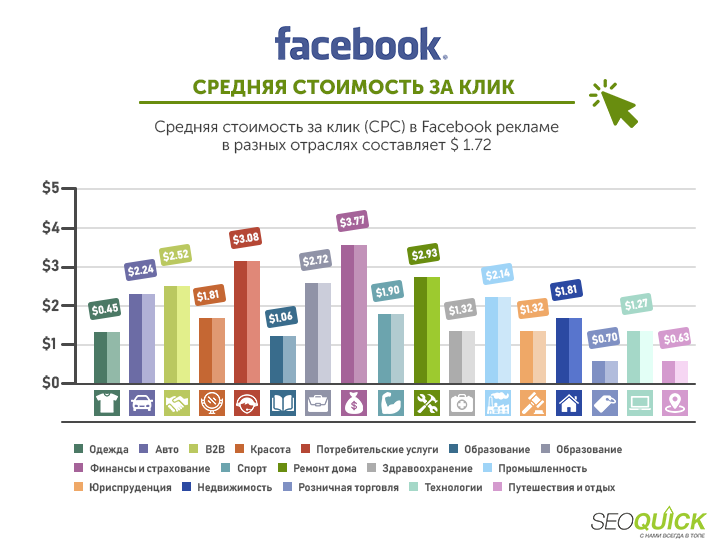
There are two bidding strategies: there's the option to pay for clicks per 1000 impressions (CPM) or to pay for each individual click (CPC).
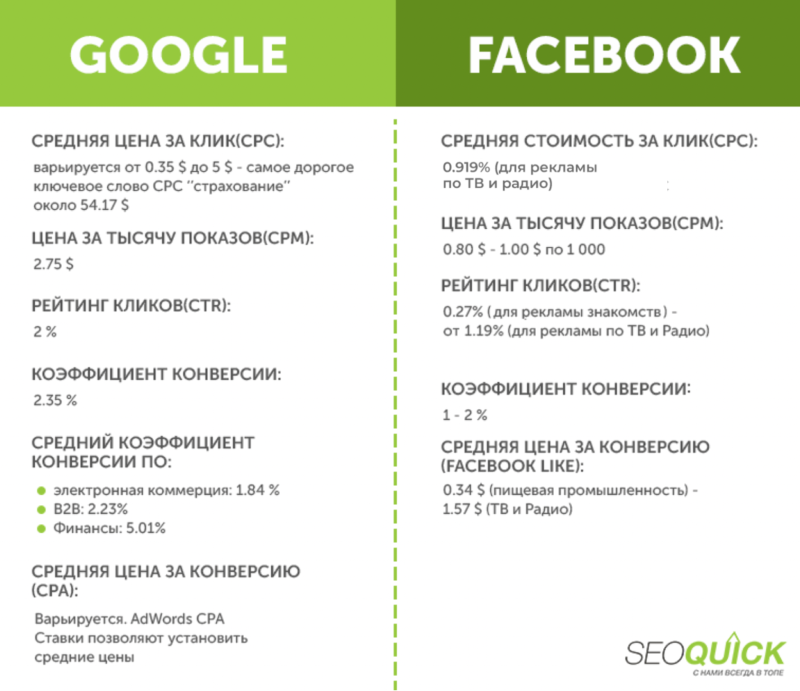
But you may notice that the average CTR in context is many times higher — it averages 2%.
Whereas on social networks it varies from 1% to 0.027%.
Today conversion also varies greatly depending on the social network. Local businesses, for example from Instagram, and online mini-stores have far higher conversions than their equivalent websites.
A barbershop's website may have a far worse conversion than its equivalent Instagram profile.
How the auction works
The third feature is the difference of the auction market.
The auction cost per click on social networks is influenced by many metrics:
- The bid.
- The relevance of the ad text to the advertised topic (site, page).
- The quality of the ad.
- The overall % of activity engaging with the ad.
This is logical — the last factor is connected with the so-called audience "burnout."
Every day your ad gets "stale," and it's liked, discussed less, and people don't want to share it again.
So we recommend refreshing it.
Neil Patel shared this advice. He said that posts burn out after a month, but the same recipe for checking post quality in ads is a simple test of three post variations.
His recipe for successfully refreshing ads on social networks is as follows:
- You make the first creatives as ad posts (which aren't published).
- The first wave of ad creatives is made for a 7-day run.
- You make 3 ads in which several elements differ.
- Over 7 days you note which creative format gave better Engagement.
- Then you delete all the creatives, make a post on social media with the successful creative, and run it as an ad for 28 days. And the next post, which comes out a week later, you run through the creative test.
As a result, you'll immediately be posting content that's interesting to your target audience.
It's precisely this last factor that more strongly affects ranking — and through constant ad refreshing you can achieve a 30% reduction in ad spending at the same performance metrics!
If your social media budgets exceed $10,000 a month, that's serious savings — you can buy a car in a single season!
How to do it? Watch my colleague Alena Polyukhovich's video about Facebook targeting to the end and learn all the nuances of setting up targeting on Facebook.
So it turns out that, in the overall picture — even though you save on clicks, the return on investment ends up being not the most profitable?
That's right.
If you look at the short term, social networks sell poorly in the "here and now" concept. But they have other advantages. More on that in chapter 3.
Advantages of targeting on social networks
Advertising on social networks is less "targeted" than contextual advertising.
Yes, if your laptop breaks, you definitely won't be looking for a repair specialist in the Facebook feed. You'll google the query "service center" + your laptop's name and your city and pick one of the first listings in the results.
So looking for live customers "here and now" on social networks is a thankless task.
And some types of business won't need it at all.
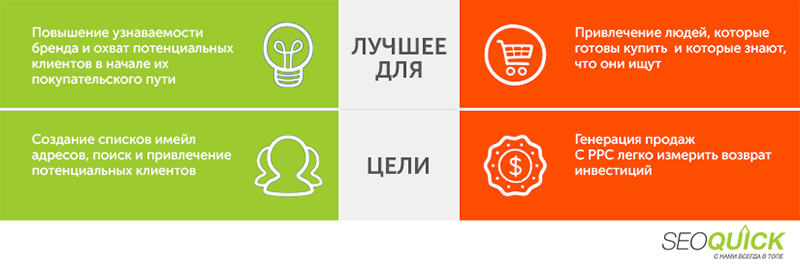
The goal is branding
As you've understood, the social media channel is more oriented toward the following strategies: engagement and informing. You can engage the audience with your business, products, goods, and content. And you can also inform it — about promotions, discounts, offers, new content, and terms of cooperation.
In short, the goals of these ad channels differ.
Targeting on social networks effectively allows you to:
- increase brand influence and the volume of potential audience at the primary sales funnel;
- collect email lists, leads, and raise the audience's interest in your page.
That is, if you remember the sales funnel, the first stage needs to be gathered en masse and cheaply. And social networks handle this task perfectly.
How exactly does your brand's influence grow?
Roughly speaking, there are several criteria you can build up:
- The number of views of your ad posts.
- The number of interactions with your posts (likes, comments, click-throughs, shares — when your post was shared).
- The number of subscribers to your page.
You should know that the Facebook algorithm affected pages in a negative way — now it doesn't matter how many subscribers you have, your posts will be shown in the feed with low priority.
In the case of Facebook, we recommend always running targeted ads to promote your posts — both informational and commercial ones.
And informational ones work much better.
That is, don't try to sell the product.

Instead, make a review of it.
Or just give it some attention.
A review will work better than any ad post!
Why is it important to pay attention to the brand?
First, if you're little-known, people simply won't trust you.
After all, a user often goes to your social media profiles and tries to find reviews about you.
Or they'll write to you in a messenger, asking about the price and timelines.
And they may be put off by a poorly designed page with no content and "dead" subscribers.
Even more off-putting can be "bought" reviews or faked likes.
Second, real readers (subscribers) of your business are the audience you need.
They can ask you questions in the comments under posts, and with your answer you'll win the customer over to your side.
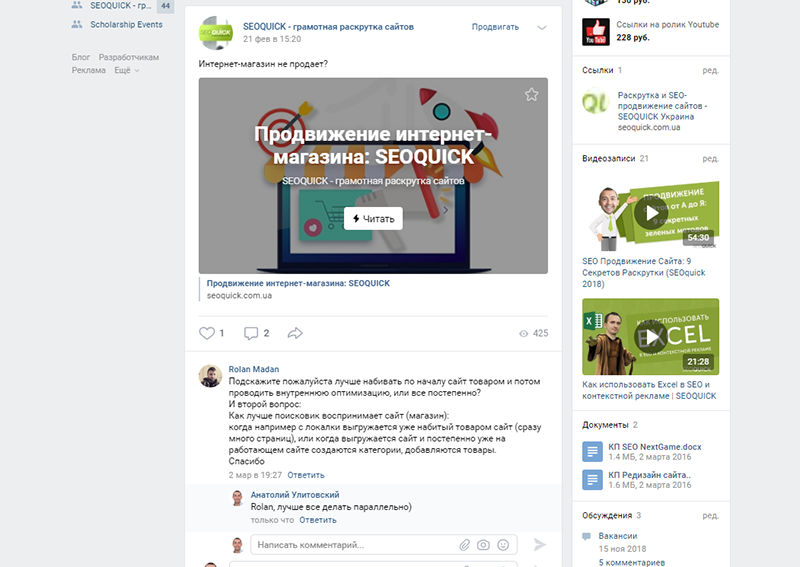
So targeting on social networks (Facebook, Instagram) is a good way to strengthen your brand.
Flexibility in ad delivery
Unlike query-based targeting, social networks work on all users at once who simply fall within your targeting conditions here and now.
For example, you're opening your bicycle shop in one of the districts of London.
You'll make ads, for instance, for locals first of all, who live near you and are interested in a healthy lifestyle.
Then you'll segment the audiences — create the following groups.
For each group you'll show different ads.
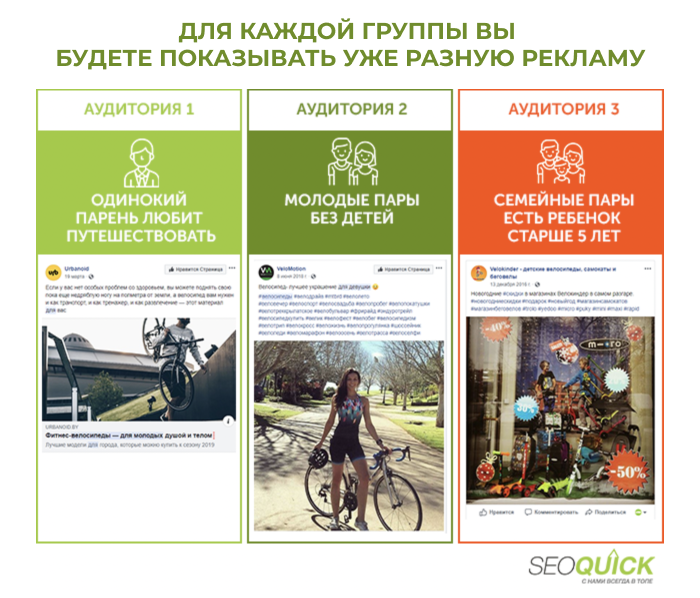
For each of the audiences you'll select several ad offers that
will be maximally useful to them.
Creating ads in the interface of the ad accounts is quite simple and doesn't require complicated actions: you pick the right photo, specify the ad text and the page you'll run the ad to.
And, of course, don't forget about UTM tags.
You'll use them to track traffic sources in analytics.
Ad penetration
Ads in Google can be hidden using utilities like AdBlock.
But on social networks it's simply impossible to get rid of ads. They follow us everywhere.
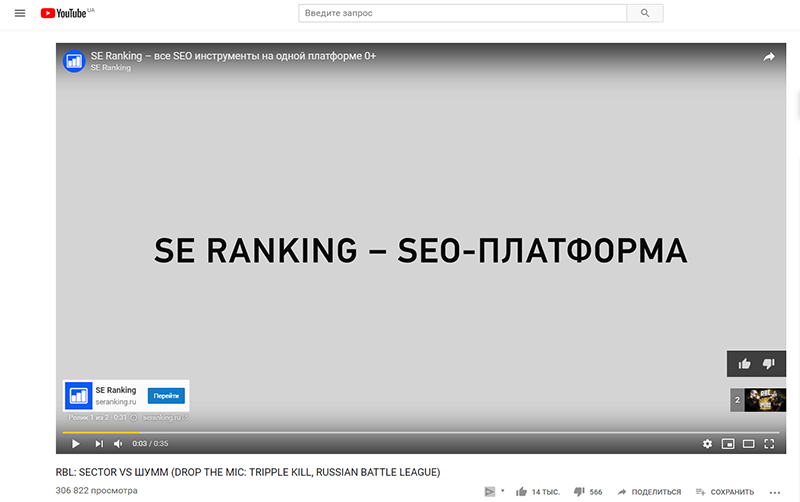
For example, on YouTube, when you try to watch a video, you're greeted by an ad clip that can't be skipped right away.
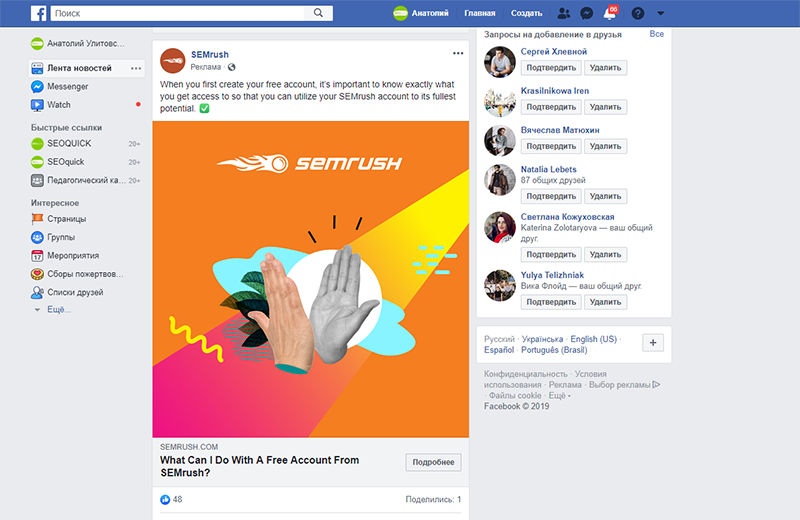
And the third post in the feed is already an ad and offers you to buy something or try it for free.
Everyone also knows Instagram Stories, which came from Snapchat.
Stories on Instagram are also crammed with ads — and such offers are shown quite often.
And in the feed itself, an ad post on Instagram comes second in line!
As a result, the penetration of ad posts on social networks is quite high: whether users want it or not, they'll see your ad.
Positive effect on SEO
A non-obvious advantage that may not immediately catch the eye.
According to Google, social media is not a direct SEO ranking factor.
Rand Fishkin mentioned this in his presentation "The Future of Great Links."
And according to his conclusion, the correlation between social signals and rating position is extremely high.
In fact, there's a lot of evidence that social signals, such as likes and shares, are connected with your rating in search engines and can affect a resource's ranking.
It turns out that social signals positively affect mentions of your brand across the web.
And there are simple ways to do this.
I'll talk about that in the next chapter.
How to make money on targeted advertising?
So, we've understood that targeted advertising is a paid way of attracting traffic to social networks.
But how can it be monetized? And is it worth spending on targeting?
Earning by selling goods and services
As I described above, of course, you can earn by selling goods and services.
Here you should focus on the product you're showing. And first of all — on the content that will complete the formation of the customer's idea about your offer.
But let's imagine that your user knows nothing about you.
What will you show in the ad post?
Of course, the product that's your most advantageous one compared with competitors.
Or content that no one else has an equal to.
In that case, intrigue them, try to attract the audience by any means so they want to study your offer.
And what if they've already visited your site, for example? Know who you are?
Show them the details of your offer!
For example, I know who these guys are — and they chase me with ads about the nuances of earning. The ad offer has more details, numbers, and a clearly spelled-out USP. Usually such ads work in the language of numbers.
And what if they're already your buyers? Or your (current) customers?
Tell them about news and promotions!
Emphasize urgency, value, and the limited nature of the offer.
For example, like here: SERPSTAT simultaneously offers a discount, reports "bad news," and at the same time boosts its sales.
In this case it's very important to properly build the customer funnel and skillfully work out the offer (what you'll propose to them) for each customer.
Earning on subscribers
This means selling photos with ads, mentioning products in videos, paid reviews.
These methods work well for Instagram, TikTok, Facebook, and YouTube.
I'll briefly give the numbers.
Earnings on social networks directly depend on the number of active subscribers.
Those with more than 100,000 subscribers earn from 700 to 900 dollars per photo.
Those who have 500,000 subscribers can get from 2,000 to 3,000 dollars per published photo.
Some might think that for 100 thousand subscribers $900 is catastrophically little.
But this amount can be increased: an Instagram user can earn 5,000 dollars per post in partnership with a brand at the same number of subscribers! But you have to be interesting to the brand for them to start working with you.
As a result, through targeted advertising you drive traffic to your main content, which should hook the audience and turn them into subscribers.
And only then do you advertise goods and services covertly or under an affiliate agreement.
What's the downside of this kind of earning?
First, the products you advertise may not always be of good quality. And if you advertise outright junk, you'll lose subscribers.
Second, there should be little advertising in the videos. Ideally — no more than one insertion.
Third, hidden advertising can play a cruel trick on your subscribers.
For example, for photos in Instagram posts or in YouTube videos in the style of "I tried it, loved it so much" or "this is an honest review of such-and-such cream from the company 'Acme Inc.'"
Everyone expects unbiased opinions from bloggers, and "paid reviews" are immediately met with hostility. People perceive you as opinion leaders, and they'll definitely be upset if they suspect that you recommend not what you like, but what you were paid for.
So this kind of advertising is gradually dying out.
Earning on content
Subscribers on social networks are great, of course.
But when do You earn through a blog?
You need readers, of course.
And we've already reported that social signals positively affect SEO.
So we also apply this method — when we advertise simply content.
Earning on affiliate programs
Most YouTube bloggers start earning money with the help of Google AdSense on their blogs.
YouTube shares 55% of its ad revenue with video creators.
That comes out to about $7.60 per 1000 ad views for the US market. For ours — even less.
To be honest — it's from 0.006 to 0.015 dollars per video view on average. This is not the cleanest kind of earning.
But unlike the first one, you don't "stuff" your content with ad insertions, and instead focus simply on creating content.
But the magic of small numbers works at large multipliers: the most famous blogger, PewDiePie, earned 15 million dollars in 2016!
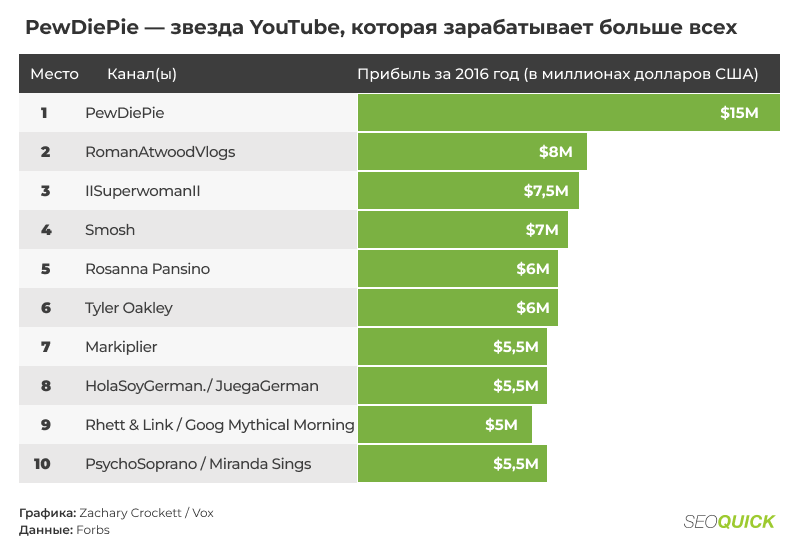
Many bloggers who simply make quality content earn good money on AdSense. Here, of course, you need to be not a niche blogger, but one oriented toward a mass audience.
And this type of earning will only suit those who don't tie their work to customer service — because in that case you risk your competitor's ads being shown on your channel.
Earning through affiliate networks
A type of earning that has become popular now is CPA networks. These are affiliate programs where traffic is attracted from sites that place targeted advertising.
So, there are affiliate programs that attract traffic exclusively from social networks: they set up targeting from Facebook and Instagram to created landing pages and collect leads there.
The mechanism is mainly as follows.
The advertiser initially places a request in the affiliate service.
Then they create the ad posts they'd like to promote in the affiliate service.
The affiliate program itself launches targeting on social networks and can combine this with seeding posts across public pages.
This way the advertiser gets completed lead requests within the affiliate program. These can be contact data, app installs, and so on.
The advertiser pays for actions, the affiliate program earns on commission.
Earning on traffic arbitrage
Traffic arbitrage is a special way of using purchased traffic in one channel for the purpose of funneling or reselling it to another channel. It lets you get around the problems of ad moderation on social networks when you can't set up ads directly. And here, building a funnel of traffic channels helps.
We're currently working with projects involved in cryptocurrency exchanges, and we need people on one of the projects to want to click through referral links.
You simply can't run ads directly to a referral link. Moderation won't let it through.
But you can create a YouTube channel, launch a section teaching trading for beginners, where you explain the mathematical fundamentals of trading, how and why certain schemes work, and show it in simple terms. Content like this will pass moderation.
And then simply start advertising individual videos from this channel, aimed exclusively at gaining subscribers.

For example, this video was aimed at gaining subscribers, and targeted advertising was run to one of them, by the main target audience — men 20-40, the countries Bangladesh, Nepal, India. The video was shot in English (but the descriptions and video were traditionally translated into English. Instructions are in the article YouTube video promotion).
In the videos themselves, the trader needs to mention that they have other channels (for example, Telegram or another YouTube channel where they run trading sessions and share tips), and the right people will then reach them out of the mass audience.
The resulting traffic can be safely resold, for example — by funneling traffic from it to referral links and earning on them.
In fact, you don't sell any services, but you earn. That is — you sell traffic. You don't even collect anyone's contact data, which makes your life easier.
Targeted advertising here will be aimed at broad audiences across the project, since you'll need to look for those interested at the very top level of the interest funnel. After all, even if you promote a blog through organic reach on social networks, targeting will help very well in the early stages.
Why is this type of advertising better than earning on subscribers? The audience and topic a specific blogger promotes are niche. It's not a travel blogger advertising yet another course aggregator, but a trader who teaches traders, trades themselves, and reveals secrets. The effectiveness of their audience will be far higher.
Secrets of successful targeting on social networks
In this chapter I'll tell you about the tricks that only experienced marketers know and skillfully use in setting up targeted advertising on social networks.
Before choosing ads on social networks, we always face a number of questions.
For example, what to write in the ad post?
Which ad post format to choose?
Where should you even start with targeting?
After all, you can have a great idea, a good product or content, but inept targeting can simply drain your money to zero.
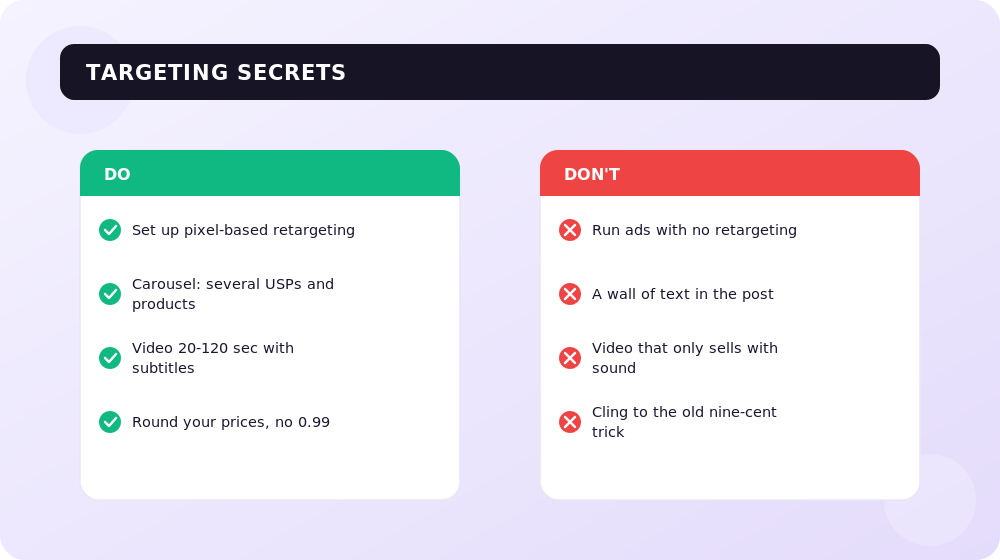
The carousel as a way to show more information
In an ad offer you want to dump a huge wall of text all at once.
But studies have shown that users read no more than 2 lines of an ad post.
And after that they decide whether to let their gaze rest or scroll further down.
But it's known that if there are many images in a post, they'll try to study several of them.
And the carousel comes to the rescue.
This type of targeting is available only for ad posts — you can't create a regular post in carousel format.
In a carousel you can show several products or concentrate on several USPs, dedicating a separate photo to each USP.
The carousel display format is available for both Facebook and Instagram.
Use video
Video advertises very well. Video advertising works excellently for branding.
But you need to approach it very creatively too.
First, the ad must sell without sound. For this, use subtitles.
Second, the clip should be short (no longer than 2 minutes, but no shorter than 20 seconds).
Third, the clip should continue the teaser text written in the body of the post.
And yes, you must skillfully load all the intrigue into the clip:
- The benefit.
- The interest in watching.
- What needs to be done to become a customer / get the offer.
Demos work better than paid versions
The best customers are those who tried your service.
If you offer a product on a Freemium plan, emphasize this.
Distribute the product for free through targeting.
People willingly share everything that's free. And they try any product they don't have to pay money for right away. So targeting is the ideal way to advertise products distributed through trial periods, offering free installation or a limited demo version of the product.
Remarketing (or retargeting) is the king of sales
The best audience on social networks is the one that knows about you.
So if you've read this far, ask yourself — do you have retargeting set up?
If so, write in the comments which method you use.
If not — just follow these links.
For Facebook and Instagram, go to the Business account in Pixels, create it, and install it on your site.
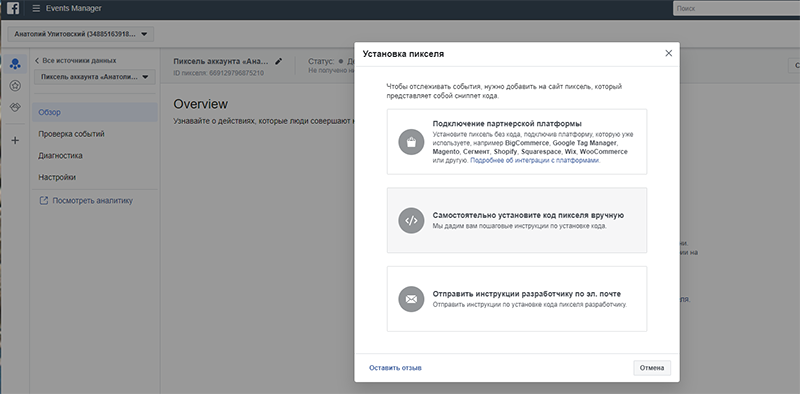
Then go to the AUDIENCES section and create an audience based on site visitors.
Use the created audience to promote posts on Facebook and Instagram publications.
You're guaranteed not to drain money for nothing.
The rule of thirds
In ad design there's a long-standing rule that all objects should fit neatly into block grids if you virtually divide the image evenly into three parts vertically and three horizontally.
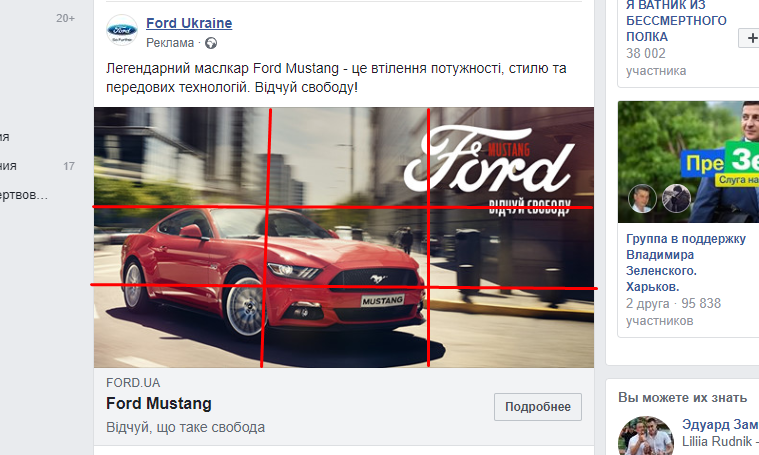
I checked it on a number of posts by large companies, and yes — this trick is present in many ad publications.
$0.99 doesn't work
You should remember that everything gets stale. The trick of the '80s, which wore out its welcome on price tags with endless nines, is morally obsolete and no longer works on the audience.
Everyone is in a hurry now, wants to be concise.
So round your prices, don't try to think in old templates.
This one cent won't make the difference, but it'll wreck sales.
For example, this is clearer, and 799.99 would simply be out of place here.
Conclusions
Targeting on social networks is the most powerful tool for getting inexpensive traffic, but unlike contextual advertising, here you can't get sales head-on right away.
We recommend taking the social media channel seriously, taking into account its features and advantages.
- It's important to skillfully build the sales funnel and show different content depending on the audience. The higher up the funnel, the less you need to sell and the more you need to inform.
- Use each system's targeting capabilities. Sometimes it's appropriate to promote videos, sometimes product carousels. Sometimes — posts with links. Unlike regular posting, the targeting account's toolkit is wider than that of the public page itself.
- Always use remarketing (retargeting). Bringing the audience back is the most profitable way to work with targeting.
- Approach the choice of branding strategy wisely. Try to focus most of the budget precisely on it and segment the brand work depending on the target audience segments. What's appropriate to show one audience, show only to it. And don't show it to another.
- Constantly refresh your ads. Unlike context, the ad-refreshing trick lets you reduce ad spending by up to 30%!
If your ads on social networks aren't working, write in the comments why. We'll try to answer your questions in our YouTube videos.
Facebook Targeting 2026: Step-by-Step Setup Scheme and Strategy
How to set up targeted advertising on Facebook and Instagram in 2026: Advantage+ audiences, the Andromeda AI algorithm, privacy, placements, and budgets. A step-by-step guide from SEOquick.
Read →
Broken Links and Redirect Chains: Clearing 3XX, 4XX and 5XX Without Bleeding Link Equity
Broken links and extra redirects quietly steal traffic, crawl budget and link equity — and they push your pages out of AI answers. Here's what actually goes wrong and how to get your hops down to zero.
Read →
Stop blogging for the sake of blogging: launch AI tools that earn SEO traffic and leads
Why endless articles no longer work the same way and how to create AI tools, calculators, and interactive pages for SEO, GEO, and conversion.
Read →Want to apply this to your site?
We will review the current situation, find the first growth levers, and suggest a practical working format.