SEO Trends 2026: 10 Changes You Need to Prepare For Right Now
Search in 2026 is no longer a list of ten blue links. AI Overviews appear on nearly half of all queries, two-thirds of searches end without a click, and ChatGPT has become the largest source of AI traffic. Here are the 10 changes businesses need to prepare for right now.


The main SEO trend of 2026 is that search no longer guarantees a click. AI Overviews show up on roughly 48% of Google queries, 68% of searches end without a visit to a website, and traffic from ChatGPT and other AI assistants is growing at triple-digit rates. The winners are not those chasing position №1, but those the AI chooses as a source.
Every year on the SEOquick channel we break down what has changed in search. But 2026 is special: for the first time in 25 years, the rules are being rewritten not by yet another Google update, but by the format of the results page itself. Below are 10 trends already affecting your traffic, with numbers and sources.

1. AI Overviews became the default search
A year ago, AI answer blocks above the organic results were an experiment. Now they are the norm: according to BrightEdge, AI Overviews presence grew 58% over the year and reached ~48% of all queries (up from 31% in February 2025). In some niches the reach is off the charts: healthcare — 88% of queries, education — 83%, B2B technology — 82%.
The takeaway is simple: if your topic is informational, an AI answer almost certainly sits above your links. Fighting for the "blue ten" is no longer enough — you need to get into the block itself. We covered how to do that in detail in our piece on GEO optimization for GPT.
2. Zero-click passed 68%
Search increasingly resolves the task right on the results page. According to research by SparkToro and Similarweb (June 2026), in the first four months of 2026, 68% of Google searches ended without a single click — versus 60.45% in 2024. That is the sharpest two-year jump in the entire history of the metric.
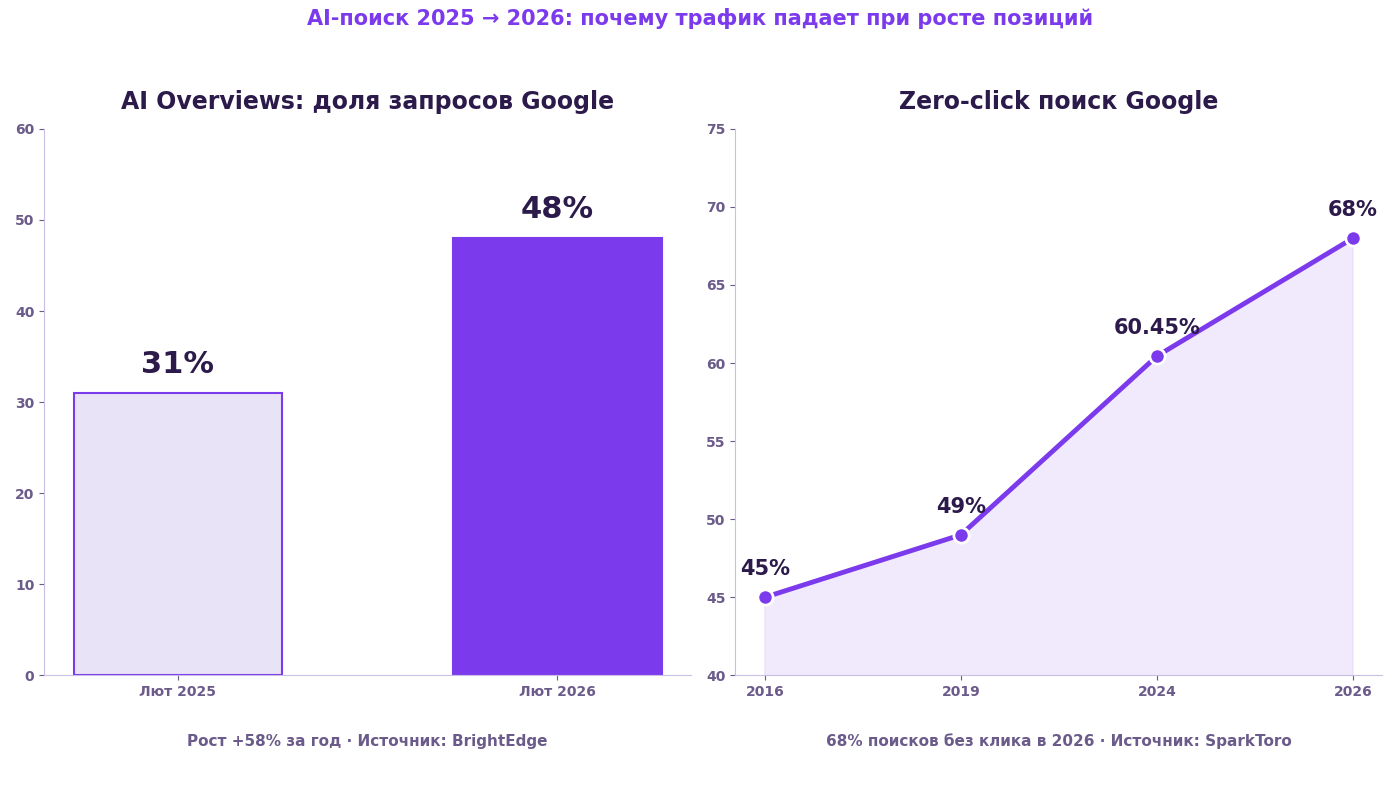
For business this means the "rankings" metric is decoupling from the "traffic" metric. You can hold the top 3 and still lose clicks. That is why branded queries and presence inside the answers themselves matter more and more.
3. ChatGPT is the largest source of AI traffic (and it converts)
ChatGPT crossed 900 million weekly users (February 2026, up from 400 million a year earlier) according to TechnologyChecker. Outbound traffic from ChatGPT to third-party sites grew 206% in 2025, and it converts better than classic organic — around 7.1% versus 2.8%.
In the December breakdown I put it this way:
"The largest traffic to any site today comes from ChatGPT — by our internal client data it is the №1 platform by referral volume. And we expect OpenAI to start monetizing free users with ads in 2026 — that will reshape the entire paid-search landscape."
Practical step: learn to track this traffic. Referrals from ChatGPT arrive with the utm_source=chatgpt.com tag; Gemini and Perplexity have their own. If you don't see them in analytics, you aren't managing the channel.
4. Google AI Mode went from experiment to mainstream
AI Mode — a separate mode where Google works like a chat — went international in October 2025 (35+ languages, 40+ countries) and crossed a billion monthly users. According to Digital Applied, up to 93% of AI Mode sessions end without an outbound click, and ads already appear in ~25% of AI results.

5. Entities matter more than keywords
Gemini 3 with automatic routing of complex queries changed the ranking logic. Here is how I explained it in the December digest:
"Now the system itself routes complex multi-step queries to a more powerful model. Which means it pulls in pages that were never in the top 10 of ordinary search. For SEO this is a signal: you have to work on the basis of the brand entity, not just on keywords."
Entity SEO is about making the AI understand who you are, what you do and why you can be trusted. The brand name, consistent expertise in one topic, mentions on authoritative platforms — all of this weighs more than keyword density.
6. First-position CTR collapsed
When an AI block sits above the organic results, people click them noticeably less. According to industry research in 2026, the CTR of the first position on queries with AI features fell from roughly 27% to 11%, and across informational categories the drop reaches 38–58%.
This is not a reason to give up but a reason to reset expectations: traffic targets should be counted separately from ranking targets, and the bet should go on commercial-intent queries where the AI block appears less often.
7. Brand and mentions are the new link factor
The paradox of 2026: links work, but they are increasingly invisible. AI systems lean more and more on brand mentions — even without a clickable link. According to research, brands cited inside AI Overviews earn 35% more organic clicks and 91% more paid clicks on the same queries.
What to do: build recognition through PR, expert publications, reviews and presence where the AI sources its data (including Reddit and niche platforms). A branded query is a trust signal the AI reads directly.
8. Search Console gained AI tools
Google built AI right into Search Console. In the December breakdown I highlighted three long-awaited features:
"The Brand Query Filter automatically separates branded and non-branded traffic — something we used to do with complex filters. Custom annotations let you log updates and migrations right in the console. And Query Groups is AI clustering of queries. I had been waiting for it for a long time."
For the specialist this means part of the manual analytics goes away, but there is now a need to reconfigure reports and explain new metrics to clients.
9. The 2026 core updates reward experience and originality
The March and May 2026 core updates rewrote the weight of the Information Gain signal — how much genuinely new value your content adds compared to what already ranks. According to the breakdown by Evertune, the focus is on three properties: information originality, verifiable author expertise and topical coherence of the domain.
AI content is not penalized as such. What gets hit is mass generation without editorial oversight. As I said in December: "Google will penalize low-quality content, and mass AI generation with no substance will be in the crosshairs." The answer is real author experience, numbers, your own data and author pages as part of E-E-A-T.
10. Ads are getting more expensive — post-click beats traffic
A trend from the paid channel, but it affects the whole strategy. Black Friday 2025 revealed a paradox: spend on paid search rose 17% year over year, while impressions fell. Visibility got more expensive. In 2026 high bids persist.
The conclusion: buying even more traffic is a dead end. It is more important to optimize the post-click — working with those who already arrived: response speed, UX, work with your existing base. This converges with SEO: in both, the winner is the one who retains the user, not just brings them in.
What to do about all this right now
If we boil the 10 trends down to one action: stop optimizing only for the algorithm and start optimizing for trust — of the user and of the AI. Specifically for the coming quarter:
- Convert key pages to the answer-first format: a direct answer in the first 2–3 sentences.
- Set up AI traffic tracking in GA4 (ChatGPT, Gemini, Perplexity, Claude).
- Strengthen your brand entity: author pages, expert mentions, topical consistency.
- Count traffic goals separately from rankings and build zero-click into your forecasts.
- Don't cut corners on content quality — mass generation is now a risk, not a saving.
We keep an ongoing breakdown of search changes and update it on our blog, and you can go deeper on the AI side in our guide to GEO optimization for GPT.
Frequently Asked Questions (FAQ)
Does SEO still work in 2026?
Yes, but the outcome has changed. Classic SEO is now the foundation, with AEO (answer engine optimization) and GEO (generative engine optimization) working on top of it. A site without a technical base and AI trust simply won't be cited.
What matters more in 2026 — rankings or getting into AI answers?
Both, but the link between them has weakened. You can be at the top and lose traffic to AI Overviews. So you need to aim simultaneously at organic results and at citations inside AI blocks.
Should you allow AI crawlers on your site?
If you want traffic from ChatGPT, Gemini and Perplexity — yes. A site closed to GPTBot and similar bots won't appear in their answers. This is controlled via robots.txt.
Does Google penalize AI content?
No, not for the mere use of AI. Sanctions hit low-quality content without editing and original value — regardless of whether it was written by a human or a machine.
How do you measure traffic from AI?
By the UTM tags of the sources (for example, utm_source=chatgpt.com) in GA4 and by separate segments in reports. Each assistant has its own tag.
H1 vs Title: how many H1 tags you need and how they differ
H1 in SEO 2026: how many H1 headings are acceptable, optimal length, how it differs from title, empty H1 and H1 as an image. Based on a measurement of 77 pages from the Ukrainian top and data on how often Google replaces your title with the H1.
Read →
Pagination SEO: how to index list pages without breeding duplicates
Pagination SEO in 2026: canonicals on list pages, noindex, rel=next/prev, infinite scroll, crawl budget. Based on a check of 36,000 traffic-driving URLs across twelve Ukrainian retailers, plus a teardown of pagination at Foxtrot, Epicentr and our own blog.
Read →
URL Structure: The Full Guide to Addresses You Can't Change After Launch
How to get URLs right: transliteration or Cyrillic, slug length, duplicates from case and filters, pagination, UTM tags, redirect maps. A breakdown of Rozetka, Comfy, Prom and Makeup URLs plus 2026 research data.
Read →Want to apply this to your site?
We will review the current situation, find the first growth levers, and suggest a practical working format.