SEO in 2026: The Complete Guide to Promoting Your Website
Search has split into three layers: classic results, AI Overviews, and AI Mode. This guide is a map of the entire SEO process in 2026 — from keyword research and technical work to getting cited in AI answers, with numbers from our own projects.


SEO in 2026 is no longer about “getting a site into the top 10 for a list of keywords.” Google shows an AI-generated answer right above the classic results, more than half of all searches end without a single click, and some of your future customers aren’t searching on Google at all — they’re asking ChatGPT.
At the same time, organic search remains the most cost-effective channel for most businesses: it still brings in people with a specific need rather than a “cold” audience. It’s just that the rules by which that traffic gets distributed have changed more than in any other five-year period in the history of SEO.
I rewrote this guide from scratch. Here is the full picture: how search works now, what to do about keyword research, technical SEO, content, and links, how to get into AI answers, and how to measure results. With numbers from recent studies and our own case studies.
In short: what is SEO in 2026? SEO is the set of activities that makes a website the best answer to users’ queries: keyword research and site structure, technical optimization, expert content, and authority built through links and brand mentions. In 2026 the goal is twofold: rankings in Google’s classic results and citations in AI answers (AI Overviews, AI Mode, ChatGPT) — both zones bring in customers.
How Google Search Works in 2026
Before optimizing anything, you need to understand what you’re aiming at. Today Google’s results page consists of three layers, each with its own mechanics.
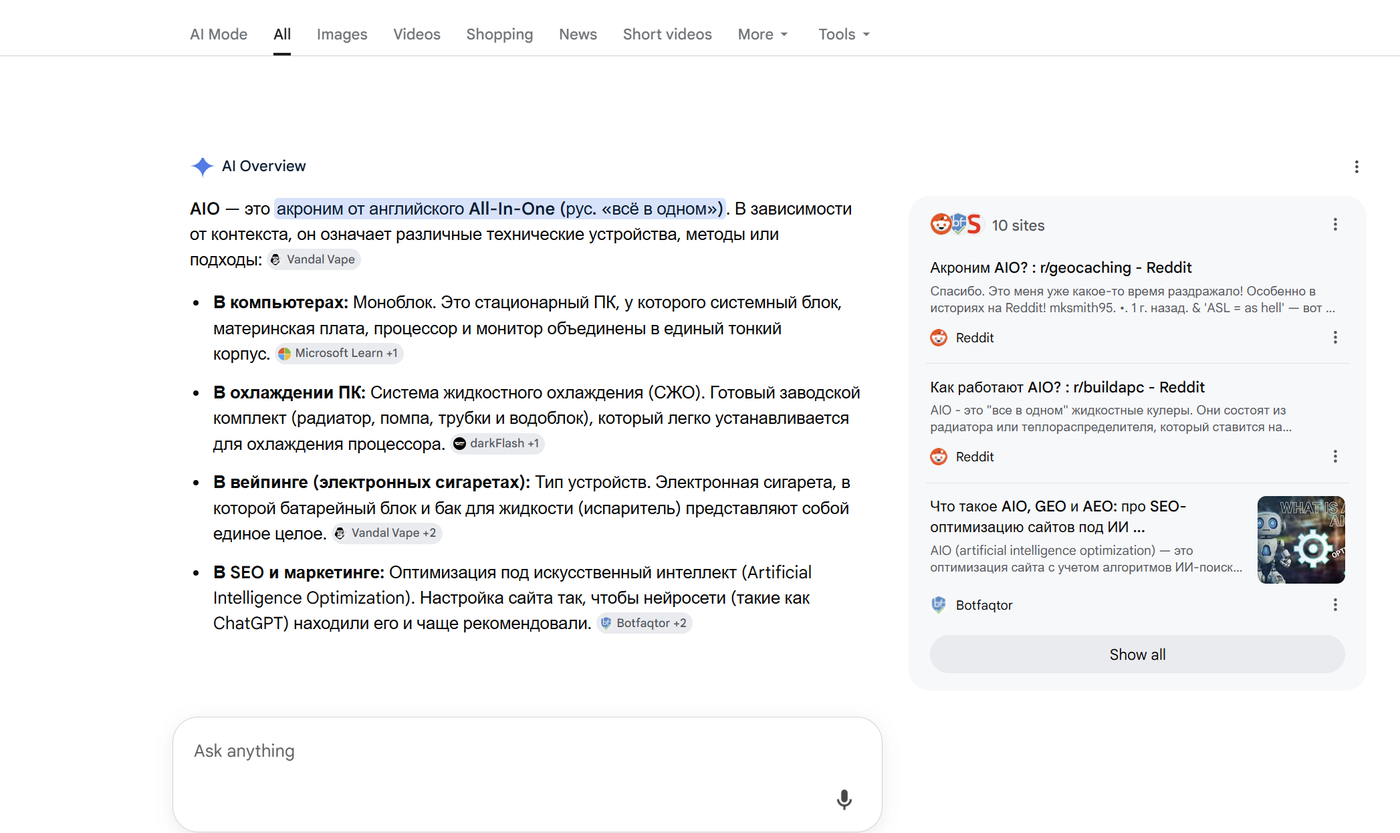
The Three Layers of the SERP
Classic organic results — ten blue links, maps, snippets, videos. They haven’t gone anywhere and still deliver the bulk of traffic. All the foundational work — keyword research, content, technical SEO, links — serves this layer.
AI Overviews — a generated answer above the search results with links to sources. According to BrightEdge, by early 2026 an AI answer appears for nearly half of tracked commercial queries; Semrush’s more conservative methodology puts it at 15–25% of all queries. Either way, this is no longer an experiment but a permanent element of the SERP — especially for informational and how-to queries.
AI Mode — a separate chat tab in Google Search powered by Gemini: the user asks a question, refines it, compares options — and gets a detailed answer with links to sources. According to Google, AI Mode passed the one-billion-monthly-users mark in its first year. It’s a full-fledged conversational search inside Google with its own visibility rules — more on those in the GEO section.

How Google Ranks: The Mechanics in Brief
Beneath all three layers lies a single three-stage pipeline:
- Crawling. Googlebot follows links and sitemaps to discover pages. If a page is unavailable, responds slowly, or is blocked in robots.txt, it won’t make it any further down the pipeline.
- Indexing. Google renders the page, evaluates its quality, and decides whether to include it in the index. This stage is no longer a formality: weak content today simply doesn’t get indexed.
- Ranking. Hundreds of signals — relevance to the query, content quality, site authority, user experience, links and mentions — determine the position. The AI layer works on top of the same index: the Gemini model picks sources for its answers mostly from documents that already rank highly.
Several times a year Google rolls out core updates — large-scale revisions of how quality is assessed. After each one, some sites rise and others fall. The healthy response to an update is not to “roll back the changes” but to compare your content against what started ranking higher: the updates of the past two years have consistently rewarded sites with real first-hand experience and punished templated AI generation.
Zero-Click Is the New Normal
A zero-click search is a query after which the user doesn’t click on any result: they got their answer right on the results page.
The numbers are telling. According to a Semrush study (2025), 58.5% of searches in the US end without a click. For queries with AI Overviews it’s harsher: per Seer Interactive, organic CTR on such queries dropped 61% — from 1.76% to 0.61% by late 2025 — and only began recovering to ~2.4% in early 2026.
But hidden in the same statistics is the biggest opportunity of the year: brands cited inside an AI Overview get, according to Seer, roughly 35% more organic clicks than uncited competitors on the same queries. The AI answer takes clicks away from those who aren’t in it and gives some back to those who are.
What This Means for Strategy
- Measure business results, not rankings: traffic, leads, sales, visibility in AI answers.
- Top-of-funnel informational queries (“what is X”) have been almost entirely consumed by AI answers — you can no longer bet on them as a primary traffic source.
- Commercial and transactional queries are still clickable: when someone is ready to buy, they need a website, not a summary.
- AI citability is a new KPI on par with rankings. It’s not “instead of SEO” — it’s an extension of it.
Keywords and Intent: The Foundation Hasn’t Changed
A semantic core (keyword map) is a structured list of the queries a site should be found for, grouped by meaning and mapped to pages. Every project starts with it, and in 2026 that’s still true — what’s changed is how queries are analyzed.
The Four Types of Intent
Intent is the purpose behind a query. The classic typology still works:
- Informational — “how to choose a boiler”: the person is researching the topic. Content: articles, guides, videos.
- Commercial (investigational) — “best gas boilers 2026”: they’re comparing options. Content: reviews, rankings, comparisons.
- Transactional — “buy Vaillant boiler Kyiv”: ready to purchase. Content: categories, product pages, service pages.
- Navigational — “rozetka boilers” (Rozetka is Ukraine’s largest marketplace): they’re looking for a specific site.
The biggest mistake is promoting a category page for an informational query, or an article for a transactional one. Google detects intent more accurately than any SEO tool: look at which page types occupy the top 10 — that is the answer to what kind of content you need.
What’s Changed in Keyword Research
The basic toolkit is the same: Google Keyword Planner, Ahrefs, Semrush, Serpstat, Search Console. But in 2026, three mandatory layers of analysis have been added.
- Question queries and conversational phrasing. People carry their chat habits into search: queries are getting longer and more specific. People Also Ask blocks and autocomplete suggestions are a direct source of such phrasing. According to Google, about 15% of daily queries have never been entered before — the long tail is endless, and it’s precisely what triggers AI answers most often.
- Checking what the SERP actually shows. For each cluster, record: is there an AI Overview, which SERP features are present, who is in the top. A query with an AI answer and a query without one are different channels with different click economics.
- Keywords for AI visibility. Separately collect the questions your customers ask ChatGPT and AI Mode: “which service should I choose for…”, “X or Y — which is better.” Your site needs direct, citable answers for these queries.
Competitors as a Keyword Source
The fastest way to build a working keyword map is to dissect those who already get the traffic. The algorithm:
- Identify 3–5 real search competitors: enter your main queries and see who is consistently in the top. These aren’t always the companies you consider business competitors.
- Export their keywords via Ahrefs, Semrush, or Serpstat and filter for relevance to your offering.
- Find the overlap: queries where two or three competitors rank and you don’t. That’s a ready-made content and structure plan.
- Separately, look at their highest-traffic pages: their format will tell you what kind of content Google considers the best answer in your niche.
Supplement the picture with your own Search Console data: the Performance report shows queries where your site already gets impressions without clicks — the cheapest growth opportunities, because the ranking is already there; only the position or the snippet is missing.
Clustering and Site Structure
The rule hasn’t changed: one query cluster = one page. Cluster by SERP overlap (queries whose top 10 results intersect point to the same page), build a hierarchy of “section → category → subcategory → page,” and lay out the structure before the site is built, not after.
In 2026 a topical completeness requirement has been added: Google and AI models assess how fully a site covers a topic. Five deep, interlinked pages on one topic work better than twenty scattered articles on different ones.
Technical SEO: The Base Without Which Nothing Takes Off
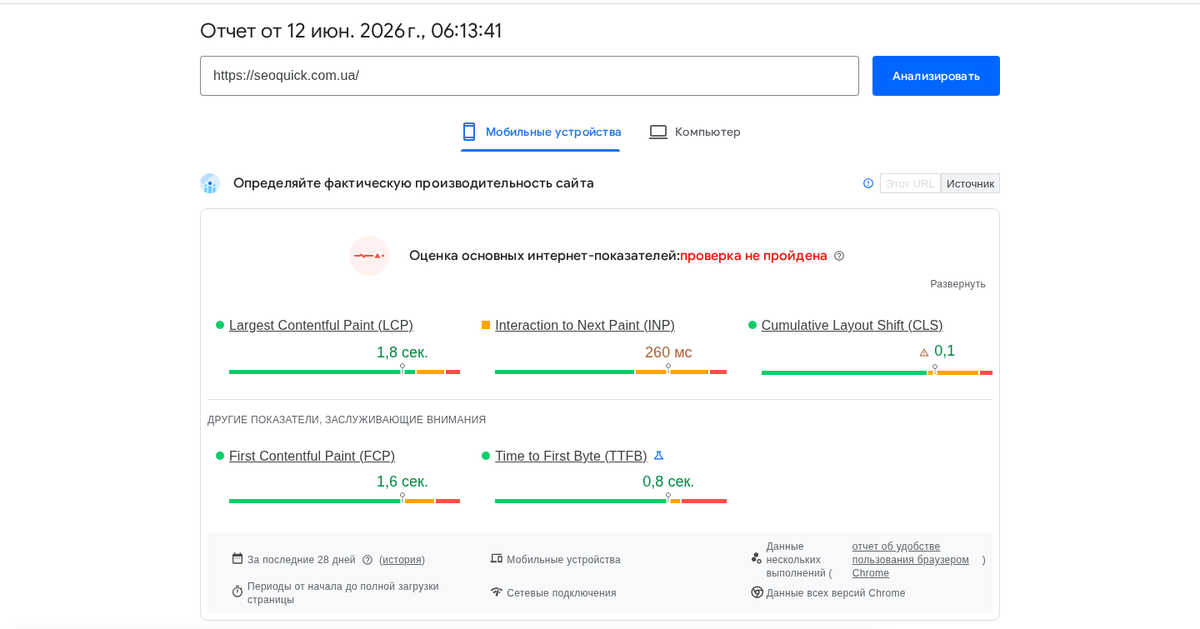
Technical SEO is the work that ensures correct crawling, indexing, and fast page delivery. It won’t push weak content to the top, but a technical pit will sink even the best content.
Core Web Vitals and INP
Core Web Vitals are three user experience metrics Google factors into rankings:
- LCP (Largest Contentful Paint) — how fast the main content renders. The threshold is 2.5 seconds.
- INP (Interaction to Next Paint) — how responsive the page is to user actions. The threshold is 200 ms. INP replaced FID in March 2024 and turned out to be noticeably stricter: it measures all interactions on the page, not just the first one.
- CLS (Cumulative Layout Shift) — visual stability: nothing should “jump around” while loading.
Fresh HTTP Archive data (Web Almanac 2025) is sobering: only 48% of mobile pages pass all three metrics, and among the world’s thousand most-visited sites only 53% pass INP — heavy JavaScript and third-party scripts choke responsiveness precisely on large projects. For a mid-sized business, that’s a real chance to beat bigger competitors at least on the technical front.
Where to check: PageSpeed Insights (page by page) and the Core Web Vitals report in Search Console (site-wide, based on real user data).
Typical culprits: unoptimized images (LCP), third-party chat, analytics, and widget scripts (INP), banners and fonts without reserved space (CLS).
Indexing and Crawl Budget
The minimum mandatory set:
- Sitemap.xml — up to date, free of 404s and redirects, submitted to Search Console.
- Robots.txt — doesn’t block what’s needed, does block the junk: on-site search, duplicate filter pages, the cart.
- Canonical URLs — on every page; in e-commerce with filters and sorting, this is critical.
- Index hygiene — regular audits of the Page Indexing report in GSC. A growing “Crawled — currently not indexed” section is the main symptom of quality problems: Google sees the content but doesn’t consider it worthy of the index.
- Server response time — TTFB under 600 ms; on large sites this directly affects crawl completeness.
A distinct 2026 item: accessibility for AI crawlers. GPTBot, ClaudeBot, PerplexityBot, and other LLM bots don’t execute JavaScript the way Googlebot does. If key content renders only on the client, it doesn’t exist for AI search. Critical content must be served as HTML from the server (SSR or prerendering). And check your robots.txt: many sites blocked AI bots “just in case” back in 2023–2024 and are now invisible in ChatGPT and Perplexity.
Duplicates, Redirects, Multilingual Setup
Three technical areas that yield the most findings in audits:
- Duplicate content. Versions with and without www, with and without trailing slashes, pagination and filter pages, print versions, UTM-tagged URLs in the index. Every duplicate dilutes signals across copies. The cure: 301 redirects to the canonical version, the canonical attribute, and blocking technical parameters.
- Redirects and broken links. Chains of 2–3 redirects eat crawl budget and slow loading; internal links to 404s leak authority. Run the site through a crawler (Screaming Frog, Netpeak Spider) quarterly and clean up.
- Multilingual setup. For multilingual markets like Ukraine this is fundamental: language versions (for example, Ukrainian and Russian) must be connected with correct hreflang, and each version must be self-sufficient and indexed. hreflang errors lead to the wrong language version appearing in the SERP and cannibalization between languages.
Mobile
Google indexes the mobile version of your site — period. If part of the content is hidden on mobile, category texts are truncated, or the menu doesn’t work, it’s that stripped-down version that ranks. Review the site through a mobile user’s eyes at least quarterly: speed, readability, tap targets, forms.
Content and E-E-A-T: Experience First
E-E-A-T is Google’s content quality framework: Experience, Expertise, Authoritativeness, Trustworthiness. It’s not a direct ranking factor but a set of signals by which algorithms and quality raters distinguish living expertise from a retelling.
Why Experience Came First
Google added the first “E” (Experience) in response to the wave of generative content. AI can competently retell everything already written on the internet. What it can’t do is run its own test, photograph a process, cite numbers from its own project, make a mistake and tell the story of that mistake.
That’s why content that works in 2026 is built on what neither competitors nor a neural network have:
- proprietary data: research, surveys, statistics from your own projects;
- real case studies with before/after numbers;
- first-hand experience using what you write about;
- opinions backed by arguments, not a vague “it all depends”;
- photos and videos of your own production, product, or process.
This also answers the AI content question. You can use neural networks in content production — Google explicitly says it evaluates usefulness, not the method of creation. AI is great for drafts, outlines, rephrasing. But “generate 50 keyword-targeted articles and publish them” is a strategy that, after the series of 2024–2025 core updates, consistently ends in collapse: the helpful content classifier hits the entire site, not individual pages.
Authorship and Trust Signals
Every piece must have an author — a real person with a bio page, photo, credentials, and links to profiles. In YMYL topics (medicine, finance, law) this is critical: add an expert review, cite data sources, and show the update date.
Site-level trust signals: an About page, contact details with a physical address and phone number, a return policy for e-commerce, HTTPS, reviews. Banal? Yes. But half the sites we audit fail at this.
SEOquick’s experience. We grew an English-language weight-loss content project (US market) from 100,000 to 700,000 visits per month in 6 months — a 7x increase in a hyper-competitive YMYL niche. The bet on E-E-A-T is what worked: real authors with expertise, original reviews instead of rewrites, systematic article updates. The site entered the US top 75 in the Health/Nutrition category on SimilarWeb. Details in the case study: promoting an English-language review site.
Content Refreshes: The Most Underrated Work
Content ages: data goes stale, competitors publish fresher material, AI models prefer to cite current sources. A regular refresh cycle is the cheapest source of growth for a site with history:
- Quarterly, export pages with declining traffic from GSC.
- Update the data, add missing subtopics (check PAA and the SERP), remove what’s outdated.
- Update the modified date — and, for substantial reworks, the title too.
- Reinforce the refreshed page with internal links.
In 18 years of work we’ve learned: reworking an old article brings traffic back faster and cheaper than creating a new one from scratch — the page already has history, links, and rankings that just need to be revived.
Formats and Cadence
Don’t fixate on articles. The same expert material is worth unrolling into several formats: a long-read on the site, a video on YouTube (which Google also shows in the main SERP), short takeaways for social media. Video also keeps visitors on the page and provides an extra entry point from the world’s second-largest search engine.
On cadence, the rule is simple: a steady 2–4 strong pieces a month beats a salvo of 20 articles every six months. Search engines and AI models assess how “alive” a source is, and an editorial pipeline with a constant tempo disciplines both the team and the quality.

On-Page Optimization
On-page optimization means tuning the elements of the page itself for queries and for user convenience. There’s no magic here — only discipline.
Title, Description, Headings
- Title — up to ~60 characters, the main keyword near the beginning, no spam or all-caps. It’s still one of the strongest on-page signals and at the same time your “ad” in the SERP: CTR depends on it.
- Description — 130–155 characters, a concrete benefit plus a call to action. Weak effect on rankings, strong effect on clickability.
- H1 — one per page, aligned with the title but not duplicating it verbatim.
- H2–H3 — a logical structure; put the topic’s real sub-questions into subheadings (the same phrasings as in People Also Ask).
Content Structure for Humans and for AI
The requirements of humans and language models have converged: both need short paragraphs, direct answers, and clear structure. Practical rules:
- the first screen answers the page’s question instead of “warming up” the reader;
- definitions in the “X is…” format — these are exactly what AI Overviews and regular snippets extract;
- lists and tables for enumerations and comparisons;
- one semantic block = one subheading, and the block is self-contained: understandable without reading the whole page.
Internal Linking
Internal links are SEO’s most underused tool. They pass authority, aid indexing, and distribute traffic. The rules: every important page is reachable within 3 clicks from the homepage; contextual links with meaningful anchors work better than “related articles” blocks; a new page immediately gets 3–5 internal links from older relevant ones.
Images
Images are an underrated source of both traffic and problems. The rules: modern formats (WebP/AVIF) and compression without visible quality loss; explicit width/height so the layout doesn’t jump (CLS); lazy loading for everything below the first screen, but not for the LCP element; meaningful file names and alt texts that describe the content — that’s accessibility, visibility in image search, and content clarity for multimodal AI models that “look at” pages together with their images.
Structured Data
Schema.org doesn’t move rankings directly, but it earns rich snippets and — more importantly in 2026 — helps machines understand content unambiguously. The minimum: Organization, BreadcrumbList, Article (with author and dates), Product with price and reviews for e-commerce, FAQPage where there are real questions and answers, LocalBusiness for local businesses.
Link Building in 2026: Quality, Brand, Citability
External links remain a ranking factor, but the market has gone through a paradigm shift: from “how many links” to “who talks about you.”
What the Data Shows
An Ahrefs study of 75,000 brands (2025) found that brand mentions across the web correlate with citations in AI answers at a coefficient of 0.664, while classic backlinks correlate at just 0.218. Three times weaker. For the classic SERP, links still work, but for AI search visibility it’s mentions that decide: in reviews, comparisons, on forums, in industry media.
The takeaway isn’t “links are dead” but “the proportion has changed”: in 2026 it makes sense to split your off-site budget between links from relevant sites with real traffic and work on brand mentions — even unlinked ones.
What Works
- Digital PR and original research. Data that gets cited is the most powerful magnet for both links and AI mentions.
- Guest posts on living sites. The criterion is the donor’s real traffic and topical relevance, not just a DR number.
- Expert commentary in the media — via journalist request platforms (Connectively — formerly HARO, Qwoted, Featured): links and mentions from media domains.
- Presence where people ask questions: Reddit, Quora, niche forums and communities. These platforms are heavily cited by LLMs — but only honest expert answers work, not spam.
- Reviews and directories: G2, Clutch, Trustpilot, industry rankings — third parties confirming that you exist and that people choose you.
- Unlinked mentions: find brand mentions without a link and ask for one to be added — the cheapest link building there is.
How Many Links You Need
The honest answer to this question is “look at your competitors, not at quotas.” Export the link profiles of the top 5 for your main queries: number of referring domains, their quality, growth dynamics. Your goal is not “100 links a month” but a profile comparable to the leaders within a reasonable timeframe. In a low-competition local niche that might be 2–3 quality links a month; in a competitive Western one, dozens. Sharp spikes of unnatural growth are a typical link-buying pattern that algorithms have learned to recognize; consistency matters more than volume.
What No Longer Works
Bulk buying on link marketplaces, PBN networks, spammy crowd links with identical anchors, directory blasts — all of it is either ignored or penalized. SpamBrain devalues junk links automatically, and in 2026 the effect of a “link buy” shows up only in the spent-budget report. The anchor profile must be natural: branded and bare-URL links dominate, with exact-match commercial anchors in the low single-digit percentages.
GEO/AEO: How to Get Into AI Answers
GEO (Generative Engine Optimization) is optimizing a site for generative search systems: AI Overviews and AI Mode in Google, ChatGPT Search, Perplexity, Copilot. It’s also called AEO — Answer Engine Optimization. The essence: make your content the kind a language model picks as the source for its answer and cites with a link.
Why this is no longer “for later”: AI traffic is small in volume but anomalously good in quality. Microsoft Clarity, analyzing more than 1,200 sites, recorded a 1.66% conversion rate from LLM visits to target actions versus 0.15% from classic search — people arrive after they’ve already “discussed” the choice with an assistant, and they arrive ready.
The Seven Rules of Citability
- A direct answer at the start of the block. Question in the subheading — answer in the first 40–60 words below it, in a self-contained paragraph.
- Facts, numbers, sources. Models prefer specifics: “reduces it by 23% according to X” gets cited; “significantly improves” doesn’t.
- Clear definitions and steps. The “X is…” format and numbered instructions are the most extractable constructions.
- Entities instead of pronouns. Name the brand, product, and term explicitly: the model must understand who and what a paragraph is about without the context of the whole page.
- Freshness. The update date is visible and the content is genuinely refreshed — LLMs systematically prefer fresh sources.
- Technical accessibility: server-side rendering of key content, AI bots allowed in robots.txt (see the technical SEO section).
- Brand mentions beyond your site (see the link building section): the model “trusts” those it encounters across multiple independent sources.
Where AI Search Engines Get Their Data
Different systems have different sources, and that shapes tactics. AI Overviews and AI Mode rely on the Google index: classic SEO works, plus the citability rules above. ChatGPT Search uses Bing’s search index — which means your site must also be healthy in Bing Webmaster Tools, which most people ignore. Perplexity combines its own crawling with external indexes and readily cites fresh material and discussions. The common denominator is one: bot-accessible, structured, fact-rich content with a clearly identified source brand.
The good news: GEO doesn’t conflict with classic SEO. It’s the same quality work, taken to the “ready answer” format. A site Google gladly puts in the top is usually the one cited in AI as well — studies consistently show strong overlap between AI Overviews sources and the organic top 10.
We’ve covered the topic in more depth in dedicated articles: how to optimize a site for GPT and AI search and how to create content that gets into AI answers.
SEOquick’s experience. We took an online store selling industrial autoclaves from 5,000 to 20,000 visits a month (4x) and to the #1 spot for “buy autoclave,” outranking the marketplaces — and then recorded that the site started appearing in Google’s AI answers for the niche’s commercial queries as well. The same foundation — deep categories, expert content, clean technical setup — delivered both the classic top and AI visibility. Case study: promoting an online store.
Local SEO: In Brief
If a business has a physical location or its services are geographically bound, the local block is mandatory:
- Google Business Profile filled out 100%: categories, services, photos, hours, posts.
- Reviews: systematic collection and replies to all of them, including negative ones. The quantity, freshness, and content of reviews are the main local factors.
- NAP consistency: name, address, and phone identical on the site, in GBP, and in directories.
- Local pages on the site — one for each city or district you serve, with unique content rather than a templated place-name swap.
Local results (the Map Pack) have suffered less from AI answers: when someone searches “dentist near me,” they need a map and a phone number, not an essay. For a detailed breakdown, see our local SEO guide.
Analytics: How to Measure Results
Without measurement, SEO turns into a religion. The minimum stack is free: Google Search Console + GA4.
Search Console
The key reports: Performance (queries, clicks, impressions, CTR, positions — watch trends by page groups, not a meaningless “average position”), Page Indexing (index health), Core Web Vitals. An important 2026 caveat: Google includes AI Mode impressions and clicks in the overall Performance report without a separate breakdown, so growing impressions with flat clicks may mean growing visibility specifically in the AI layer.
GA4 and AI Traffic
In GA4, set up key events — leads, orders, calls — otherwise you’re measuring visits, not results. Separately, build a report on AI sources: create a segment for the referral sources chatgpt.com, perplexity.ai, copilot.microsoft.com, gemini.google.com and watch the dynamics. In our client projects this share is still in the low single digits of traffic, but it grows quarter over quarter and converts above average.
To track AI visibility, add regular monitoring: once a month, ask your niche’s key questions in AI Mode, ChatGPT, and Perplexity — manually or with a service — and record who gets cited.
Which KPIs to Set
| KPI | What it shows |
|---|---|
| Non-branded organic traffic | Real visibility growth |
| Leads and sales from organic | Business results |
| Share of important pages in the index | Technical health |
| Rankings by cluster | Momentum by direction |
| Citations in AI answers | Visibility in the new search layer |
| Referring domains and mentions | Authority growth |
Typical SEO Mistakes
A list from our audit practice — every one of these comes up constantly:
- SEO after development. Structure and keyword mapping are laid down before the site is built, not “stretched over it” afterward.
- Pages without intent. Texts “about everything” answer no query at all — there will be no traffic.
- Cannibalization. Several pages compete for one cluster and sink each other.
- Generative content without editing or experience. A straight road into the helpful content classifier.
- Buying cheap links. Budget down the drain; in the worst case, a manual penalty.
- Ignoring the mobile version and INP. Half of all sites fail Core Web Vitals — and don’t know it.
- Blocked AI bots or client-side rendering of key content. Invisibility in a growing layer of search.
- No goals in analytics. A “traffic is up” report with no connection to money.
- Expecting results in a month and changing strategy every six weeks. SEO doesn’t work that way — see the next section.
- Forgotten content. Articles get published and never updated — traffic slowly dies.
Timelines and Budgets: What to Realistically Expect
The honest conversation that should happen before any project starts.
Timelines
According to Ahrefs, only about 2% of new pages reach the top 10 within a year, and the average age of a page in Google’s #1 spot is around five years. That doesn’t mean new sites have no chance. It means the promise of “top rankings in a month” is a diagnosis of the contractor.
A realistic trajectory based on our experience:
- Months 1–3 — audit, keyword research, technical cleanup, content launch. Few visible rankings yet.
- Months 3–6 — the first tangible movement on mid- and low-volume queries, growth in the long tail. For most projects, the first organic leads arrive here.
- Months 6–12 — consolidation on competitive queries, systematic growth in traffic and conversions.
- Months 12+ — breaking into highly competitive queries, the effect of accumulated authority.
For a young site in a competitive niche, add another 6–12 months to each stage. For a site with history and technical problems, an audit can conversely deliver a quick leap just by fixing the pits.
Budgets
There is no universal price: cost is determined by niche competitiveness, region, the site’s condition, and your ambitions. Benchmarks from our practice for the Ukrainian and Western markets:
- Small local business — from $500–800 per month: local SEO, basic content, Google Business Profile.
- Regional e-commerce and service sites — $1,000–3,000 per month: the full cycle with content and links.
- Competitive niches and Western markets — from $3,000–5,000 per month and up: there, a single quality external publication costs hundreds of dollars.
The main budgeting principle: SEO is an investment with delayed but compounding returns. Unlike ads, the channel doesn’t switch off the moment payments stop — but it doesn’t switch on the moment they start, either.
How to Choose a Contractor: Five Questions
If you’re hiring an agency or a specialist, ask five questions in negotiations — the answers will tell you more than any portfolio:
- “What exactly will be done in the first three months?” — you should hear a work plan, not “comprehensive promotion.”
- “Which KPIs will we judge results by?” — leads and traffic, not “rankings for 10 queries” (those are easy to cherry-pick).
- “How do you work with AI visibility?” — in 2026, no answer means being at least two years behind the market.
- “Show me a case study in a similar niche with before/after numbers” — and check the site from the case study live.
- “What happens if there are no results?” — an honest contractor talks about risks and horizons; a dishonest one guarantees #1.
SEO for Beginners: Where to Start on Your Own
If there’s no budget for an agency but you need to grow, here is a minimal program for the first three months:
- Set up Google Search Console and GA4, submit your sitemap.
- Build basic keyword research for your services and products (Keyword Planner + autocomplete + People Also Ask) and group it by intent.
- Check that every important page has a unique title, description, H1, and copy that answers the query.
- Run the site through PageSpeed Insights and fix the critical issues — usually images and third-party scripts.
- Fill out your Google Business Profile if the business is local and start collecting reviews.
- Publish 2–4 expert pieces a month answering the questions customers actually ask — with direct answers up front.
- Get your first links and mentions: niche directories, partners, local media, professional communities.
The fundamentals of SEO haven’t changed in two decades: clear structure, an answer to the query, technical cleanliness, authority. A starter video lesson is below: its fundamentals still hold today — only the tools on top keep changing.

The 2026 SEO Checklist
Save it and run every project through it.
Strategy and keywords
- The keyword map is built and clustered by intent.
- A page and content type are defined for each cluster.
- AI Overviews presence checked for key clusters.
- The site structure covers the topic completely.
Technical
- Core Web Vitals in the green: LCP ≤ 2.5s, INP ≤ 200ms, CLS ≤ 0.1.
- Sitemap, robots.txt, canonicals configured.
- The index is clean: no junk, important pages indexed.
- The mobile version is fully functional.
- Key content is server-rendered, AI bots are not blocked.
Content and E-E-A-T
- Every piece has an author with a bio.
- Content contains first-hand experience, data, case studies.
- Direct answers at the start of sections, “X is…” definitions.
- FAQ blocks on pages with question-driven demand.
- A plan to refresh old content — at least quarterly.
On-page
- Title up to 60 characters with the keyword, clickable.
- One H1, logical H2–H3 structure.
- Internal linking: important pages ≤ 3 clicks away, new pages receive internal links.
- Structured data: Organization, Article/Product, FAQPage, LocalBusiness.
Off-site signals
- Links only from living, relevant sites.
- Work on brand mentions: PR, reviews, communities, review platforms.
- A natural anchor profile.
- Monitoring of mentions and unlinked citations.
Local (if applicable)
- Google Business Profile filled out, reviews being collected.
- NAP consistent everywhere.
Analytics
- GSC + GA4 with goals configured.
- An AI traffic segment in GA4.
- Monthly monitoring of citations in AI answers.
- KPIs tied to leads and sales, not just rankings.
FAQ
Does SEO still work in 2026 now that there are AI answers?
Yes. Classic organic search remains the largest source of quality traffic, and AI answers mostly cite the same sites that are strong in regular SEO. What’s changed is the structure of the returns: fewer clicks on informational queries, higher value of commercial queries and AI citations. SEO isn’t dead — it has gained a second front.
How long does SEO take?
The first measurable results usually come in 3–6 months; confident growth, in 6–12. According to Ahrefs, only about 2% of new pages reach the top 10 within a year, so a promise of “top rankings in a month” is the marker of a dishonest contractor. Speed depends on the site’s age, the competition, and the scope of work.
What is GEO and how does it differ from SEO?
GEO (Generative Engine Optimization) is optimization for AI search engines: AI Overviews, AI Mode, ChatGPT, Perplexity. SEO’s goal is a position in the SERP; GEO’s goal is a citation in the generated answer. The methods overlap by 80%: expert content, clear structure, direct answers, brand mentions. GEO is an extension of SEO, not its replacement.
Can you write SEO content with AI?
You can: Google evaluates the usefulness of content, not the method of its creation. AI is good for drafts, outlines, and routine work. But publishing raw generation without editing, fact-checking, and adding your own experience is dangerous — the helpful content classifier punishes mass-produced templated content at the level of the whole site.
How much does SEO cost?
It depends on the niche, region, and the site’s condition. Benchmarks from our practice: a local business — from $500–800 per month, regional e-commerce — $1,000–3,000, competitive and Western niches — from $3,000–5,000. A budget noticeably below the market bar usually means an imitation of work — it’s cheaper not to do SEO at all.
How to Promote a Binary Options Website in 2026
Learn how to effectively promote a binary options website in 2026. An overview of white-hat SEO strategies, E-E-A-T improvement, link building, and bypassing ad barriers. SEOquick case studies
Read →
Corporate Website Promotion: A Business Guide for 2026
Learn how to promote a corporate website in 2026 with SEO. Strategies, case studies, and trends. Order an audit!
Read →
Ecommerce SEO in 2026: A Checklist for AI Search and Zero-Click
An ecommerce SEO checklist for 2026: a product feed tuned for AI Mode, Product schema, AI-citable product content, technical SEO for checkout and cart. A hands-on breakdown with real numbers from SEOquick.
Read →Want to apply this to your site?
We will review the current situation, find the first growth levers, and suggest a practical working format.