How Much SEO Costs
I pulled 21 Ukrainian price lists in a single day. The entry point runs from $111 to $2,000 a month — one country, one month. One source out of twenty-one names a minimum term, and not one says what happens to your results after you leave. I break down what the sum is made of and show my own quote line by line.


I will look at your site and answer your questions on the topic of this article. 30 minutes, no slide decks, no pressure.
Book a consultationShort answer: in Ukraine, SEO services cost between $111 and $2,000 a month at entry level — that is the real spread across 21 price lists pulled on 8 October 2026. The median entry point is $500, the average is $626, and the top of the market reaches $4,000. We charge around $500 a month to start, around $800 for a mid-size project in a competitive niche, and around $1,300 for a large catalog or several languages. The 18x gap between the lowest and the highest price is not arrogance and not a discount — it is a different volume of work and a different number of hours a real human spends on your site.
This is not an article about SEO being important, and it is not an agency roundup. It is a breakdown of one line in your future invoice: where the number comes from, what it covers, what surfaces later, and which questions will test a contractor before you sign.
Conflict of interest up front. We sell SEO services, and this article has a goal — for you to come to us. So I am not going to build a ranking of "the best agencies in Ukraine": I would compose any such ranking so that we win, and you would feel it. Instead of a ranking you get a measurement of other people's prices with links to the pages, our own numbers named first, and a list of questions you can use to test us too.
What I checked, and how
One day, 8 October 2026, 21 Ukrainian sources. I only took pages the server actually serves: I found them through robots.txt and the sitemap rather than through search — search on Ukrainian queries is tied to the US and returns junk. Every page was downloaded and parsed in full, including what is hidden inside tabs and accordions.
For each source I recorded ten fields: whether a price is named at all, what it is, what period it covers, whether there is a tiered pricing table, what the minimum package includes, what the price depends on, the minimum term, whether results are promised, whether there is reporting, and whether the agency's own fee is separated from the budget for links and content.
All hryvnia amounts are converted at the NBU rate on the day of the measurement: 1 USD = 44.8639 UAH. This matters: half the market publishes prices in hryvnias, half in dollars, and comparing them without a fixed rate is meaningless. The sample contains Ukrainian sources only: prices from other markets were not included, otherwise the spread would stop meaning anything.
Five agencies did not make it into the sample, and that is a result too: inweb.ua, wezom.com.ua, livepage.ua, uamaster.com and koloro.ua have service pages but no prices on them as of 8 October. Two more — aweb.ua and artjoker.ua — sit behind bot protection and will not serve the page even to a browser with ordinary headers.
A 36x spread: what the market shows
Nineteen sources name a minimum price for SEO services. Here is the whole row of entry points in dollars, lowest to highest:
111, 156, 290, 301, 312, 334, 380, 390, 399, 500, 500, 669, 750, 892, 900, 1,000, 1,000, 1,003, 2,000.
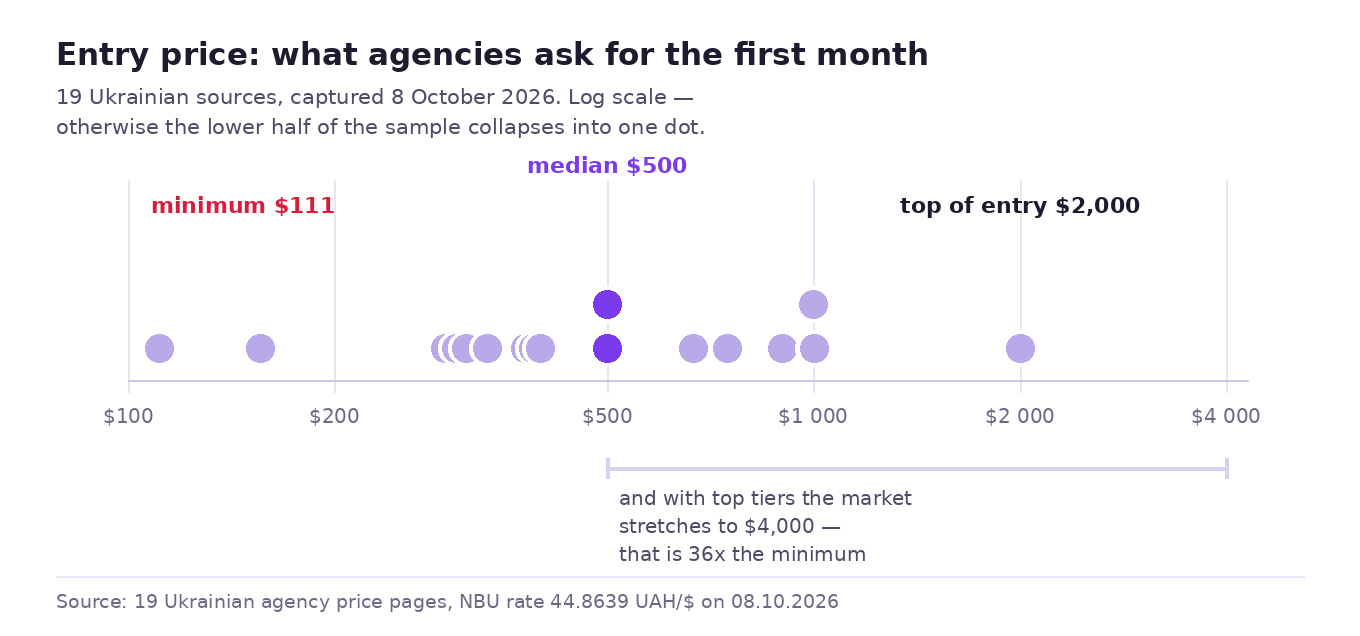
The floor is $111: webscraft.org writes "From UAH 5,000 a month for small business". The highest entry point is $2,000: rankup.ua's minimum Basic package costs exactly that, with a separate line saying "link and content purchases are paid additionally, from $500". The gap between entry points is 18x.
Look at the whole market rather than just the entry point and the gap gets wider. The top of the pricing tables reaches $4,000 (rankup.ua, Premium, and again plus $1,000 for purchases on top). From the market's lowest price to its highest is 36x.
That gives the first practical conclusion. With a spread like that, any "average market price for SEO" is a useless number. The arithmetic mean across this sample is $626, and it describes no real project: it simply sits between a cheap contractor working four hours a month and an agency with a team of five. If a contractor quotes you "the market average", ask which sample it was calculated from.
A quarter of price lists never say what period the figure covers
The most unexpected finding of the measurement. Five sources out of twenty-one publish a figure from which it is impossible to tell whether it is a month, a one-off job, or the whole project.
On web-promo.ua's services page there are four amounts — UAH 30,000, 35,000, 40,000 and 60,000. The words "per month" appear in neither the Russian nor the Ukrainian version of the page: I checked both with a text search. site2b.ua has a twelve-row table whose column is simply labelled "Price, UAH". netpeak.ua says "the average project budget Netpeak works with is $2,000" — a project budget, not a monthly one.
The difference between "UAH 30,000 for the project" and "UAH 30,000 a month" is a twelvefold difference over a year. When a figure stands without a period, the reader fills in the blank, and fills it in their own favour.
Fifteen sources out of twenty-one state the period outright. That is normal practice, and it is exactly what you should demand: the first question about any price list is "is that per month?".
Half the people searching for the price of SEO are not asking about SEO
When I pulled the search results for pricing queries, the "People also ask" block held sixteen questions. Eleven of them are not about SEO at all: "How much does a turnkey website cost?", "How much does it cost to maintain a website?", "How much does a site on Horoshop cost?", "What is the average salary of an SEO specialist in Ukraine?", "How much do SEO courses cost?".
Which means that at the "how much does SEO cost" stage, most people do not yet separate SEO from development, hosting and a specialist's salary. Let me untangle it right away, because all the arithmetic further down depends on it:
| What it is | How you pay | Ballpark figures |
|---|---|---|
| Building a website | once, as a project | landing page from $500, a full site from $1,000 per month of work — covered separately |
| Keeping a website running | monthly, technical | hosting, domain, CMS updates — hundreds of hryvnias, nothing to do with SEO |
| SEO audit | once | from $250 with us, up to $2,035 across the Ukrainian market — measured here |
| SEO services | monthly | $111–2,000 at entry across the Ukrainian market, that is what this whole article is about |
| In-house SEO specialist | salary | a different model: you pay for a person's time, not for a project result |
The rest of this article is about the fourth row only.
What a month of work is made of
My biggest complaint about the market: the price is named as a single "from $N" figure, and the reader never sees what stands behind it. Ten sources out of twenty-one break the scope down into items, and only six tie that scope to a specific tier instead of dumping one general list across the whole page.
One source out of twenty-one converts the price into hours. That is itforce.ua: a rate of $30–40 an hour, 30–50 hours a month, broken down across six blocks of work. And webscraft.org honestly writes that "for UAH 3,000 a specialist can spend 4–5 hours a month on your site" — which is probably the most useful sentence in the whole measurement.
Let me show my side. In our proposal engine a month is not taken as a ready-made figure — it is assembled from tasks. Here are the base task prices the quote is built from:
| Block | Task | From, $ |
|---|---|---|
| Project start | Technical audit | 300 |
| Keyword research | 300 | |
| Usability review | 250 | |
| Competitor analysis | 250 | |
| Site structure | 120 | |
| Technical work | Core Web Vitals | 140 |
| Structured data | 120 | |
| Internal linking | 90 | |
| Search Console work | 90 | |
| Content | Landing pages | 150 |
| On-page optimization | 90 | |
| Blog | 60 | |
| Trust and local | E-E-A-T | 180 |
| Google Business Profile | 150 | |
| Directories | 80 | |
| Reviews | 80 | |
| AI visibility | GEO/AEO | 220 |
| Off-site | Link building | 70 |
An important caveat, without which this table would be a lie: these are not fixed prices. They depend on the size of the niche and on how structurally large the site is. A technical audit of a two-hundred-page site and a technical audit of a forty-thousand-item catalog are different jobs with the same name. The figures above are the floor from which a specific project is calculated.
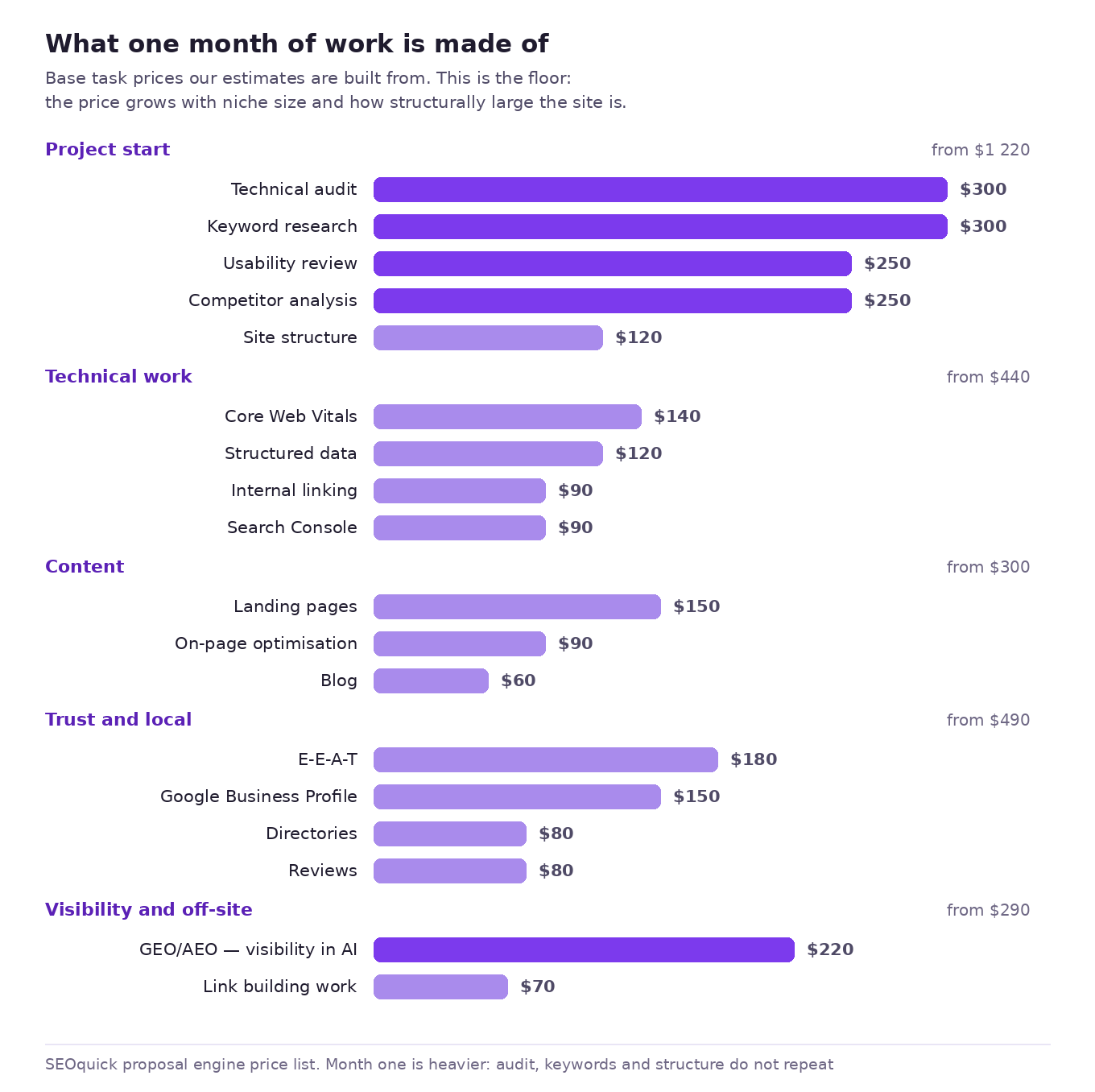
The point of this table is not for you to add it up in your head and arrive at your own price. The point is that the question "what am I paying for" can be answered with line items instead of a paragraph about a comprehensive approach. If a contractor cannot break a month down into tasks, that is not a trade secret — it means the month is not broken down on their side either.
Three ways to buy SEO — and when each one is the honest choice
Three models coexist on the market, and confusing them is the second most common cause of arguments about price, after the unstated period.
| Model | How you pay | When it fits | What you risk |
|---|---|---|---|
| Monthly retainer | a fixed sum, the scope set out in an addendum | systematic work lasting longer than six months | you cannot see how many hours were actually spent |
| Hourly | $15–50 an hour with us, $25–73 across the Ukrainian market | specific tasks, consulting, your own specialist in-house | the amount floats, budgeting is harder |
| Single task | a price for an audit, keyword research, a migration | one-off work with a clear deliverable | nobody is accountable for the resulting traffic |
An hourly rate is a good way to sanity-check a retainer. If an agency charges $500 a month and its rate is $40 an hour, your month contains roughly twelve hours of work. That is neither good nor bad — it is a fact you can measure promises against. Twelve hours is one person for a day and a half. A day and a half does not produce "comprehensive promotion on all fronts".
What it costs by type of site
Price depends on the size of the site more than on anything else: type and volume are named as a factor by thirteen sources out of twenty-one, and niche competitiveness by fourteen. Here are the ballpark figures across the Ukrainian market and on our side:
| Type of site | Ukrainian market, per month | Our price |
|---|---|---|
| Landing page, one service | $200–550 | around $500 |
| Services site, small corporate site | $300–950 | around $500 |
| Mid-size project in a competitive niche | $500–1,200 | around $800 |
| Online store | $500–1,500 | covered separately |
| Large catalog, several regions or languages | $1,000–4,000 | around $1,300 |
| Foreign markets (Europe, the US) | $2,000–5,000 | quoted separately: links and content cost more |
Foreign markets deserve a straight answer, because this often looks like a surcharge for a flag. There is no surcharge: our link-buying multiplier for Poland is two, and three for the rest of the world. What gets more expensive is not the agency's work but the external costs, and no contractor can get around that.
I will cost out your quote before you pay anyone
I will send a task-by-task breakdown with a price on every line — the same table as above, but for your site and your niche. You will see what the sum is made of, and you will be able to compare it with other proposals item by item instead of by the bottom line.
It is free and commits you to nothing — even if you end up going with a different contractor.
Book a consultationOur prices and what they include
I demand transparency from the market, so I show my own numbers first. They are already published on the service page and they do not change depending on who is asking:
| Plan | Per month | Who it is for |
|---|---|---|
| Start | around $500 | a small services site, one niche, no critical problems |
| Business | around $800 | a mid-size project, a competitive niche, several service lines |
| Premium | around $1,300 | a large catalog, several regions or languages |
| Hourly | $15–50 an hour | specific tasks; the rate depends on who does the work |
| Technical audit | from $250, one-off | comes with a 75% discount if you move on to ongoing SEO |
To compare with the measurement: our "Start" at $500 is exactly the median of the Ukrainian market. Six sources out of nineteen come in below us, eleven above. So we are not the cheapest and nowhere near the most expensive, and I see no point in pretending otherwise.
"Links included" — how many, and starting which month
The most expensive thing left unsaid in the industry. Five sources out of twenty-one explicitly separate the agency's fee from the budget for links and content. Rankup puts purchases outside the package price: "+ from $500" on top of the two thousand. ITForce names the client's overall marketing budget separately from its own work. Idea Digital, by contrast, writes that purchases are included in the price. The other sixteen say nothing — and so the same "$800 a month" at two agencies means different things.
On our side link building is included in the package, and it is itemised line by line in the quote. But I want to say the thing that usually goes unsaid, because without it "included" is an empty word.
In the "Start" package at $500 this is normally one or two links a month, and they do not appear immediately — they come several months into the work. The first month goes into the on-site part: audit, keyword research, structure, technical fixes. A link from our own catalog costs UAH 1,500–3,000, which is $33–67, plus $15 for the content behind it. Let us do the maths:
| Number of links | Spent on placements | Share of $500 |
|---|---|---|
| None (the first months) | $0 | 0% |
| One | $48–82 | 10–16% |
| Two | $97–164 | 19–33% |
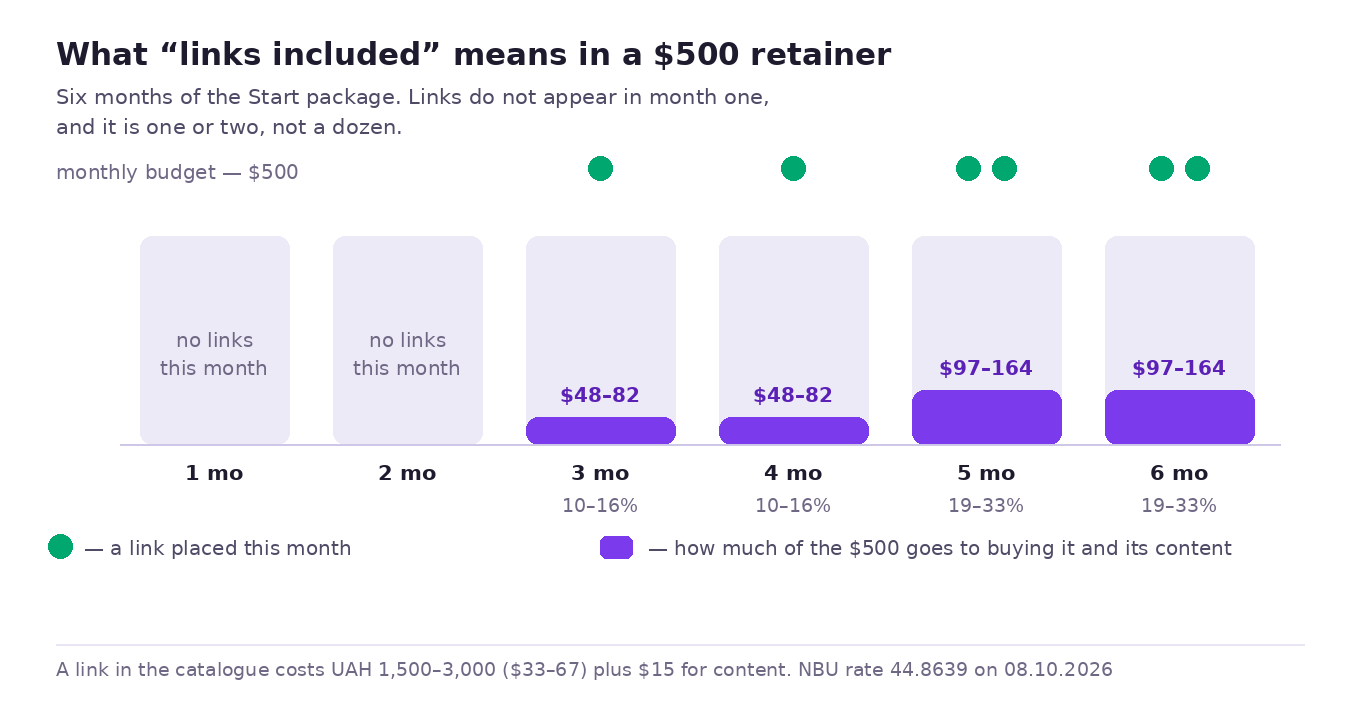
Someone who hears "links included" and pictures a dozen a month is deceiving themselves, and the contractor benefits from it. So the right question is not "are links included" but "how many a month, and starting which month". An answer in units can be verified six months later; the answer "they are included" can never be verified at all.
Term: there is no minimum, but before six months there is nothing to measure
Here the market is almost entirely silent. A minimum contract term is named by one source out of twenty-one — vdcom.net.ua, which has a "Promotion timeline" column in its table and, in its FAQ, "for a term of no less than three months". Nobody else.
Five of them, though, substitute the time to first results for the contract term, and those are different things. ITForce: first results from 3–4 months, steady growth 6–12. Webscraft: 3–4 months, 6–8, 12 and more depending on the niche. Idea Digital: first changes after 3–6 months, a stable top 10 from 9–12. Rankup: first results in 1–2 months, full effect in 3–6.
Our position. We have no minimum term. The contract is a one-year framework, but invoices are monthly, and a client can stop simply by not paying the next one. But I will say honestly what I think: there is no point starting unless you work the plan for six months on SEO, or at least three months on paid search. Not because we demand a commitment — because three months of SEO gives you nothing to evaluate. The technical work and the content produce early signals sooner, but we measure steady growth in cycles of three to six months.
The difference in wording is fundamental. "We require a six-month contract" shifts the risk onto the client. "There is no commitment, but before six months there is nothing to measure the result with" is a warning, after which the decision stays with you.
How long to wait for results
Contract term and time to results are different things, and the market names the second more readily than the first. Seven sources out of twenty-one give timelines, and here they are side by side:
| Source | First movement | Stable result |
|---|---|---|
| Rankup | 1–2 months | 3–6 months |
| VDcom | 1–3 months | does not say |
| ITForce | 3–4 months | 6–12 months |
| Idea Digital | 3–6 months | from 9–12 months |
| WebCraft | 3–4 months | 6–8, in hard niches 12 and more |
| Site Ok | on-site part up to 2 months | off-site — after the second month |
| Promodo | one audit takes a month | does not say |
The spread on first movement is from one month to six. And that is not different levels of professionalism: these are different niches, different starting states of the sites and different understandings of the word "movement". For one, movement means first rankings on long-tail queries; for another, growth in non-brand traffic.
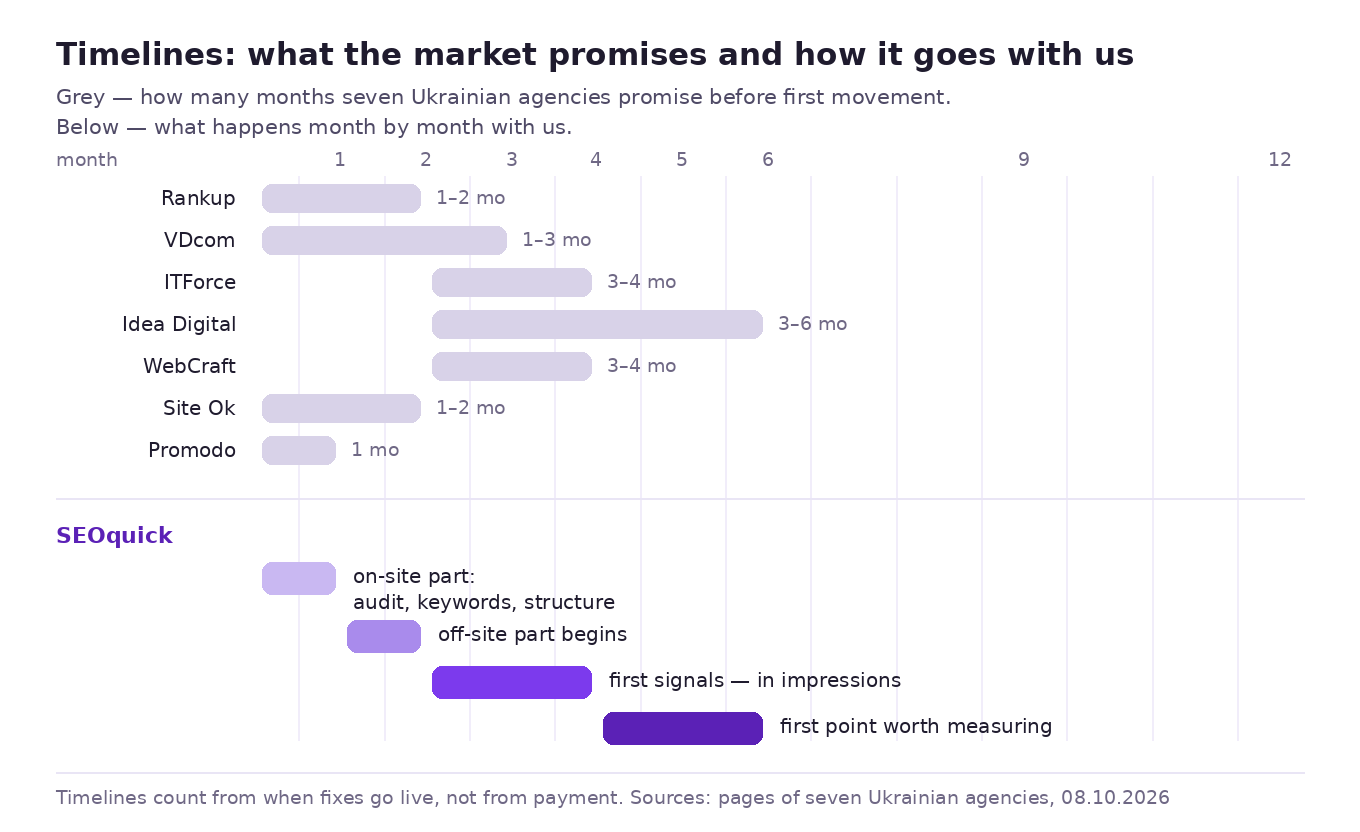
Here is how it looks on our side, stated in months rather than promises.
Month one — the on-site part. Technical audit, keyword research, structure, the brief for the developer. There will most likely be no visible change in search this month, and that is normal: the fixes have not been deployed yet. If a contractor promises growth in the first month, ask what exactly it will come from — usually from the fact that they found one under-optimised query.
From month two the off-site part kicks in. This is not our invention: link building starts in the second month and is written that way in the contract. Buying links in month one for a site whose technical base has not been cleaned up means paying for the growth of something that is not growing yet.
Months three and four — the first signals. They usually show up not in top-3 rankings but in the number of queries the site appears for at all, and in growing impressions in Search Console. This is an important point: impressions grow before clicks, and clicks before enquiries. If you only look at enquiries, the first months feel empty.
Month six — the first point where there is something to evaluate. Hence our wording: there is no minimum term, but before six months there is nothing to measure the result with. We count steady growth in cycles of three to six months, and that matches what Google itself writes when answering the question of how to choose an agency: the process takes six to twelve months, and a promise of the first position in a few weeks is a reason to be wary.
One caveat about timelines that almost nobody makes. All of these months are counted from the deployment of the fixes, not from the payment. If the brief sits with your developer for six weeks, the clock on results stands still while the months keep running. So the timeline is an obligation on both sides, and it is worth knowing before the first conversation who will deploy on your side and how fast.
What happens if you stop paying
The most uncomfortable question of all the ones I collected: in English-language discussions it appears in eight different phrasings. On the pages of Ukrainian agencies, not one of the twenty-one answers it.
Answering for myself. Work is suspended. The site may keep growing on momentum for a while — what has already been done keeps working. Then the decline starts. And here is the main thing nobody usually warns about: even if the work resumes, the decline from momentum can continue for several more months.
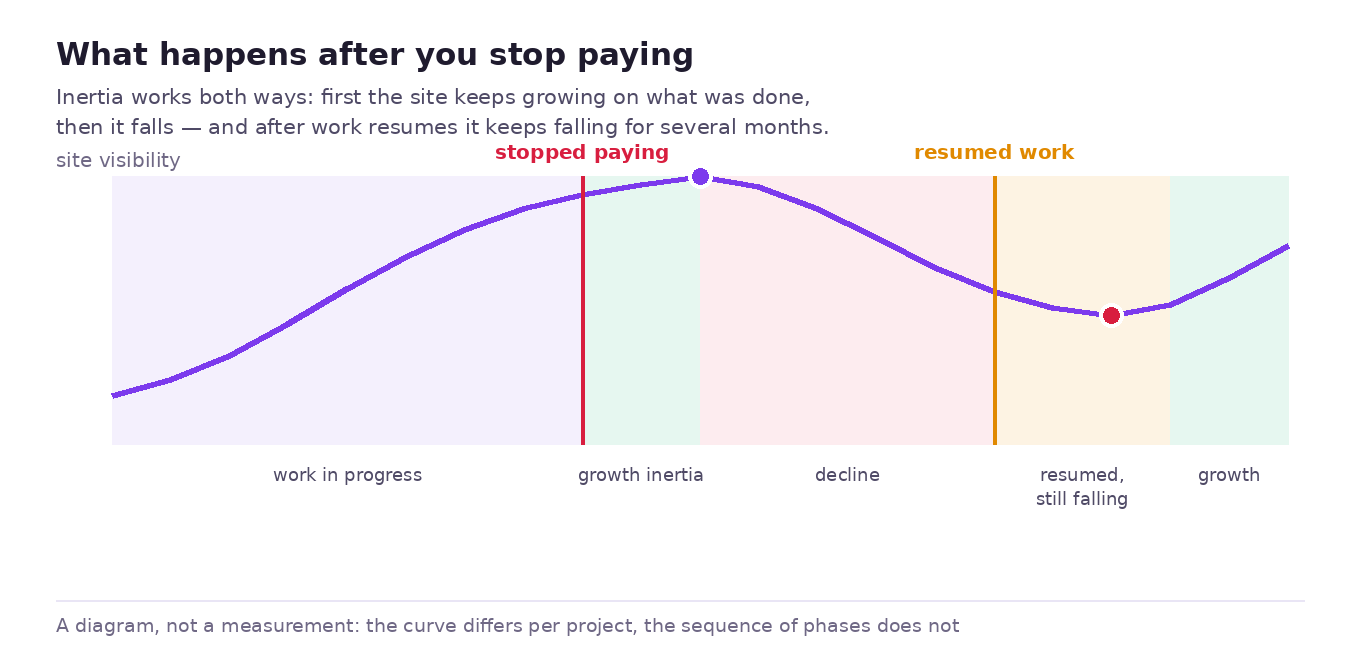
The logic is simple. Our work helps the site rank, but if nobody works on links and content regularly, SEO metrics start depending more heavily on behavioural factors — on how people behave on the site without any help from you. That holds until competitors do more than you do. The moment they do, you slide down.
Separately, about what stays with you in any scenario. Our links are external, built through outreach, not rented — they stay with the client and are not taken down. All the accounts are the client's; we create nothing on our own. You can check this with any contractor with one question: in whose name are the accounts registered, and what kind of links are being bought.
Who promises results, and who refuses outright
The breakdown across twenty-one sources turned out unexpectedly decent:
| Position | How many | Who and how |
|---|---|---|
| Promise a result | 2 of 21 | promodo.ua — a traffic forecast as a KPI; web-promo.ua — sales growth in 90 days, but in an audit call-to-action, not in the package |
| Refuse to guarantee outright | 4 of 21 | vdcom, seomarket, webscraft, rankup — wording along the lines of "we do not promise magic" |
| Say nothing | 15 of 21 | the numbers appear only in case studies — as an illustration of the past, not as a commitment |
There are no promises of a #1 ranking in a month on the pages I checked. That is good news about the market: in public, almost nobody lies. The lying happens on the call, and no measurement can check that.
We give no ranking guarantees and we write that plainly in the contract. Instead of a guarantee the client has the right to leave: the sum in the contract covers one month only, and every month you decide for yourself whether to continue, having looked at visibility. In my view that is more honest than any guarantee, because guaranteeing someone else's algorithm is making a promise on behalf of a party that never made one.
What to do if there are no results
The largest group of questions after the price itself. In English-language discussions it comes in a couple of dozen phrasings, and they all boil down to three: can I get my money back, how do I terminate, and whose fault is it.
Let me start with a fact that is unflattering for the industry. When I went through the contracts of twenty-two Ukrainian agencies, a guarantee with a publicly named sanction — that is, "if we fail to do it, then this happens" — was published by one out of twenty-two. A formula for calculating the payable result: two. The other nineteen make do with words.
Our position, item by item, so that it can be verified.
Money for work not done is returned. At the end of the month we sign off a statement of completed work. If part of the work was not delivered, the advance for that part is returned. This is not a "results guarantee" — it is a guarantee that you pay for what was done.
There is nothing to terminate. The contract is a one-year framework, but the sum in it covers one month only; after that every month runs on its own invoice and addendum. To leave, you simply do not pay for the next month and tell us. No obligation to pay in advance ever arises, so termination is not needed. The one-year frame is not bondage — it is the option to stop and come back without re-signing paperwork.
If a page drops out of the index and does not come back within thirty days, we re-optimise it at no extra charge. That clause is in our contract, and across the twenty-two contracts measured it did not appear once.
We do not guarantee rankings, and we say so plainly. Instead of a guarantee you have the right to leave in any month, having looked at visibility. Guaranteeing positions inside someone else's algorithm means promising on behalf of a party that made no promise.
Now, honestly, about the other side. If there are no results after six months, it is not always the contractor's fault. The three most common real causes I see in practice: the fixes were not deployed for months, the niche turned out to be more expensive than it looked at the start, or the site sells something people have stopped buying. You can push traffic into the top and not get a single enquiry — you cannot sell what nobody buys. So the conversation about "no results" starts not with a refund but with the question of what exactly was counted as the result and who failed to do which part of the work.
"Pay for results" and "pay for rankings"
Schemes like this are sold on the Ukrainian market: Elit-Web has dedicated landing pages for them — both for pay-for-results and for ranking-based SEO. It sounds flawless: you only pay when it works.
I consider it a trick, and I will explain what it rests on.
Somebody has to count the result. Of the twenty-two contracts I went through, two published the formula by which the payable result is calculated. The rest ask you to take their word for it — and the counting is done by the party that gets paid for its own count.
The rankings are chosen in advance, and the contractor chooses them. When payment is tied to a top 10 on a list of queries, the list is composed so that it contains queries the site is already nearly ranking for. Formally the obligation is met; traffic has not increased.
The model often hides a loss of control. To risk their own money, the contractor needs guarantees on their side: accounts in their name, their own links that can be taken down, sometimes closed access to the site's code. So you trade a prepayment for dependency — and that is the worst trade available, because getting out of it costs more than overpaying for a month.
The right frame for the conversation is not the payment scheme but transparency of mechanics. The question is not "can I pay for results" but "show me in whose name the accounts are registered, what links are bought and who counts the result". If there are coherent answers to those three, any payment scheme will do. If there are not, no scheme will save you.
Freelancer, agency, in-house or yourself
Before comparing agencies with each other, it is worth working out whether you need an agency at all. Four options, with prices and with what you pay for them.
| Option | Per month | What you get | What you risk |
|---|---|---|---|
| Do it yourself | only your time | full control, Google's free tools | the cost of a mistake: recovering from bad fixes costs more than a year of work |
| Freelancer | $111–400 | one person for a clearly defined task | no backup: illness, holiday or a new client and the project stalls |
| Agency | $500–2,000 | a team: technical, content, links, analytics | you cannot see how many hours were actually spent |
| In-house specialist | $800–1,500 plus taxes and tools | a person inside who knows the product | a single viewpoint with no outside experience; paid services at your expense |
The floor on freelancers is not made up: shevchenko-seo.com.ua states outright that "the minimum cost of work by a private SEO specialist starts from UAH 5,000 a month", which is $111. The ranges for in-house and freelance are the ones Google assembles from Ukrainian sources in its own answers.
How to choose, briefly. A one-off, clearly defined task — hire someone for the task, an agency here is an overpayment: fixing meta tags and setting up Search Console can be done for $150. Systematic work lasting longer than six months — agency or in-house. Your own specialist plus an outside consultant is the cheapest option in the long run, if you have enough volume to keep that person busy.
One detail about in-house that rarely gets costed. Add paid services on top of the salary: without them the specialist works on free versions with less data. An agency already has that toolkit and spreads it across all its clients — and that is part of what you are paying for.
Why we charge $500 and a freelancer charges $200
The most common question about the price difference, and there are four concrete answers to it rather than one paragraph about quality.
Experience. Eighteen years and several hundred projects is, first and foremost, a list of mistakes we will no longer make on your site. A mistake in SEO costs more than a month of work: a site that sank after bad internal linking or a junk link profile takes months to recover.
Tools. Paid services for every kind of task plus our own in-house builds. That is a cost line a $200 freelancer simply cannot afford — so they work on free versions with less data.
Depth of expertise. More than one person works on a project: technical, content, links and analytics are different competencies, and they rarely fit inside one head at a good level.
Accountability for the work. There is a contract, a statement of completed work and a refund of the advance for anything not done. With a freelancer on a freelance platform, accountability ends the moment they stop replying.
That said, I do not think a $200 freelancer is a bad choice in every case. For a small site with no competition, where meta tags need fixing and Search Console needs setting up, an agency is an overpayment. Choose not "who is better" but "what is needed": if the task is one-off and clearly defined, hire someone for the task.
What this price does NOT include
A section none of the pages I checked has: not one Ukrainian FAQ contains a question about the boundaries of the service. And it is precisely because of those boundaries that an "$800 a month" project suddenly becomes a $1,400 one.
- Changes on the site itself. We write the brief, your developer deploys it. If there is no developer, that is a separate budget — and then it is often cheaper to take development and SEO together.
- Content beyond the package. Copy for new landing pages is part of the work, but rewriting two hundred product cards is a separate line.
- Buying links beyond the plan. One or two links a month on "Start" is a plan, not a ceiling. Want it faster — that is budget on top.
- Advertising. SEO and paid search are different budgets, and they must not be mixed into one figure.
- Downtime on your side. This is the most important one. If the fixes are not deployed for a month, the month is paid for anyway and there is no result. It is the single most common real reason a budget gets burned, and it should be asked about before the start, not after.
I will check the site before we talk about money
Before naming a price, I look at where the site stands now: technical errors, structure, visibility in search and against competitors. Without that, any figure is pulled out of thin air.
Run the free audit — the automated report arrives in half a minute, and I will go through it with you myself.
Check your site for freeHow to read a contractor's quote
Seven questions that take five minutes and save you months. I have put them in the order in which they actually work in a negotiation.
- Is that per month? Obvious, but a quarter of price lists do not answer it.
- How many hours a month, and whose rate is that? The sum divided by the rate gives the number of hours. Then measure the promises against that number.
- Break the month down into tasks with a price on each. Not "comprehensive promotion" but line items. If there are no lines, there are none on the inside either.
- How many links a month, and starting which month? Not "are they included" but how many.
- What do I get if I leave after six months? Links, copy, accounts — in whose name, and what stays.
- What is not included in this sum? A good contractor answers with a list. A bad one says "everything is included".
- What happens if my developer does not deploy the fixes? The answer shows whether the contractor has thought about your side of the process.
These questions work against us too — ask them of me, and I will answer with the same numbers that are in this article.
What Google answers by itself — and why you cannot rely on it
I checked what search shows for four pricing queries. An AI Overview sits as the first block on all four and answers not with "it depends on the project" but with specific ranges: $500–2,000 a month, freelancer $200–400, agency $500–2,000, audit from $500, consulting $90–100 an hour.
The figures broadly match my measurement, and that is good news. The bad news comes in two parts.
First: answering a Ukrainian query, it mixes prices from different countries and different currencies into one paragraph. Different labour markets, different costs for links and content — you cannot add them into a single range. If you plan a budget from an answer like that, you are planning it on someone else's economy.
Second: the AI Overview is assembled from agency pages — that is, from the same price lists I went through above. A quarter of those price lists do not state the period. An answer assembled from sources with an unstated period inherits their problem and does not warn you about it.
Use it as a guide to the order of magnitude — and check the specifics with the contractor using those seven questions.
In brief: the questions people ask most
How much does SEO cost per month in Ukraine?
From $111 to $2,000 at entry level, based on a measurement of 21 Ukrainian price lists on 8 October 2026. The median entry point is $500, the average is $626, and the top of the pricing tables reaches $4,000. On our side it is around $500 to start, $800 for a mid-size project and $1,300 for a large catalog.
Why is the price spread so wide?
Because one word covers very different volumes of work. The sum divided by the hourly rate gives the number of hours: $500 at a rate of $40 is about twelve hours of work a month, which is a day and a half of one person's time. Different prices mean a different number of those days, not a different markup.
Is there a minimum contract term?
Not with us: the sum in the contract covers one month only, and you can leave by not paying the next one. But before six months there is nothing to measure the result with. On the Ukrainian market, a minimum term is named by one source out of twenty-one.
When will the first results appear?
Month one is the on-site part, with no visible change in search. Months three and four bring the first signals, usually in impressions rather than enquiries. Month six is the first point where there is something to evaluate. Ukrainian agencies name one to six months to first movement; Google, in its own answers, six to twelve to a stable result.
Are links included in the price?
With us they are, and they are itemised as a separate line in the quote. But something else matters more: in a $500 package that is one or two links a month, and not from the first month. Ask a contractor for the number and the starting month, not for the mere fact that they are included.
What happens if you stop paying?
Work stops, the site grows on momentum for a while, then the decline begins. Even after the work resumes, the fall can continue for several more months. Links and accounts stay with you: the links are external and not rented, and the accounts are the client's.
Can I pay only for results?
You can find offers like that, but the question is not the payment scheme. Somebody counts the result, somebody picks the rankings in advance, and to take on that risk a contractor usually asks for control over accounts and links. Ask in whose name the accounts are registered, what links are bought and who counts the result.
Why is an agency better than a $200 freelancer?
Experience, a toolkit of paid services, different competencies on the team, and accountability under a contract with a statement of work and a refund of the advance for anything not done. But for a one-off, clearly defined task a freelancer is cheaper and more appropriate — an agency here is an overpayment.
The short version
The Ukrainian SEO market asks from $111 to $2,000 a month at entry level, the median is $500, and the top reaches $4,000. The 18x gap is explained not by greed but by the number of hours and the volume of purchases, and you can check that with arithmetic: the sum divided by the hourly rate gives the real volume of work in your month.
Our prices are $500, $800 and $1,300 a month depending on the size of the project, plus an audit from $250 with a 75% discount if you move on to ongoing SEO. There is no minimum term, but before six months there is nothing to measure the result with. Links are included in the package — on "Start" that is one or two a month, and not from the first month. We give no ranking guarantees; instead of them you have the right to leave in any month.
If you have read this far, you have three things: the order of magnitude across the market with links to the sources, an understanding of what a month of work is made of, and seven questions that reveal whether a contractor thought about your project or pulled a figure out of thin air.
I will name a price for your site, not for the market average
Thirty minutes, no slide decks and no pressure: I look at the site, the niche and the competitors, and tell you what volume of work is needed and what it will cost with us. If the task can be solved more cheaply without us, I will say that too.
Pick a time that suits you — I will answer those seven questions about our own quote.
Book a consultation
Website development cost in 2026 and what drives it
A landing page from $176 to $2,000, an online store from $335 to $6,700 — measured across 17 Ukrainian price lists. What website development cost is made of, why a “from” figure means nothing, what we charge and how long each type of site takes.
Read →
Link Building in 2026: What a Backlink Really Costs
I checked 19 Ukrainian link building price lists: 8 name a price per link, 2 name selection thresholds, 5 say what is left behind. Plus our own traffic test.
Read →
SEO Agency Contract: What It Must Include
We checked 22 Ukrainian agencies: only two publish an SEO contract, and neither of them is a Ukrainian legal entity. We break down 21 court cases, nine ways clients get misled and what can actually be guaranteed.
Read →Want to apply this to your site?
We will review the current situation, find the first growth levers, and suggest a practical working format.