SEO for Service Websites: A Real SEOquick Case Study and the 2026 Strategy
Service websites don't sell a product with a shopping cart — they sell a phone call and a technician's visit. Using a live case study, I break down how we built a keyword structure spanning hundreds of pages and outranked competitors with thin content and links. And what has changed by 2026: the Local Pack and AI search now decide who gets the customer.


In 2019, a client approached us asking to promote their website for one single service category.
I studied the site and realized there was a lot of work ahead: even back then, there were 106 pages to promote.
Service websites are a special type of project. They don’t sell a product with delivery — they sell a service with an on-site specialist visit: appliance repair, plumbing, cleaning, moving.
We still run this project today, and in 2026 it is more interesting than ever: classic SEO has been joined by the Local Pack as the main source of leads, and by AI search, which is already bringing in real customers.
How do you promote a service website in 2026? Build out your keyword structure down to a dedicated page for every service, brand, and neighborhood, design those pages as selling landing pages, grow your backlink profile through article content and outreach, and claim your spot in the Local Pack via a Google Business Profile with reviews. The new mandatory layer is optimization for AI search: direct answers, structured content, and brand mentions, so that AI Overviews and ChatGPT cite you.
Why this niche is worth fighting for — the numbers speak for themselves.
According to Technavio (2026), the global home services market will grow by $1.23 trillion over 2026–2030, at an annual growth rate of 11.3%.
And the customer journey almost always starts with search: according to Google, 76% of people who search “near me” on their smartphone visit a business within 24 hours.
Meanwhile, 78% of local mobile searches end in an offline purchase — which, for services, means a phone call and a technician booking.
Promoting such websites is harder than promoting online stores, for which an almost ready-made “toolkit” exists.
Service websites have a number of peculiarities:
- They are built on all kinds of CMS platforms, often custom-coded engines
- They have no familiar shopping cart and work as “lead aggregators” instead
- Their content design can be either simple or complex
- They range from simple business-card sites to keyword-segmented “monsters” with hundreds of pages
And in this case, I got exactly that kind of “monster.”
SEOquick experience. This project is nadomu.kiev.ua — a Ukrainian home-services website offering appliance repair in Kyiv — which we have been running since 2019. Over 5 years, its organic traffic grew 10x, and since 2025 the site has been getting conversions from ChatGPT: customers arrive with service requests, citing the assistant’s recommendation. Details are in our service website promotion case study (in Russian).
Keyword Research and Site Structure
Service websites have to build their keyword structure from scratch.
Every page needs to be planned in advance: each specific service, and repair for each brand, gets its own page.
The finishing touch is intuitive, convenient navigation.
A semantic core is a set of query groups that the site’s pages are tailored to. Each group corresponds to a separate page, and the queries themselves carry metrics for competition, commercial value, and search volume.
Every SEO specialist should know how to do keyword research, and every site owner should understand why it matters.
We knew how to build a semantic core, so we took it on with ease.

Keywords for the Homepage
The site repairs washing machines and other appliances, but first we had to decide on the keyword set for the homepage.
The main keyword was the Ukrainian equivalent of “household appliance repair” — and we built the cluster around it.
We understood these keywords weren’t the most commercially valuable: they bring almost no orders. So we didn’t put much work into the homepage copy beyond mentioning the brand.
Service Pages
The key pages, however, we worked out in detail, extracting all keywords by type:
- Commercial keywords
- Informational keywords
- Geo-modified keywords for city districts
Commercial keywords are straightforward — they can be split into types and grouped onto a single page, since the site serves Kyiv:
- Service keywords — e.g., “washing machine repair”
- Service keywords with the city — “washing machine repair Kyiv”
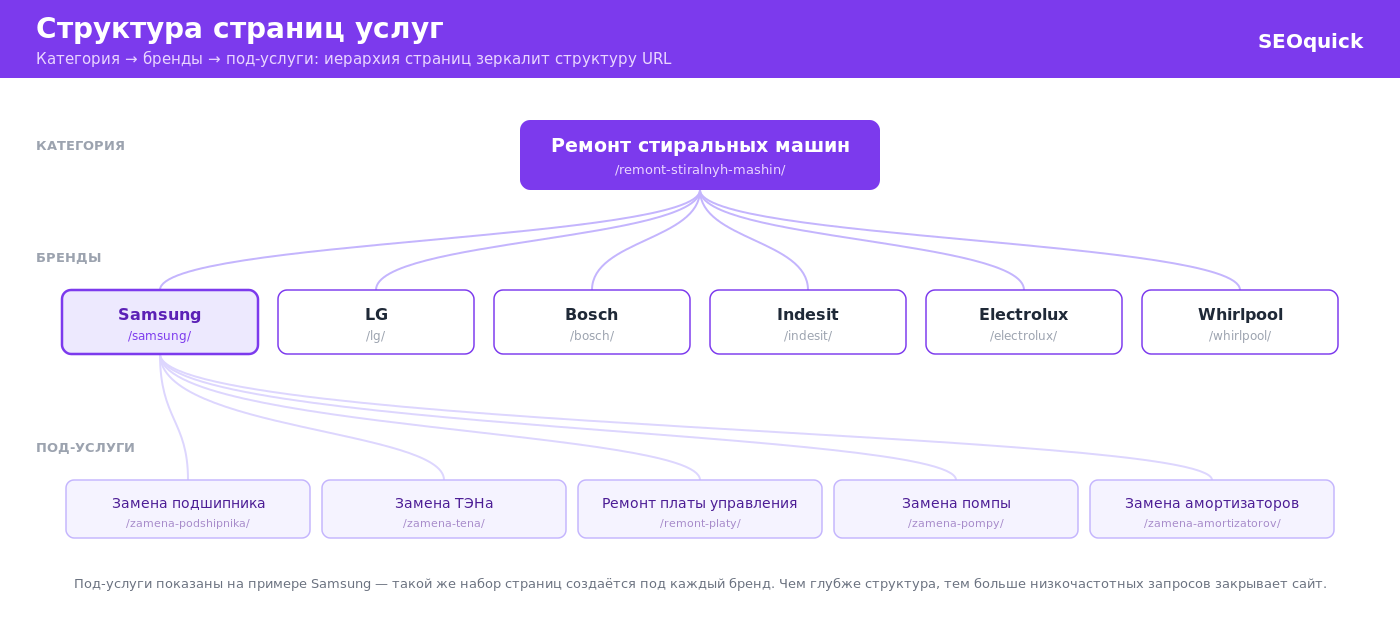
But pages for individual brand repairs should be separated: Samsung washing machine repair and Bosch washing machine repair are two different pages with different demand.
Likewise, more specific “sub-services” (bearing replacement, control module repair) get their own pages, linked from the main service page via clickable visual blocks.
Geo-Modified Keywords
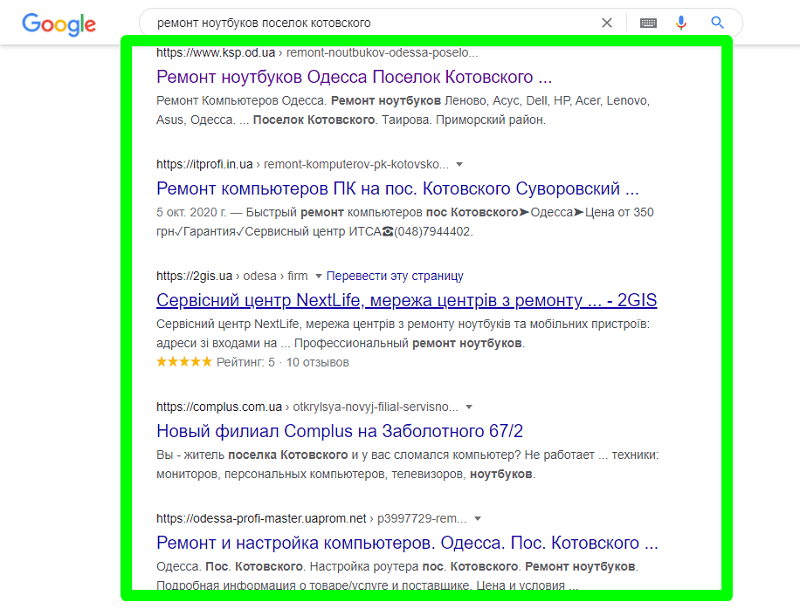
These are queries where the user adds a district or suburb to the main service — the local equivalent of “refrigerator repair Obolon” (Obolon being a Kyiv district).
Google loves geo-modifiers and often shows a suggestions block for them.
Geo-dependent pages bring little traffic but almost guarantee top positions — competition for them is minimal, and the intent is red-hot.
So target such queries and cover the districts of every city you serve. For us it was important to capture all the suburbs, and keywords beyond the city limits became the basis for future regional pages.
“Problem” Pages
“Breakdowns” deserve separate treatment: the user’s intent is to find out how to quickly fix a problem, or which technician to call and at what price.
This content is usually best suited for articles: people google dozens of questions like “washing machine won’t drain,” and each needs its own page.
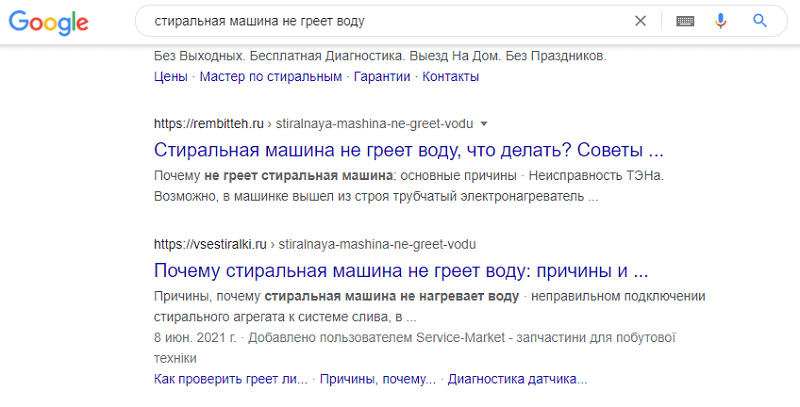
You can build a breakdown “knowledge base” in advance — and start collecting traffic right away, interlinking your core services along the way.
In 2026, these pages gained a second customer — AI search. It is precisely the “problem” pages with a direct answer in the first paragraph that get cited most often in AI Overviews and ChatGPT. I covered how to prepare such content in my article on content for AI answers.
That’s why keyword research is the top-priority task for a service website.
Once the pages are mapped out, you need to solve navigation: you can’t hang hundreds of pages off the homepage, and there’s no e-commerce category functionality.
Here you need manual interlinking — well-thought-out link placement modules. For example, brand repair pages typically get a grid of clickable logos.
Content Creation
Any website needs quality content.
Content is not text. Content is everything you show on a page: every button, heading, and paragraph in its proper place.
Visually, you can always tell a bad site from a good one: on one, a stock image that gives no clue what the site does; on the other, the problems it solves are shown clearly.
Content Design
Design is not about primitiveness and simplification — it is the process that defines functionality and interface.
Jonathan Ive
Any content on a page should have its own design.
The text you create should be turned into a full brief: along with the copy, prepare a task for the designer right away, so the content is laid out properly on the page.
In our case, it was the designer who implemented all the recommendations and assembled the service page mockups from the copy briefs.
Content for Service Pages
Many people mistakenly write “walls” of text on service pages.
That’s a pointless copywriting expense: a customer landing on the page definitely doesn’t want to read about “how important glass was in the design industry and when it was invented.”
What the customer actually looks for on a service page:
- Service identification — briefly, what it is
- What’s included: a list of options or packages
- A unique selling proposition (USP)
- Prices
- Service delivery steps (if needed)
- Trust triggers — why order from you
- Answers to common questions
- Links to useful materials and related services
Does the page need text at all? Per Google’s recommendations — only if it’s useful.
Remember: service pages must sell. So pay special attention to the first screen:
- A header with navigation, contacts, an order button, and business hours
- A logo that identifies the company
- A navigation block for key sections (everything else goes to the footer)
- A clear service name
- Calls to action
- A USP (up to 3–4 triggers)
- Key benefits
A 2026 bonus: a Q&A block on a service page works three ways — it handles customer objections, competes for a rich snippet via FAQ markup, and becomes a source of citations for AI search.
Content Authorship
A serious mistake is handing service page copy to a third-party copywriter “from a content mill.”
We never write copy on the client’s behalf as a matter of principle. We are not experts in their niche.
Try writing an article on industrial building design or treating cavities in baby teeth without expertise. You will fail: any text of yours will lose to what an architect or a dentist would write.
In 2026, this is no longer just advice but a ranking factor: Google evaluates content against E-E-A-T criteria, where the first E stands for Experience — the author’s real-world experience. And AI systems rely on the same expertise signals when choosing whom to cite.
So the scheme is this: the client finds a practitioner-author based on our briefs, and we review and edit the copy from an SEO standpoint. This simplifies content production — you only need to write proper briefs and pick the right topics.
Not all topics qualify.
First example: the seemingly easy query “how to descale an iron.” It already has plenty of results, with a rich-snippet article at the top that you can’t simply outrank. Since 2025, an AI Overview also sits on top of such queries, taking a share of the clicks for itself.
Second example: “how to clean an air conditioner at home” — the top is occupied by videos. What’s the point of writing an article nobody will read?
Content Strategy
Not every topic is easy to promote. The reason is banal — competition.
If you write yet another article about DIY washing machine repair, you’ll create the 6,221st good guide nobody needs. The first position already takes all the traffic, and you won’t outrank it.
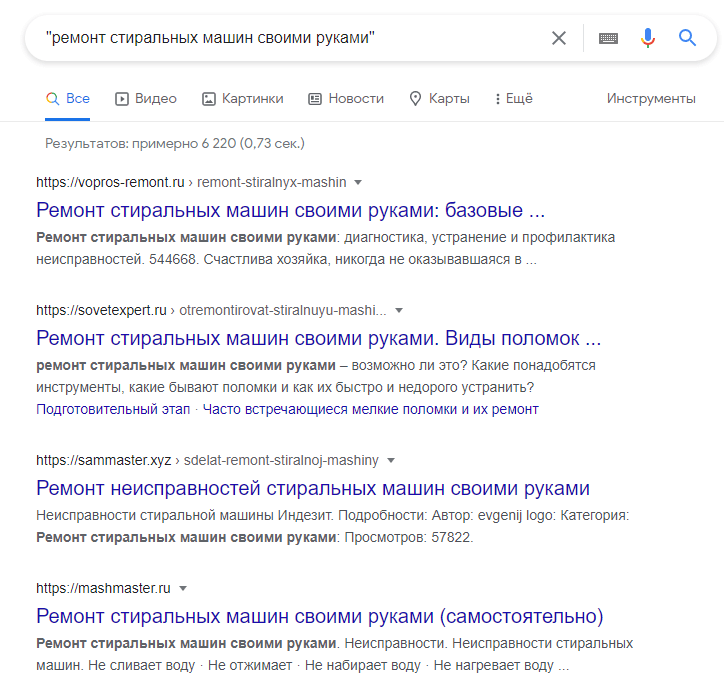
That’s why you should build your blog around a thin content strategy.
Articles written with this strategy push queries into the TOP 3 within a short time and earn a high CTR.
The thin content workflow:
- Collect the TOP 10 results for your target keywords (it takes a while, and there are many)
- Look for topics where the top-ranking sites have old, long-unrefreshed content (scrape the page update dates)
- Select content with the fewest external backlinks (check in Ahrefs)
- Filter out pages longer than 1,000 words (long ones are harder to outrank)
- Study what you’ve found: poor copy and weak design are your candidates
- Copy the competitors’ keywords from the TOP 10 and write a copywriter brief
This gives you topics where competitors simply have “weak” pages. Thin content is called thin precisely because it’s easy to outrank.
Remember the Pareto principle: out of 100% of your articles, only 20% will deliver results.
The same principle drives medical website promotion — our study of the medical niche shows that a small dozen articles hold the lion’s share of a clinic’s organic traffic, while the remaining hundreds get almost none.
After publishing, give it time and watch your organic traffic: a distinctive traffic “jump” is the signal to move to the next stage — reinforcing with links. If you don’t lock in the success, you’ll be knocked out of the rankings just as easily as you knocked out your competitors.
By the way, in 2026 the routine parts of this strategy — date scraping, competitor analysis, draft briefs — can be sped up dramatically with AI: I’ve compiled 50 working ChatGPT and Gemini prompts for SEO.
Content Relevance
Relevance deserves serious attention.
If you chase traffic for traffic’s sake, you’ll end up with 90% irrelevant organic visits — people who will never order your service.
This happens when you mindlessly work with copywriters whose only goal is “traffic, any traffic.”
Your keyword pool can run dry, and then you need to consider near-target keywords. Semantic cocoons come to the rescue.
A semantic cocoon is an internal-linking SEO strategy developed by French researcher Laurent Bourelly, aimed at optimizing site architecture through systematic content classification.
An example. You arrange student visas for the UK. Your audience is future students of British universities. So you write:
- how to get into a UK university
- what exams are taken in Britain
- what majors UK universities offer
- the top universities in London
All the topics are tied to the target service — obtaining a student visa — and are read by exactly your audience.
The ability to collect and develop near-target keywords is what working with semantic cocoons is all about.
Link Building Strategies
SEO without links is impossible. I have never managed to promote a single website without them — let alone in a highly competitive niche.
In “Alice in Wonderland” there is a scene with the Dodo, who says a seemingly nonsensical phrase:
“It takes all the running you can do, to keep in the same place. If you want to get somewhere else, you must run at least twice as fast as that!”
That’s exactly how links work: to keep your site from sliding down the rankings, you must build links constantly. And to overtake competitors — build them faster and smarter than they do.

Which strategies work well for service businesses?
Promoting Blog Articles with Links
With the content strategy above, we built a powerful informational blog. But remember the Pareto principle — not every article will bring traffic.
So after publishing, we give articles a “boost.” The strategy follows a simple scheme:
- Write articles for your own blog
- Pick the articles with potential
- Reinforce them with links
The trick is that external articles link to your blog articles, which in turn link to your service pages.
When choosing a topic for an external publication, the link builder follows two principles:
- The topic must be “thin” — otherwise it’s harder to promote
- The topic can be related to the target content either directly or indirectly
Before writing the brief, build an anchor list for the page you’re promoting and distribute the anchors across the new publications.
An important point is the publishing platform. The platform’s style dictates the structure of the piece, image requirements, length, and format.
Working formats for external publications:
- A “TOP” listicle — “TOP 5 ways to remove a stain,” where one of the ways links to your article
- A how-to article — your article appears as one of the steps
- A product review — links to the category and the product page
- A “replacement or alternative” article — a popular format in Western markets
- A press release — a brand link for a navigational query
- An interview — a branded anchor to the homepage
- A listing — your service featured in a roundup among others
And don’t outsource external articles to content-mill copywriters: you’ll get content that neither the platform nor the search engine needs, and pages that pass no link equity. Grow your own author — both for external publications and for the blog.
In 2026, article-based link building gained a bonus effect: brand mentions on authoritative platforms are a signal for AI systems too. ChatGPT and AI Overviews more often recommend companies that get written about in their niche, even if the link is nofollow. More details in my guide to GEO: optimizing your website for GPT.
How to Choose a Donor Site
A donor is a platform that places a link to your resource: to your content, product, service, or homepage.
A donor can place links of different types:
- Anchor link — a classic link with a keyword in the text, e.g. technical website audit
- Naked URL — the full URL in the text
- Image link — a clickable image
A link can also be open or closed:
- Dofollow — counted when link equity is calculated
- Nofollow — Google treats this attribute as a hint, not a directive
- Sponsored — marks a paid link, doesn’t harm the donor
- UGC — user-generated content, barely counted in rankings
- Closed via redirect — passes no equity
When picking donors, Ahrefs and its Batch Analysis tool help enormously: upload lists of platforms in batches and pull their metrics quickly.
Criteria for a good donor:
- Your material is unique for this donor
- The donor’s TOP 20 keywords include your keywords or a competitor’s
- The donor’s geo matches yours (study its traffic)
- Decent mobile layout, HTTPS, an active blog
- DR above 20 is good, above 30 is even better
- A healthy ratio of inbound to outbound links
- Donor traffic from 1,000 visits is good
- At least 100 keywords ranking in the TOP 10
The problem is that 90% of clients look for links on link marketplaces. And that’s a mistake: all your competitors sit on the same marketplaces, and niche donors there are often junk.
Outreach comes to the rescue — a method of contacting platforms directly via email.
The outreach checklist:
- Build an anchor list for your articles
- Collect platforms in your niche
- Register a domain email for the client
- Run an email campaign (e.g., via BuzzStream)
- Correspond with the platforms, clarify pricing and terms, compare with marketplace prices
- Sometimes you can even get placed for free
Article-based link building yields fewer links, but they last longer, and the anchor list develops naturally: branded keywords, naked URLs, anchors to articles, and a small share to commercial pages.
Also read: Link Building: Promoting with Evergreen Links.
The Scholarship Strategy and Charity
Among link building strategies, working with social projects deserves a special mention.
Its distinctive feature is earning links from social program pages, and the number of referring domains here can be record-breaking. Relevance is preserved: you link from a relevant site to relevant content in your geo.
But don’t stop at being “just a good company.” It’s important to do good things and to know how to tell people about them — otherwise your brand will remain “yet another company” nobody remembers.
Think about how you can help your city.
For our client, we implemented this strategy where it fit best: appliance repair — most often washing machines — for orphanages and boarding schools.
Such news sometimes has to be placed as sponsored content, but several media outlets ran the story as a full editorial piece without disclosure labels — that’s links, PR, and real-world good all at once.
Ongoing Audits
How often should you run technical audits and review usability?
In search, you have to fight for visibility: click-through rates are shrinking, and positions 6–8 no longer satisfy anyone. All the more so because an AI Overview now sits above the results for part of the queries, eating additional clicks.
The first thing to pay attention to is Google Search Console.
The indexing report shows which pages “pass the barrier” and which stay behind it, broken down by error type. Fix the issue — submit for re-validation.
These are your ongoing express audits.
A full-scale technical audit, I recommend running every six months or after any radical changes to the site. Broken links and redirects can be monitored with Screaming Frog or online services.
Run usability audits regularly using GA4 data: see how users interact with page elements, which pages lose visitors, and look for the causes.
Also keep an eye on rich snippets: add prices, FAQs, and ratings to the SERP via structured data. For service websites in 2026, the critical Schema.org types are LocalBusiness, Service, and FAQPage — and they also help AI systems “understand” your business correctly.
Local SEO and AI Search
The influence of Google Maps on search results has grown dramatically in recent years, and since 2025 AI search has joined the battle for the customer. For service websites, these are now the two main battlefields.
The Local Pack — Your Business’s Main Screen
Let me start with the numbers.
According to BrightLocal’s Local Consumer Review Survey (2026), 97% of consumers read reviews before choosing a local business, and 41% do it “always” — up from 29% a year earlier.
Rating expectations are rising: 31% of consumers now consider only companies rated 4.5+ stars — double the share a year earlier (17%).
“Near me” searches in the US alone number around 800 million per month, and 76% of such searches end in a visit or an inquiry within 24 hours.
Let me tell a story. I came back from the Carpathians (a mountain region in western Ukraine), where I had left a review for the owner of a small mountain tavern — and he never even saw it. It turned out someone else had registered his venue’s listing long ago, and the owner didn’t know it could be “claimed.”
This story is the cornerstone of service website promotion: countless businesses still don’t manage their own listing.
The Local Pack — three local businesses with a map shown above the organic results — now intercepts most clicks for category queries like “appliance repair.” Classic organic search for such queries has become almost inaccessible without a listing.
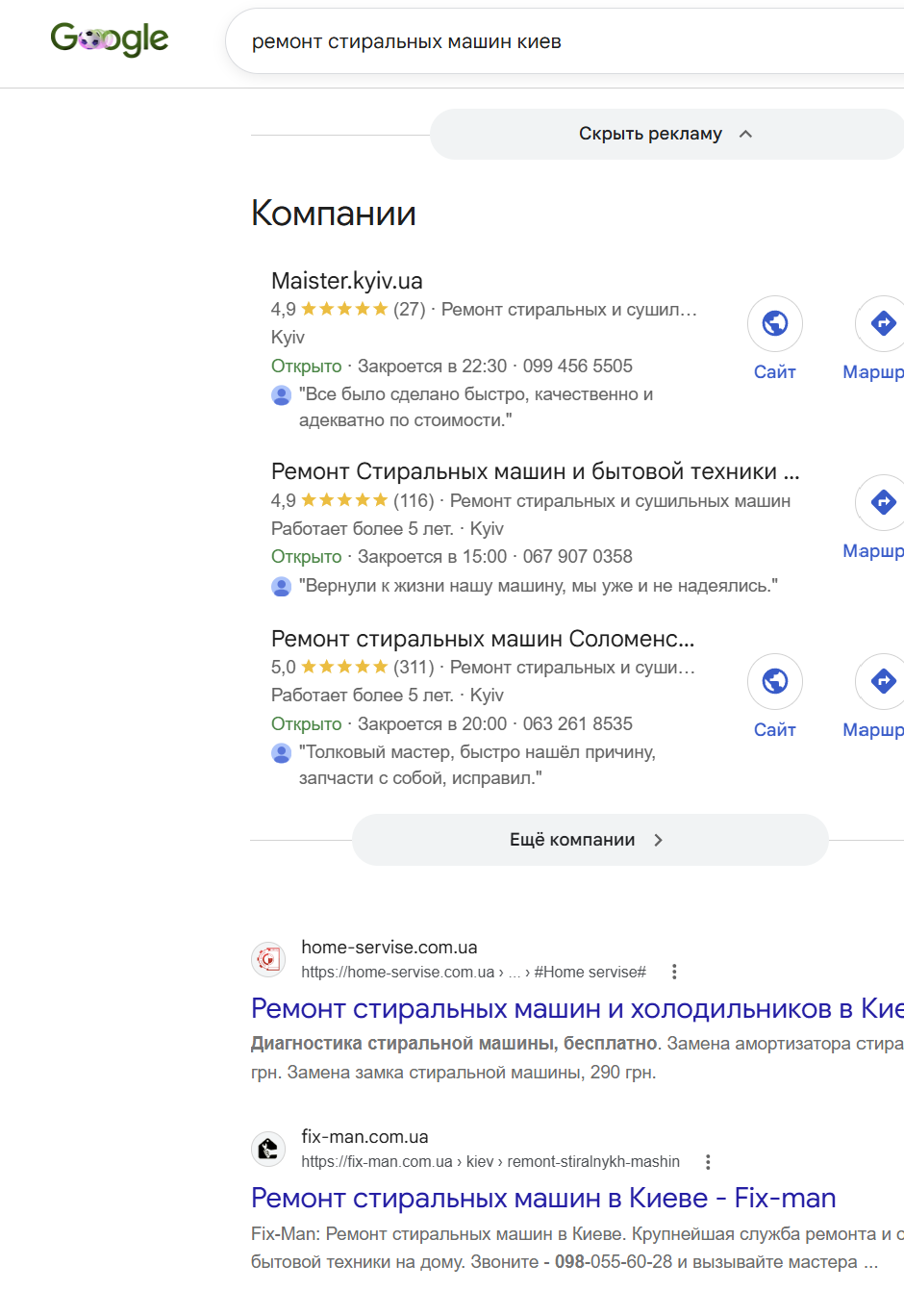
What to do with your Google Business Profile in 2026:
- Claim your listing and fill in every field: categories, services with prices, service area, business hours
- Collect reviews systematically and reply to every one — including the negative ones
- Publish photos of your work: customers click through to companies with authentic photos more often
- Use posts in your listing — a free announcement channel and a quick way to show Google new blog content
- Watch the statistics: a third of a service website’s traffic can come directly from Maps
SEOquick experience. For a massage salon in Kyiv, we took the listing and the website to #1 for the local query “Thai massage Kyiv” — local traffic grew by 120–150% in a year. The breakdown is in our massage salon SEO case study (in Russian). And for a complete guide to local promotion, read my article on local SEO.
AI Search: A New Source of Customers
Since 2025, an AI Overview increasingly sits above the classic results, and part of the audience searches for services through ChatGPT and Google AI Mode altogether.
The numbers: as of early 2026, AI Overviews appear for roughly a quarter of all US queries, and for a page ranking first, the presence of an AI block cuts CTR by 58% (an Ahrefs study). But there’s a flip side: brands cited in AI answers get 35% more organic clicks (Seer Interactive).
The conclusion is simple: you can’t fight AI search — you need to get into it.

What makes a service website citable by AI:
- Direct answers. The first paragraph of every service page and article answers the user’s question — price, timing, what’s included. AI systems extract exactly these fragments.
- Structure. Clear H2/H3 headings, step lists, price tables — machine-readable content gets cited more often.
- “Problem” pages. The breakdown knowledge base from the keyword research section is the main supplier of citations in AI Overviews.
- Reviews and mentions. AI assistants recommend companies with a strong reputation: listing rating, reviews, mentions in local media.
- Structured data. LocalBusiness, Service, FAQPage — they help the systems connect your brand, geo, and services.
This works in practice.
SEOquick experience. The nadomu.kiev.ua site from this case study has been receiving requests since 2025 from customers referred by ChatGPT — these are already measurable conversions from the AI channel. And another Ukrainian service website, Dobro Lyudyam, after we reworked its content for direct answers, now appears for 1,478 queries in Google’s AI answers: details are in the case study of a service website with +50% growth in 8 months (in Russian).
If you want to dig deeper into the mechanics, I have a dedicated guide to using ChatGPT in SEO and an article on GEO: optimizing your website for GPT.
Results
Any promotion is done for the sake of results. Our result is growth in organic traffic and rankings.
Active work on the site took the first 1.5 years: we built a strong backlink profile, optimized pages and metadata, and kept the link mass clean.
This allowed us to suppress competitors and take top positions for nearly all the target keywords. For the main query, the site held a TOP 3 position for more than six months already within the first stage.
Then the compounding effect kicked in: over 5 years of work, organic traffic grew 10x, the site claimed the Local Pack for its services, and started getting conversions from ChatGPT.
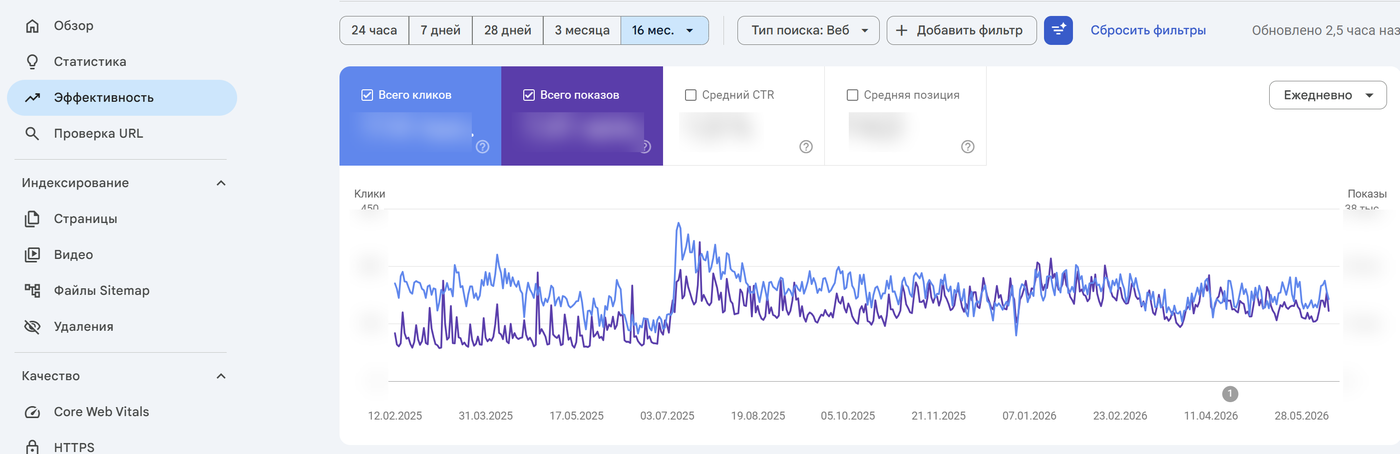
This work would not have been possible without applying all the strategies listed above.
But which one should you grab first?
Priorities
What should your SEO budget be? There is never enough money for everything.
Pay the copywriter, pay the developer, pay the SEO specialist, spend on links. How is a small business supposed to survive?
And don’t forget paid search either: the cost per click in Google Ads for a number of home-services keywords in the US exceeds $40.
There’s only one way out — choosing priorities correctly. Don’t try to cover everything: your competitors won’t let you, and the money will run out faster than you can blink.
We ourselves once tried to do everything at once and lost. But it taught us a lesson.
Starting in 2017, we went where there were no competitors, or where they were weak: articles, YouTube, guest posting, then podcasts and webinars. When we entered YouTube, we competed with only three channels — and overtook them. With guest posting, we published more than 50 articles linking to us for free, creating the content ourselves.
Competitors use a multitude of methods, but you are not obliged to copy them — otherwise you’ll forever remain the one catching up.
For a service website in 2026, I would set the priorities like this:
- Keyword structure: pages for services, brands, neighborhoods
- Google Business Profile and reviews — the fastest source of leads
- Selling service-page content with direct answers
- A “problem” knowledge base — search traffic plus AI citations
- Links: article-based promotion and outreach
- Ongoing audits and rich snippet work
Every business is unique: each has its own brand and its own mission. If they don’t exist — they need to be created and developed.
To everyone who wants to promote their service website — I’m always ready to help. Leave a request for SEO promotion, and we’ll prepare a plan for your project.
Thank you for your attention, and may your traffic, rankings, and sales grow!
FAQ
How long does SEO for a service website take?
The first results from geo-modified and low-competition pages appear within 3–4 months; reaching the TOP for the main commercial queries takes 8–18 months depending on competition. In our case study, the active phase took 1.5 years, and the compounding effect produced a 10x organic traffic increase over 5 years.
How does promoting a service website differ from an online store?
A service website has no shopping cart — it collects requests and phone calls. Its structure is built not around product categories but around services, brands, and city districts. Local SEO, Google Business Profile, reviews, and pages for geo-dependent “service + neighborhood” queries play a much bigger role.
Does a service website need a blog?
Yes. A knowledge base of “problems” (breakdowns, typical questions) collects informational traffic, interlinks the service pages, and serves as a source of citations for AI Overviews and ChatGPT. The key is to choose topics using the thin content strategy, where competitors are weak, rather than writing yet another generic guide.
How do you get into Google’s Local Pack?
Claim your Google Business Profile, fill in the categories, services, and service area, collect reviews systematically and respond to them, and publish photos of your work. Reinforce the listing with local citations (directories, media) and an optimized website. According to BrightLocal (2026), 31% of customers consider only businesses rated 4.5+.
How can a service website get into Google’s AI answers and ChatGPT?
Give a direct answer in the first paragraph of every page, structure your content with lists and tables, implement LocalBusiness and FAQPage markup, and grow brand mentions and reviews. After such a rework, our client appears for 1,478 queries in Google’s AI answers and gets conversions from ChatGPT.
How much does promoting a service website cost?
The budget depends on the niche, the city, and the competition: the main cost items are content, links, and specialists’ work. For a small business, priorities matter more than budget size: first the keyword structure, the Google listing, and selling service pages, then the blog and link building. Spreading yourself across all channels at once is the fastest way to burn the budget.
DanEri Yachts Website Development Case Study: An SEO-Ready Site for Yacht Cruises in Crete
How SEOquick developed daneriyachts.com: cruise structure, fleet pages, port categories, prices, LinkTwist links, staging-first releases, and a foundation for a customer account.
Read →
How to Write Sales Copy: Structure, 8 Formulas, Ready-Made Templates and Examples
Sales copy without fluff: the structure of a page that sells, 8 formulas (AIDA, ODC, PMHS…), a real first-screen breakdown, ready-made templates and prompts, SEO logic and metrics. SEOquick’s experience: a ×7 traffic case built on commercial pages.
Read →
Ecommerce SEO in 2026: A Checklist for AI Search and Zero-Click
An ecommerce SEO checklist for 2026: a product feed tuned for AI Mode, Product schema, AI-citable product content, technical SEO for checkout and cart. A hands-on breakdown with real numbers from SEOquick.
Read →Want to apply this to your site?
We will review the current situation, find the first growth levers, and suggest a practical working format.