Corporate Website Promotion: A Business Guide for 2026
Learn how to promote a corporate website in 2026 with SEO. Strategies, case studies, and trends. Order an audit!


For those who need corporate website promotion
Write to me and leave your contacts,
I'll get in touch and put together a promotion plan,
a content strategy, and help you grow your traffic
Introduction
When someone comes to me with the phrase, "We have a corporate website and we want to promote it," the first thing I ask is:
"And what exactly do you consider a corporate website?"
Because in 2026 it can be anything: from a simple "About the company" landing page to a complex web portal with a catalog, multiple branches, a personal account, and a partner area.
And this is where the main SEO paradox begins: most such sites are built on a template that, by definition, doesn't rank. Visually beautiful, but in reality invisible in search.

A small-page website of a very popular brand
For business owners in a world where digital transformation is in full swing, understanding how to get a site to the top of search engines becomes the key to success. I, Nikolay Shmichkov, drawing on SEOquick's experience, prepared this guide to help you grasp the nuances of corporate website promotion.
The case study we'll examine in this article is us. And our second project, Unmiss.com
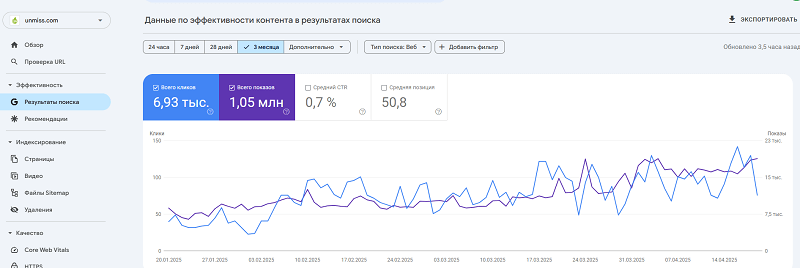
Corporate website promotion statistics in the US
SEO for corporate websites isn't just a set of technical tricks; it's a comprehensive strategy that includes audience analysis, content optimization, technical refinement, and reputation management. Unlike online stores or personal blogs, corporate sites are often aimed at a B2B audience, require an emphasis on brand and expertise, and can be structurally complex.
What is a corporate website and why promote it?
A corporate website is a company's official online resource that reflects its mission, values, products, or services, and provides information for clients, partners, and investors. It can be the site of a large financial company, an IT agency, or a manufacturing enterprise. The main goals of such a site are to strengthen the brand image, attract leads, and inform the audience — not just drive direct sales.
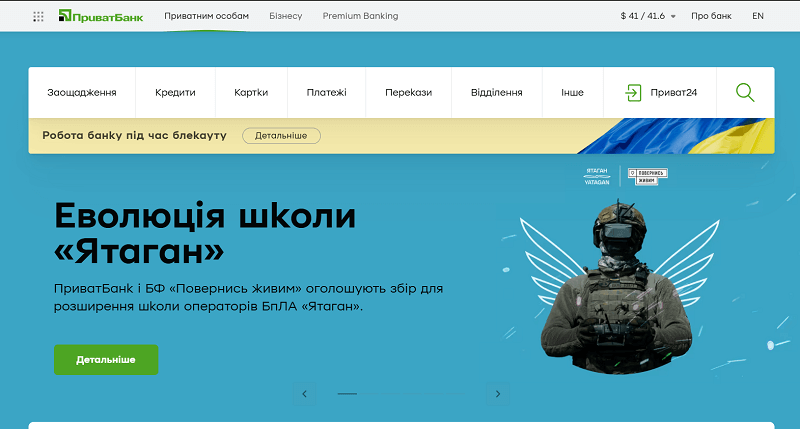
For example, a large bank may have its own internal client portal hosted on a separate site, whereas what you see is the classic corporate website.
Promoting a corporate website is essential to stand out from competitors and convey the company's value to the target audience. Without SEO, a site risks remaining invisible, even if it's perfectly designed.
In 2026, when users increasingly look for solutions through Google, a lack of optimization means missed opportunities. Effective promotion boosts brand visibility, generates quality traffic, and builds trust, which is especially important for B2B companies with a long sales cycle.
Why is SEO for corporate websites different?
SEO for corporate websites has its own specifics tied to the scale of the business and its goals. Unlike small businesses, where the focus is often on local queries, corporate sites target a broad or industry-wide audience, including international markets.
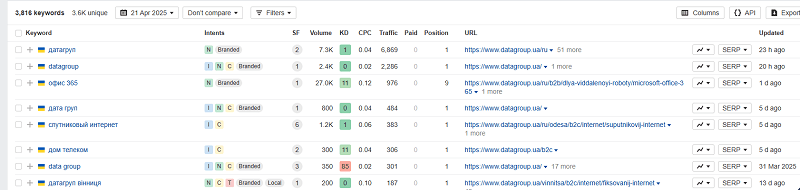
They require working with branded queries, complex structures, and content that highlights expertise. For instance, some internet provider's website may be a complete mess in terms of SEO and organic traffic, and clearly doesn't look healthy.
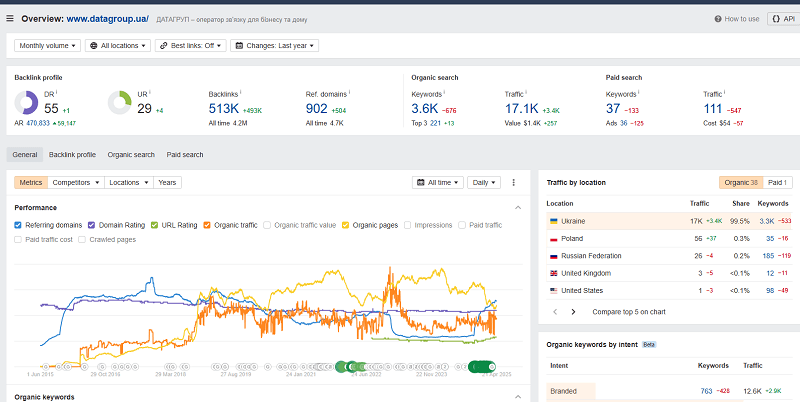
And yet it ranks perfectly for its branded query.
Moreover, corporate websites are often more complex technically: many pages, subdomains, multilingual versions. This complicates indexing and requires a deep audit.
For example, our SEOquick contains within it:
- 2 language versions.
- Classic corporate pages — about us, careers, and partnerships.
- A list of complex service pages.
- Utilities for analyzing content and sites.
- A complex portfolio page with case studies across all projects.
- A blog where you can read articles, watch videos without ads, join live streams, and listen to audio podcasts straight from the browser.
- A personal account with a history of site scans and clusterizations.
- Course sales pages.
And this is just our simple website!
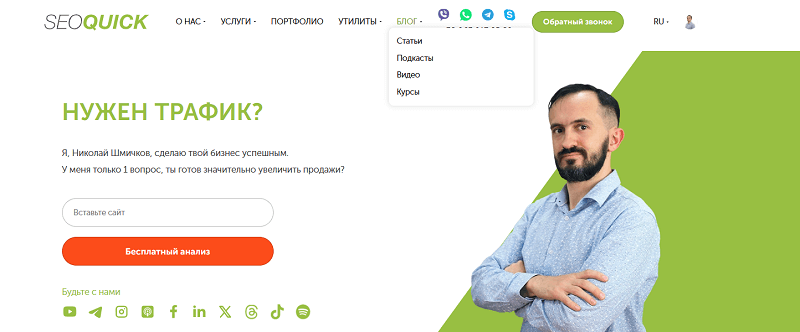
When people ask me what kind of site we have, sometimes I don't know what to say
In 2026, Google emphasizes EEAT (Experience, Expertise, Authoritativeness, Trustworthiness), which makes reputation and content quality critically important. For business owners, this means the need to invest in professional optimization, not just to reach the top but to stay there.
Anatoly Ulitovsky made a video about who can best help with SEO promotion and in what way.
Corporate website structure
A corporate website is not an online store. There won't be tens of thousands of products, cards, and UGC here.
But that's no reason to reduce the entire structure to "About us + 4 services + Contacts."
If you want to get organic traffic, the structure must be deep, branched, and most importantly — built not around a manager's logic, but around the logic of semantics + intent.
Let's say the brief specifies:
- Services.
- Industries.
- Pricing.
- About the company.
- Articles.
What happens in practice?
- The "Services" page — a list of 8 headings with no separate URLs. Everything on one page.
- Industries — not used at all. Even though in the B2B services market this is one of the most powerful semantic directions.
- Pricing — in a PDF. No content, no microdata, no text.
- Blog — technical clutter: "How to choose a contractor," "What we do," and so on.
An example of a nightmarish PDF structure
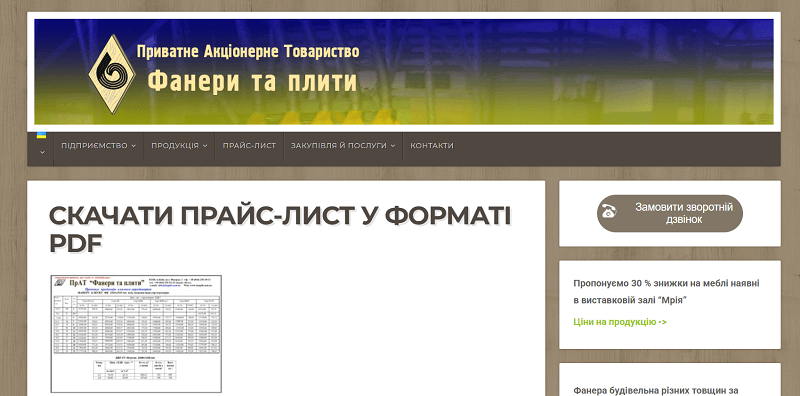
The result — 15 pages, 10 of them indexed. In the top — none.
So your page structure will be determined by a collected semantic core and the content plan for your resource.
Building the semantic core
95% of corporate websites are created around the internal logic of the business rather than the interests of users.
What does this look like?
The homepage — "We are a reliable team of professionals with 20 years of experience," sections — "About the company," "Mission," "Values," "Partners," "Contacts." And at most — a services section.
What's the problem? The problem is that this approach lacks any attempt whatsoever to satisfy search demand.
Show me where on such sites there's a page for the query "InfoSec audit for banks," "equipment supply for schools 2025," "ISO 27001 staff training," "accounting outsourcing in the city"? — exactly, nowhere. And if there is one, it's in very poor blog articles.
If you really want the site to bring in traffic, you need to design it from the outset around a content architecture tailored to:
- clusters of key services;
- industry and geographic modifiers;
- the decision-making funnel (from awareness to purchase);
- pages for informational queries (how, why, timelines, risks, cost).
Otherwise, no SEO promotion will help you. There's nothing to optimize.
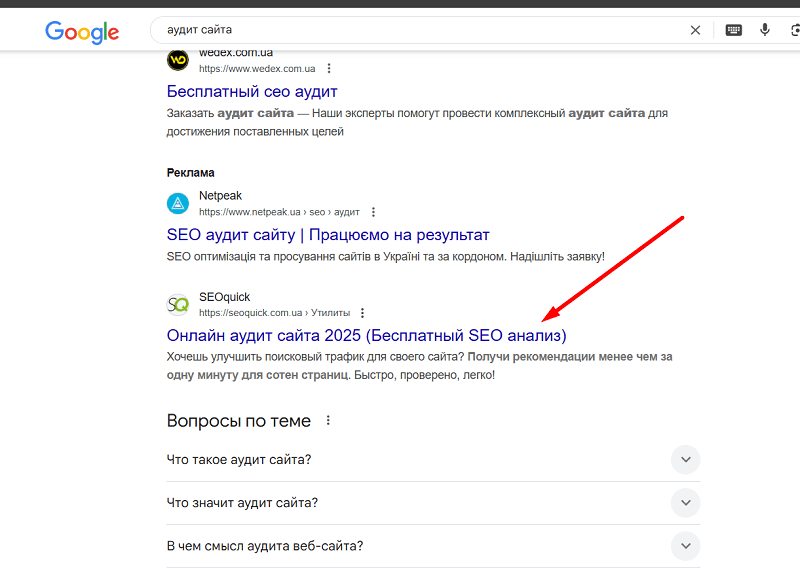
We chose the right keyword our target audience uses to order services
The work doesn't start with the menu. Or with the design. Or even with WordPress.
The first entry point is semantics.
- Queries are collected across all directions: services, industries, regions, info-navigational queries.
- They are clustered by intent type: commercial / informational / brand / mixed.
- A tree of sections is designed with a focus on:
— services;
— target sub-services (if queries allow);
— industries / audiences;
— geolocations;
— commercial info pages (such as "How we work," "Timelines," "Guarantees," "Equipment").
Semantic clustering
Keywords are the foundation of SEO, determining which queries your site will be found for in search. For corporate sites, it's important to balance between branded queries (for example, a company or product name) and industry terms that potential clients search for.
Start by analyzing your audience: who are your clients and what questions does the semantics address? Use tools like Serpstat or Ahrefs to gather keywords — from general ("seo promotion") to long-tail ("website promotion in a specific city").
I recommend collecting all queries and dropping them into the SEOquick clusterizer
Look at competitors: which queries bring them to the top? Add the questions users ask via AnswerThePublic — this will help you create content that meets their needs. For example, for an IT company, it might be "how to choose a CRM for business."
Using myself as an example, I ran a clusterization for my main commercial query, "website promotion."
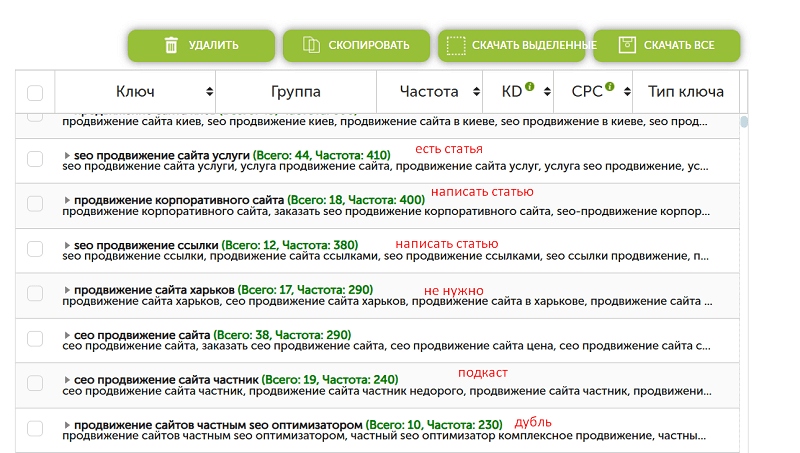
Clusterization for the query "website promotion"
After gathering keywords, distribute them across pages: one query cluster — one page. Avoid overlaps so there's no cannibalization, where pages compete with one another. Regularly update your semantics, since search trends change.
On-page optimization
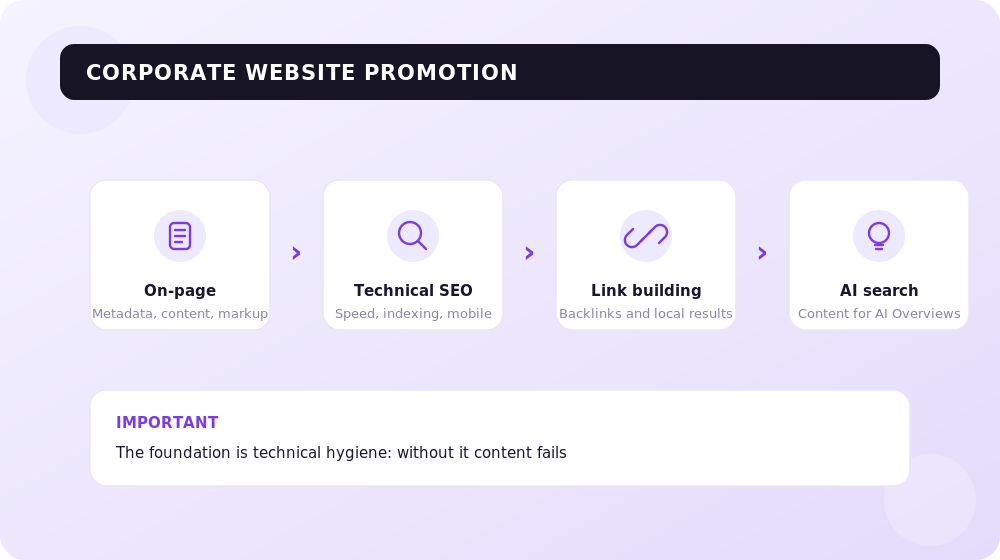
On-page SEO is the work with content and code that makes every page of the site clear to search engines and appealing to users. For corporate websites, this is especially important because of the large number of pages and complex structure.
If you think on-page SEO is just "writing a Title and an H1," you're deeply mistaken.
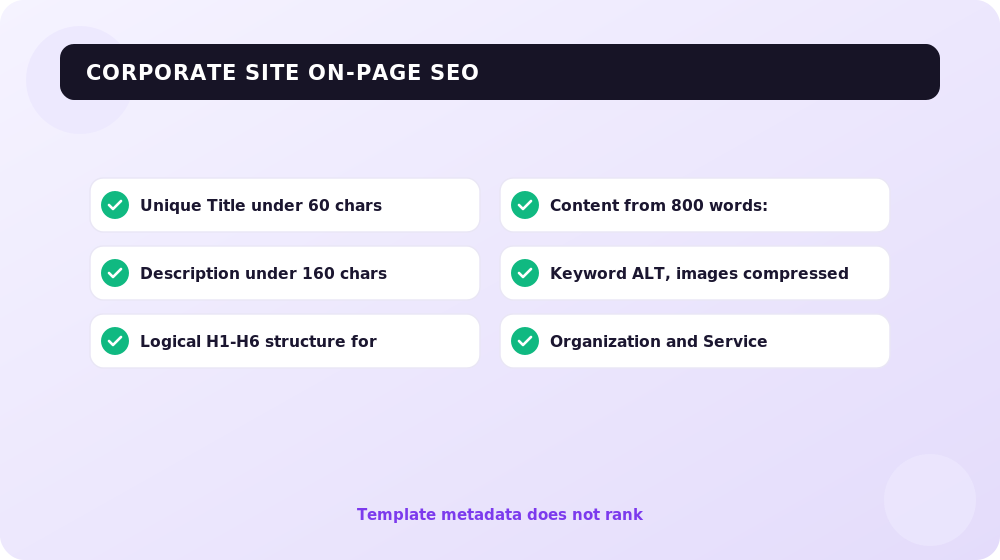
In practice, 80% of the corporate websites that come to me have templated or broken metadata, headings, duplicate content, and a broken logical structure.
And even those that don't come to me have rather unoptimized pages.
Yet it's precisely on-page SEO that determines whether a search engine understands your page and considers it relevant to the query.
Metadata
In most CMSs (especially WordPress with templated themes), all titles and descriptions are inserted automatically.
- The H1 heading is copied into the Title.
- The Description — a truncated first paragraph of text.
- And on every page it's a template like: "Company 'So-and-So' — Services, Prices, Contacts." That's it.
What's the end result?
- No keywords — doesn't rank.
- No call to action — doesn't get clicked.
- No uniqueness — gets cannibalized and filtered.
How to do it right:
- Title up to 60 characters, with the keyword included closer to the beginning.
- Description up to 160, with intrigue and a CTA (for example: "Order a security audit — 3 days and you'll know everything about your risks").
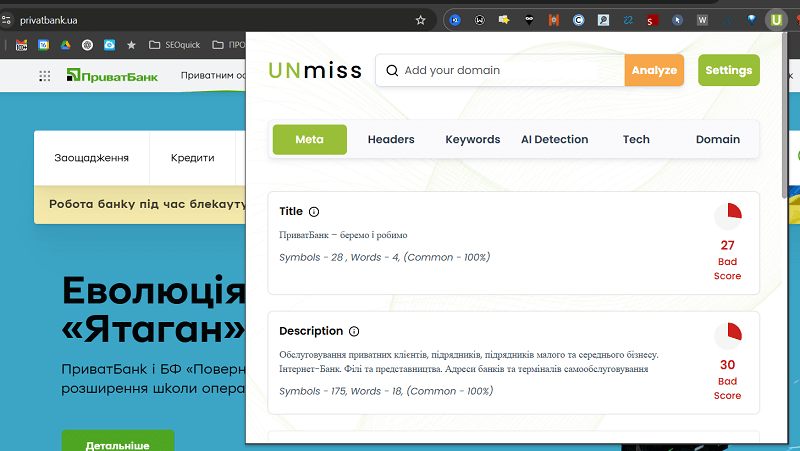
We write the headings right inside our Unmiss Audit for our own site — it analyzes your content and suggests relevant headings, and also shows the keyword density within it.
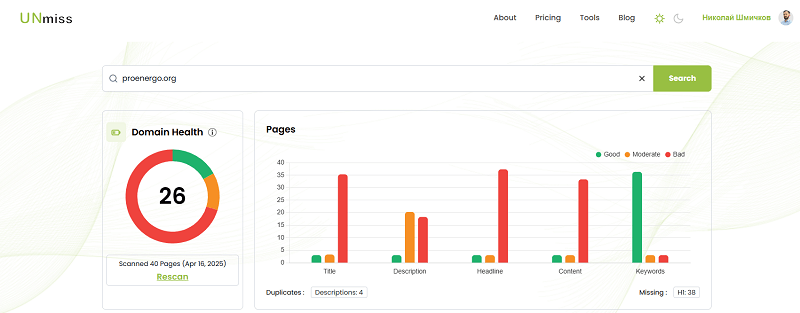
Edit your metadata right inside the tool, then export an Excel file with the metadata and hand it to your SEO specialist so they can update it in the site's content.
Headings H1 and H2-H6
On most sites:
- The H1 repeats the Title (and sometimes it's just written as "About the company").
- Inside — either a pile of h2s with no logic, or everything is h3 because "that font looks prettier."
Where's the semantics here? Where are the keywords? Where's the intent? — Nowhere.
Try to build your headings so their structure is thought through.
The GPT template says: "500 words per page."
But let's be honest: if you write 500 words for the sake of length rather than to fulfill the query's intent, that's just an SEO cargo cult.
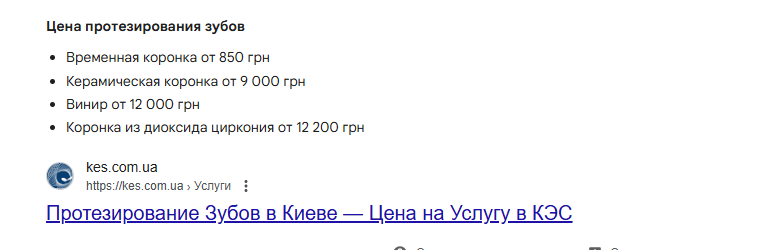
Quality content will appear in an expanded snippet.
What matters:
- A page should not just "have text" but provide an answer to a specific query.
- Ideally — at least 800 words, with tables, comparisons, bullet lists, case studies.
- And no fluff in the spirit of "We take an individual approach to every client." Better: "We conduct the audit in 3 stages: a technical scan, interviews with staff, a review of processes. The report — a PDF with CVSS priorities, detailed screenshots, and recommendations."
Images
Don't forget about images. And don't make this mistake: a site with 30 images named like image123.jpg, DSC00421.png, with an empty ALT.
What you need:
- Rename files before uploading: audit-it-city.jpg instead of IMG_0003.
- Add an ALT with a keyword: "website audit in the city."
- Compress images — via TinyPNG, without losing quality (ideally — under 150 KB).
- Add lazy loading if the engine supports it.
Use ALT tags with keywords (take keywords from the page's semantics) and compress files via TinyPNG for speed
This isn't just SEO, but also Core Web Vitals, speed, and UX.
Microdata
Set up Organization or Service microdata via Schema.org — this adds rating stars or contacts to the search results. Many "SEOs" put Organization or LocalBusiness on the homepage and consider the job done.
In reality, if you don't mark up services (Service), you lose the chance to get rich snippets.
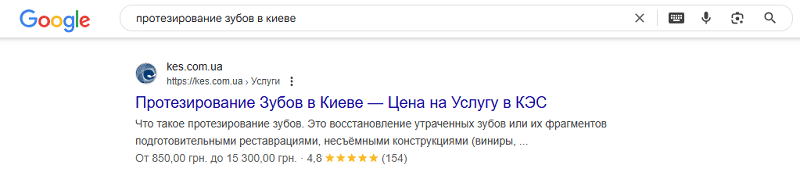
What Schema.org actually gives you:
- Reviews (stars).
- Prices (if you list them).
- Questions (if there's a FAQ block).
- Contacts (address, hours, phone).
For a corporate site, the minimum is Organization (or LocalBusiness, if you're tied to an office) + Service on all service pages.
Technical SEO
Technical SEO is the foundation without which even the best content won't work. Corporate websites often suffer from a complex structure that makes Google indexing harder. In 2026, technical cleanliness isn't an option — it's a necessity.
Site audit
Run an audit via SeRanking — look for broken links, duplicate pages, 404 errors. Make sure the site loads in 2 seconds: optimize the code, use caching and a CDN like Cloudflare.
Here it's very important to have a convenient tool for analyzing errors on the site, and SeRanking provides this excellent capability. But for those who need to fix errors on their own site, you can reach out to me directly, and I'll give you a detailed audit of the project and estimate the cost of fixing the errors for you.
Mobile version
The mobile version is a priority, since most users come from phones; check it with the Google Mobile-Friendly Test.
For us, 70% of traffic is already mobile. For some — 90%.
And Google has long been indexing sites in mobile-first mode.
Now the question: who checks corporate websites specifically on phones, rather than in Figma? Almost no one.
Check the site in the Google Mobile-Friendly Test (Lighthouse). But not just the report — open it on a phone:
- Is the text readable?
- Does the menu not overlap the content?
- Are the buttons clickable?
- Are there "sticky" elements covering half the screen?
If it's inconvenient for you, it's "inconvenient" for Google too. And it'll rank you lower. Working on the mobile version is the hardest part.
For the mobile version, we completely reworked every element: from the main menu to every functional element on our site.
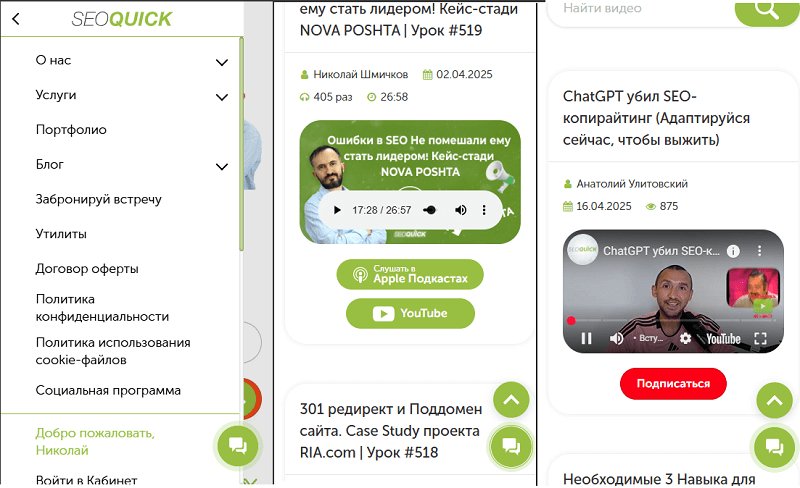
Our site on mobile isn't just usable. It's convenient to use!
Robots and Sitemap
Set up sitemap.xml and robots.txt so Google knows which pages to index.
Surprising but true: even in 2026, sites don't have an adequate sitemap.
Sitemap:
- Only pages with a 200 response code.
- Only those that actually need to be in the index.
- For large sites: no more than 50,000 URLs per file, otherwise split it by category.
- For each language, build its own Sitemap.
- Split the Sitemap by type if there are very many pages.
Robots.txt:
- Only what needs to be crawled is open.
- The admin panel, filters, and test pages are closed.
- At the bottom — a link to sitemap.xml.
I often see the opposite: Disallow: /search, Disallow: /admin, and… that's all.
Meanwhile, in the index — filtered pages, pagination, junk URLs.
This means: the robots file exists, but it does nothing.
Canonical and duplicates
For large sites, use canonical tags to avoid duplication. On sites with filters, categories, landing pages, and sorting — duplicates appear on their own. If you don't specify the canonical page, Google will choose for itself. And it's not certain it will choose correctly.
Examples of duplicates:
- Identical pages in two languages, without hreflang — cannibalization.
- The page /services and /services/ — treated as different in the index.
- URLs with UTM tags that end up in search and aren't closed in Robots.
- Pagination pages with no canonical of their own — or, the opposite, with a canonical pointing at page one: both are mistakes. Every list page needs a self-referencing canonical (here is why).
How it's solved:
- An explicit <link rel="canonical"> on every key page.
- Duplicate directories are closed in robots.txt.
- Hreflang is set up for multilingual sites.
- All redirects are checked manually — a chain of 301 → 301 → 200 can lose up to 30% of link equity.
HTTPS
HTTPS is a security standard; without it, trust falls. This is no longer a "nice to have." It's the norm.
- Without HTTPS, you'll have a red lock and a "not secure site" warning in the browser.
- Trust will drop.
- Some browsers won't even load the page (especially on mobile).
Click the top corner in Chrome and view your certificate
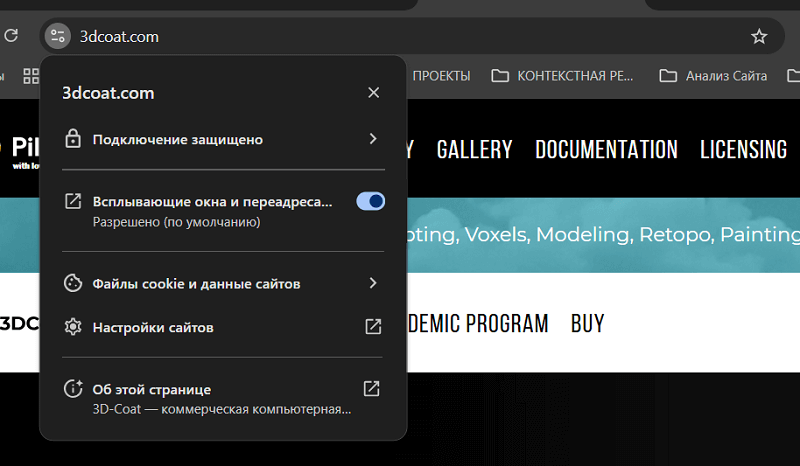
The check is simple:
- Is a Let's Encrypt (or commercial) certificate installed?
- Is the redirect from HTTP to HTTPS configured?
- Is there any mixed content (http inside an https page)?
We find mixed content errors in that same SeRanking.
Regularly check the site for errors so you don't lose positions.
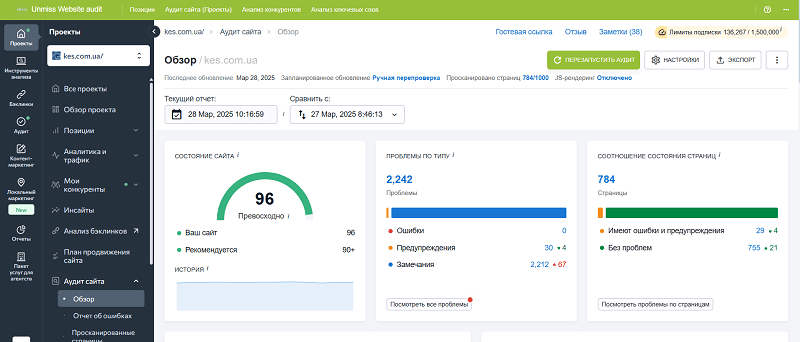
If you monitor the project regularly and fix errors in time, its positions will grow.
Content marketing
Usually, in response to the question "why do you need content on your site?" I hear one of three answers:
- So that it's there.
- So Google loves it and there's traffic.
- Because competitors do it.
And only a few say: "So a person finds an answer, realizes we're experts, and submits a request." That's the approach we work with.
Content isn't an SEO trick. It's a tool for building trust. If your site is just "a set of services + a bit of 'About us'," then Google will treat you like yet another clone site. And paid traffic from ads will be the best you can hope for.
The problem is that 90% of corporate websites publish articles following this logic:
- "Holidays at the office: how we celebrated."
- "We've moved to a new office."
- "What is ERP: everything you need to know in 3 minutes."
And all of it is written either by a copywriter with no immersion, or copied from GPT with Smart Reading.
What content actually works?
Content is what makes your site useful for clients and authoritative for Google. In 2026, corporate websites should be not just catalogs of services, but sources of expert information that answers the audience's questions.
Answers to client questions
The things written in briefs, asked on calls, clarified before payment.
Example:
- "How much does SEO cost"
- "What happens after the contract is signed?"
- "How to fix a Mixed Content error?"
Case studies with numbers and a problem
Not just "the project was completed successfully." We show: it was → we did → we got.
Example:
- "How we sped up CRM performance 4x on a project with 50+ users"
- "What went wrong during a client's cloud migration — and how we saved the project in 72 hours"
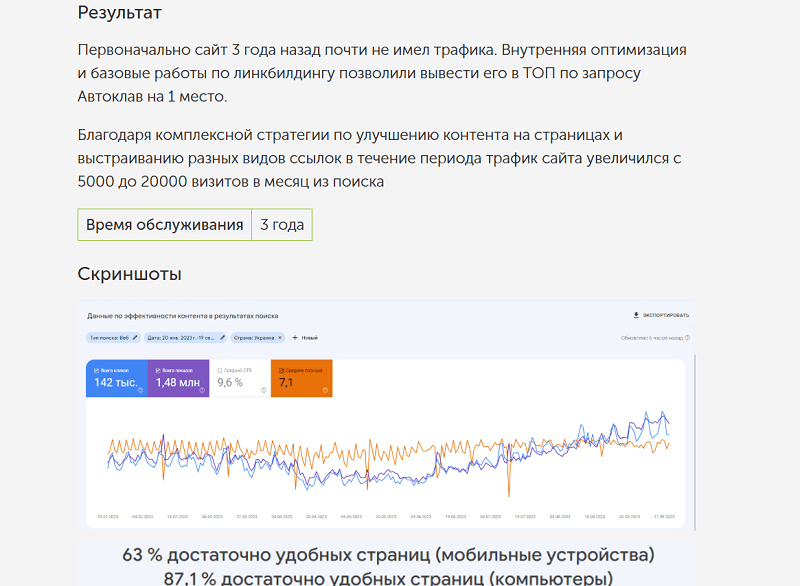
For example, in our Portfolio section all such content is interactive.
A person can browse the case studies on the site, click "More about the case," and read the details.
Guides and explainers for business
Yes, long, yes, detailed, but they work:
- "How to set up a YouTube channel"
- "Who is IT outsourcing right for, and who isn't?"
In the blog, the YouTube video channel, and in podcasts, we cover a huge layer of this type of content, and we earn a maximally loyal audience.
Who writes the content?
In 2026, Google doesn't just look at the text. It evaluates who the author is.
There's an acronym, EEAT — Experience, Expertise, Authoritativeness, Trustworthiness.
And if articles are written by a faceless author called "Marketing Department" — that's it, you're out of the game.
What works best:
- materials from real employees;
- interviews + editing;
- co-authorship with industry specialists.
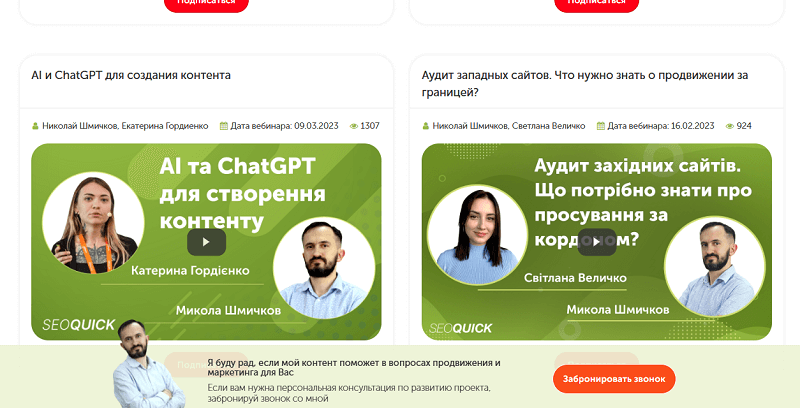
For example, SEOquick has a huge amount of material from various authors: joint podcasts, webinars, and even articles. Content must be unique and written by experts — Google values EEAT. If you write about complex topics, bring in company specialists or external authors with relevant experience. Update old articles once a year so they don't lose relevance.
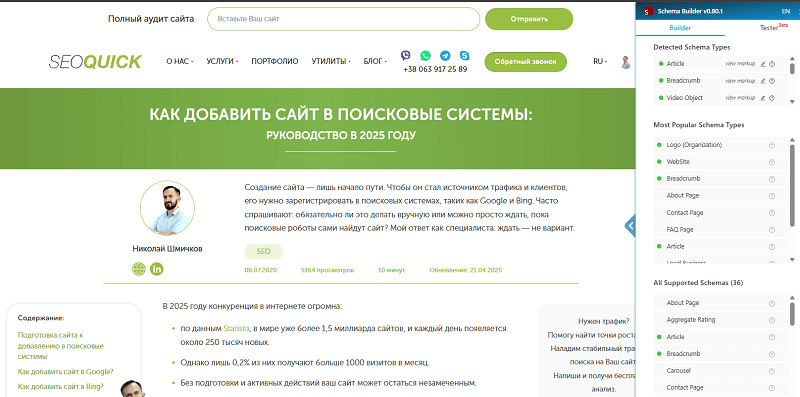
⚠️ GPT — yes, you can. But without post-editing, links to real sources, logic, and personalization — it's just junk. Use Article microdata for the blog to stand out in the results.
How often to publish?
The honest answer: it doesn't matter.
Once a month or once a week — as long as each piece meets demand, demonstrates expertise, and gets promoted.
What matters much more:
- The structure of the content on the site.
- Connection to specific services or clusters.
- Interlinking with services, case studies, navigation.
- Indexing and visibility for the right keywords.
Writing just for the sake of it is worse than not writing at all. It creates "noise" on the site that will hinder the truly important pages from ranking.
Old articles are an asset — if you maintain them
Most companies have no process for keeping content up to date.
As a result:
- Examples are outdated.
- Screenshots are wrong.
- Prices are different.
- Regulations have changed.
And Google sees this. If a page hasn't been updated in 2 years, the demotion isn't immediate, but it's steady.
We advise gathering a list of all the pages on the site and checking the content's update date for each.
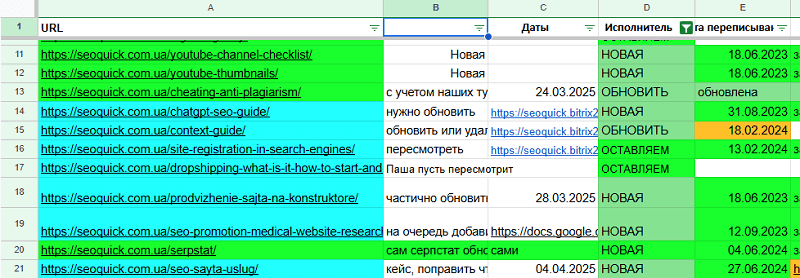
An example of "our" old content plan
What we do:
- Once every 6-12 months — a full content review.
- We update statistics, links, examples, SEO blocks.
- We check titles and descriptions (for example, our old articles were written back when they were optimized for outdated search engines).
Link building
Backlinks (also called inbound links, or in plain terms — "external links") in 2026 remain one of the ranking factors, but quality matters more than quantity. That is — yes, links work in 2026. And yes, Google has officially never removed them from the list of ranking factors. But many SEO specialists no longer include them in the TOP 3 ranking factors.
And if you think you can simply "buy 100 links from a marketplace," you're either 10 years behind reality, or working with a contractor who stopped at the level of link marketplaces and PBNs.
The importance of having links
For corporate sites, external links are an indicator of trust.
If people talk about you, if they link to you, if your materials are cited — Google considers you an expert.
If you're nowhere to be found, that means you're either a newcomer or you don't represent any value.
The difference between a link from a page like "TOP 100 IT companies according to Forbes" and a link from a forum like "spammer-forum.net" isn't just authority. It's the difference between +1 and -10.
Where to get quality links for a corporate site?
Roughly speaking, the list of TOP quality links from scratch is: industry media, Wiki, Gov/Edu links, partner links, mentions in ratings, and directories.
Partner links
Do you have suppliers, integrators, contractors, clients?
Create an "Our partners" section and ask for a similar one from them.
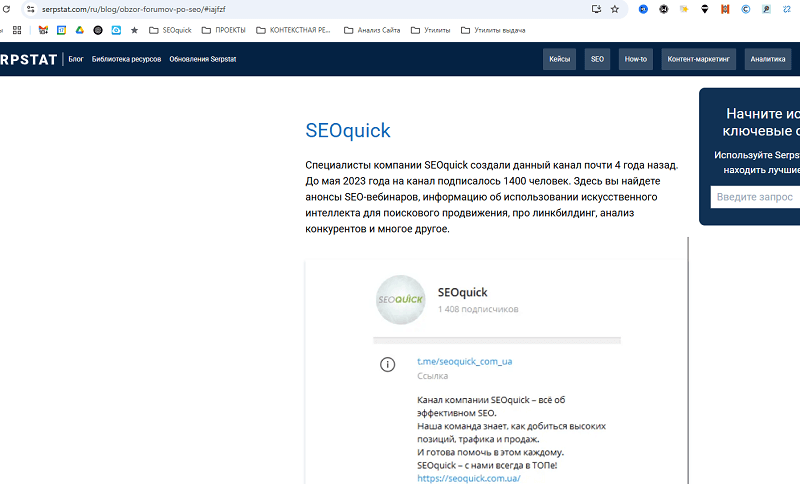
A partner link from our partner
Here's an example — our link and a link to our Telegram channel on the site of our partners SERPSTAT.
This isn't just link building — it's verification of your network of relationships.
Mentions in interviews and analytics
Publish your founder in an "Opinion" column, participate in industry ratings and reviews, comment on current topics. Even a simple reply to a journalist's query via PRNEWS.IO, Help A Reporter (HARO in the US), or a similar service is a chance to get a trusted link.
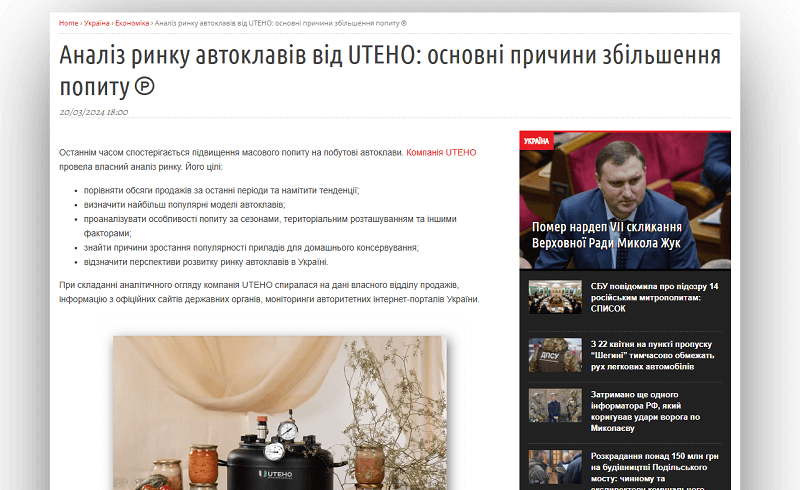
An example of research from our client
Example: "UTEHO's autoclave market analysis: the main reasons behind rising demand" — such material gets read, cited, and linked back to as a source.
Student Scholarship programs
Such programs work great for both link building and PR in general. The essence of the program is creating a "contest" page for students, where they compete in writing quality articles on your topics. And you reward the students for winning. The case is laid out in detail here.

An example of a Scholarship program — on our site
The value lies in having such links to you even after the program has already ended.

An example of a link to a Scholarship program from our client
Links on Wikipedia
Oddly enough, setting up your own Wikipedia page isn't that hard. You just need to find an author (or become one), write a quality biography, cite confirmation from media outlets (which you've arranged in advance), and link, for example, to the Scholarship programs you've run.
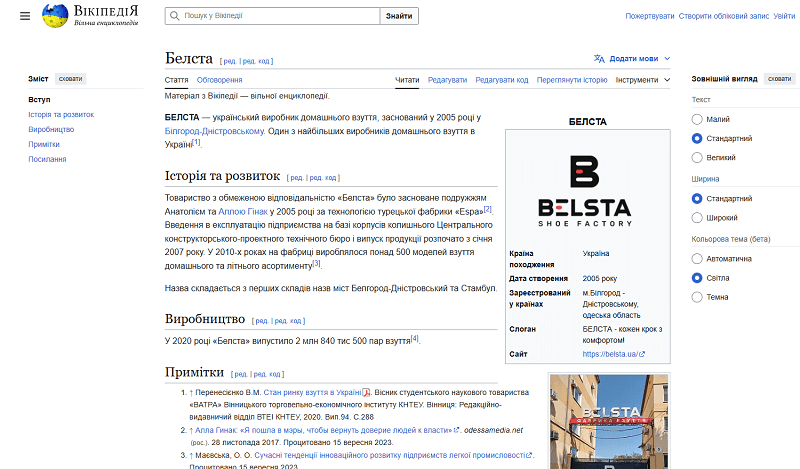
An example of a Wiki link of our client
And as a result, you get an excellent trusted link to your business.
White directories and ratings
White directories are the TOP reference catalogs that rank in your country. I covered how to gather a list of such directories in this article. The list of directories for each country and even niche can differ dramatically. Create a profile, verify your contacts, ask for reviews. Some directories give juicy dofollow links even to service landing pages.
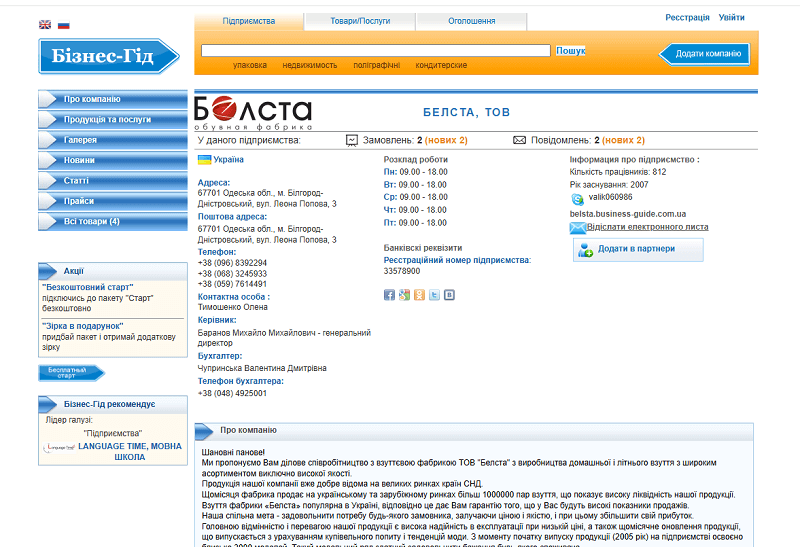
An example of a listing in a business directory
Some consider them outdated. But if you're in B2C, medicine, or offline services — it's a must-have.
Even in B2B, a link — and a client — can come from a specialized directory. Plus, they create local signals for Google.
If your site is mentioned in major local industry directories, it boosts trust and helps local ranking. Even if there aren't many referrals from these platforms.
Industry media and directories
The list of industry media can vary by type of business. For example: Ain, DOU, Liga.Tech, MC.today, Forklog (if fintech), Retailers (if e-commerce).
There you can publish not just news, but case studies, columns, guest posts.
An example of our link in an article on a partner site
Here you need to approach it creatively: compile a list of portals that accept topical articles, get to know the owners, and offer your content. The key here is to come in ALREADY known — that is, you need to work on social media too and pay attention to your personal brand. As an unknown, no one will need you.
What definitely NOT to do (even if you "really want to")?
Here's a list of what you shouldn't do even for free, let alone for money.
- Spam in comments — 0 effect, often Nofollow, sometimes harmful.
- PBN networks — even if they "fit you in nicely," it's exposed at the level of IP, CMS, and templates, and it gets wiped out during Google updates.
- Marketplaces with automatic insertions — in 2026 this not only doesn't work, but can also get hit by a SPAM Update.
- Anchorless, chaotic insertions into irrelevant articles — especially with casinos, crypto, "window repairs."
The second item — PBN networks — they're what all the link marketplaces are packed with today.
Focus on natural links; for international sites, look for links from foreign resources relevant to your niche. Check your link profile via Ahrefs, SERPSTAT, or SERANKING (yes, it has link analysis too) — remove toxic links so you don't get hit by sanctions. Regularly create content that people want to cite: research, infographics, reports.
Regional (local) promotion of a corporate website
The point is that your site often works either within a region or across an entire country. And sometimes you need to expand, or it was planned at the site-creation stage — several countries or a specific number of cities. When a company owner says, "We want to enter a foreign market" or "It's important for us to be promoted in a particular city," in practice it means one thing: the site will get an EN button and somewhere in the footer they'll write "office in [city]." And that's where the whole "geotargeting" ends.
In reality, local and international SEO require two different approaches, different tools, and different promotion logic. And if you want to actually gather traffic from the right regions, rather than just "be available to everyone," the site needs to be adapted correctly. Below — how it works.
Local SEO: when you work for a specific region
Local SEO is always relevant when:
- the company has a physical presence (office, branch, warehouse, showroom);
- you serve clients only within a city or region;
- competition in the niche depends on the geography of the query.
Google increasingly shows local blocks: maps, addresses, organization cards. And if your site doesn't get in there, even perfect pages won't show up above competitors who simply set up a Google Business profile and have a couple of reviews.
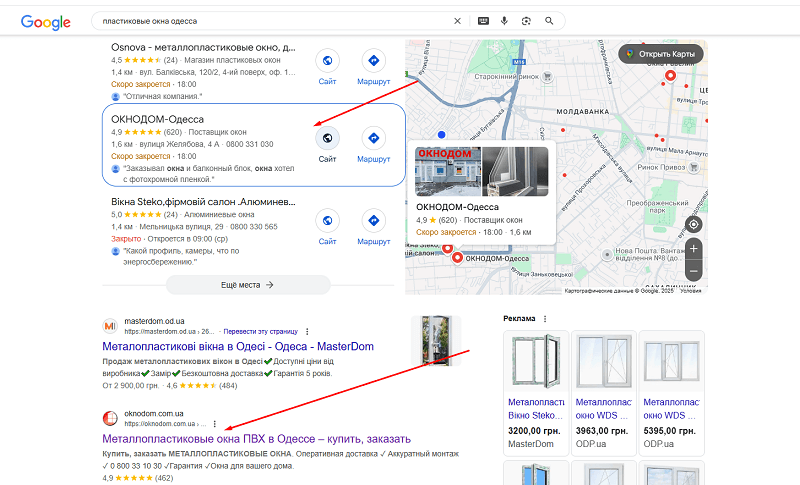
An example of a company in Google Business
But if you do everything correctly, you'll be both in Google's results and even in the maps block.
A company card in Google isn't a formality, but a ranking factor. And in this case we devote maximum time to it.
What should be there:
- photos of the office, staff, logo, not stock images;
- regular posts about company news, promotions, new services;
- reviews from clients, with responses from the company;
- up-to-date hours, phone, site, links.
A common mistake: "the Google My Business card (now Google Business Profile) exists, but it's not updated." The result — no one sees it, or Google hides it itself due to low activity. And if the card isn't verified — that's even worse than not having one: Google may show incorrect information and won't let you manage reviews.
Geo-dependent pages
If you work nationwide — yes, you need them. But not "one template multiplied by 24 regions."
Rather, make each page:
- tailored to a specific search cluster: "IT support [city]," "SEO in [city]";
- have unique content: examples of projects in the region, real reviews, address, phone numbers;
- not be a copy of others, otherwise it'll fall under the duplicate filter.
It's precisely these pages that gather traffic from regional queries. And most importantly — they let Google understand where you actually operate.
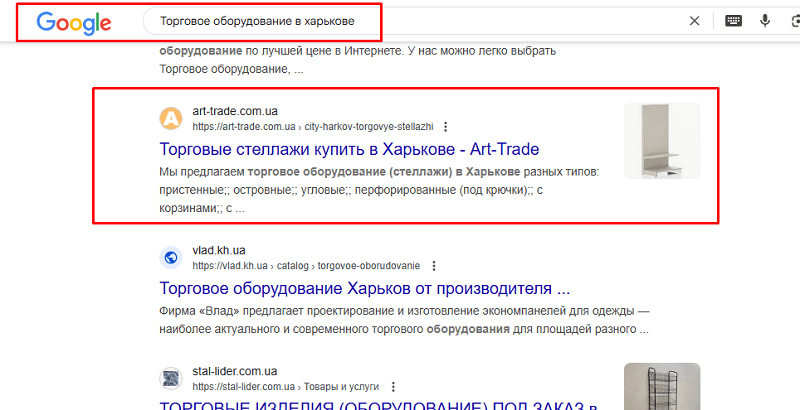
An example from my client Art-Trade for a geo-dependent page
Such pages can be created precisely for queries, but it's important not to make the mistakes mentioned above. And they will rank in Google.
International SEO
Usually "going international" on a site looks like this: an EN button in the header → a couple of pages translated, and beyond that there are simply no more pages.
At best — they translated the text but forgot about:
- meta tags;
- microdata;
- the menu;
- Hreflang;
- redirects.
The result — Google gets confused about the languages, doesn't index the duplicates, and your "international site" remains exclusively local, just in English. Below is a list of what needs to be implemented.
Hreflang — not just a "tag on the homepage"
Hreflang is a technical tag that tells Google which language and regional version of a page to show the user.
You can check Hreflang on a site in the code by finding the corresponding tag.

An example of the Hreflang tag on our site
Mistakes I see on 80% of corporate sites:
- it's only specified on the homepage;
- it's not duplicated on subpages;
- incorrect format (en instead of en-US, uk instead of uk-UA);
- no return links (hreflang A references B, but B doesn't reference A).
The last one is my colleague's favorite mistake, since it generates simply enormous tables of the same type of error on multilingual sites.
Without hreflang, you get confusion in the index, dropping positions, and a loss of traffic from the right region.
Content ≠ translation
Americans love case studies and numbers, Germans love technical details and argumentation, the French love style and presentation. If you just translated the "About us" text into English — it won't work.
Content must:
- account for the region's behavioral patterns;
- be adapted to the style of presentation (tone, examples, emphases);
- be written not "head-on," but for the needs of the specific segment in that country.
Previously, we translated content into different languages with a machine translator, and one time we got a negative case — our project died and collapsed. People didn't want to finish reading the translations.
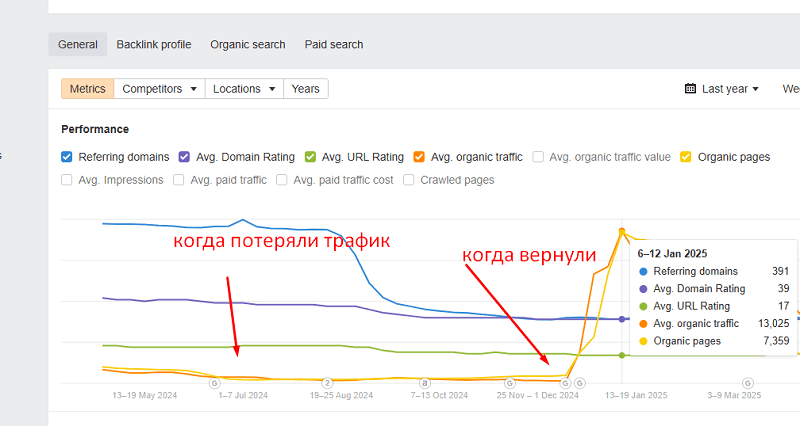
An example of our project losing traffic
We had to tear down all the translations and update them by hiring experienced specialists in each country: Russian-speaking and English-speaking traders, and even traders from India to write in Hindi. Unfortunately, the project left us, but the results of our work showed themselves later on. These things happen.
Geotargeting and domain structure
If you use subdomains (en.site.com, de.site.com) or folders (/en/, /de/) — set up geotargeting via Google Search Console.
Specify which language and region is tied to a particular version.
Additionally:
- for an aggressive strategy, you can use national domains (site.de, site.pl);
- don't forget to specify hreflang on all pages;
- create separate sitemap.xml files by language.
Social media and video content as a brand amplifier
Many still think SEO is only about the site and the text. And everything else is "another department's marketing job."
The result: the site seems to be getting promoted, yet online there isn't a single living quote, video, or mention of the company.
But in 2026, Google takes into account everything related to the brand:
- how people talk about you;
- where you're mentioned;
- whether there's activity on third-party platforms;
- who links, comments, and shares.
An example of our results for a branded query
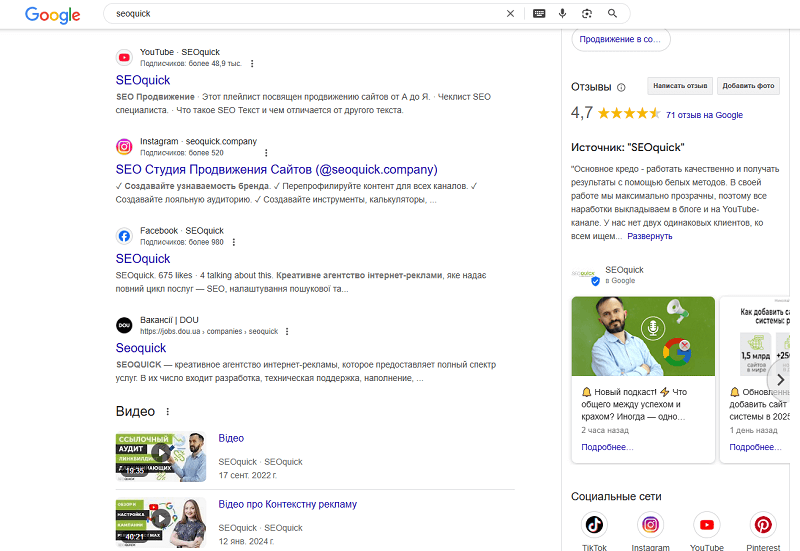
If you're not on YouTube, LinkedIn, Facebook, if no one writes about you — you don't exist for the search engine either.
A company YouTube channel: why, and how it relates to SEO
YouTube is the second-largest search engine after Google. People spend on average 90 to 100 minutes on YouTube.
But even if you don't plan to become a video blogger, YouTube accomplishes 4 things at once:
- Builds trust — the "face of the company" = real employees, not stock.
- Drives traffic to the site — from video descriptions, pinned links.
- Creates reasons for links — if you make case studies, breakdowns, tutorials.
- Appears in Google's results — especially for informational queries, where competition among articles is higher.
Analytics for our YouTube channel
Even 2-3 minute clips shot on a smartphone are better than an empty YouTube channel.
Important: upload videos with metadata (a keyword in the title, a description with a UTM link to the site, tags, subtitles). For you, I have at least two articles: how to create a channel and how to promote videos on it.
Social media
SEO doesn't always deliver fast reach.
But if your post on Facebook or LinkedIn gains reach, people will start Googling it.
Queries by brand, an employee's name, a case study, a product name — grow. And that's a signal in the site's favor.
What works:
- LinkedIn — the ideal platform for B2B. Share case studies, new materials, write "in person."
- Facebook — for corporate image and live reviews.
- Instagram — if you're in design, construction, or the legal niche — visual content works great.
- Telegram — if you want to build your own media model (yes, this also reinforces SEO).
- TikTok — combine video and blog content into videos and earn a target audience. It works, probably ideally, in any niche.
Social media reinforces the site, it doesn't replace it. And it becomes part of the overall funnel: social media → interest → search query → site.
Video and articles — it's not either/or
Very often I see businesses facing a dilemma: "Either write articles, or make videos."
In reality, the combination works:
- Video → article (transcript, SEO version, VideoObject markup).
- Article → video (shoot a short clip, post it as an explanation).
I've been doing this for a long time, see for yourself. I have both an article on promoting the Rozetka website, and a video, and even podcasts!
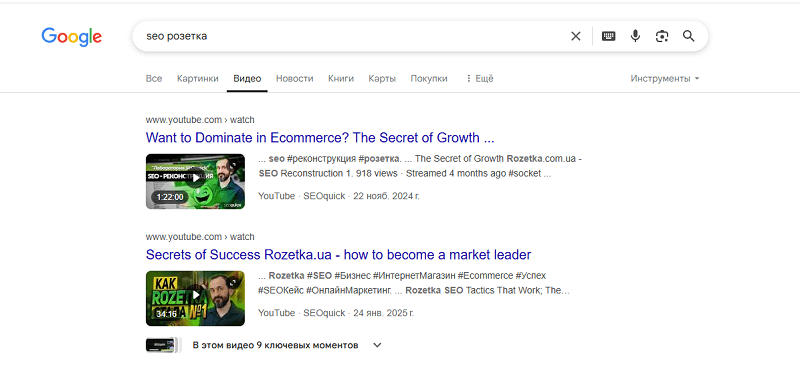
Google sees all of this. If your page has:
- structured text;
- embedded YouTube;
- microdata;
- a correct H1 and meta —
you get maximum visibility in search.
A corporate website in AI search
In 2026, users increasingly don't reach the classic search results: they get the answer right in AI Overviews (Google AI Mode), ChatGPT Search, Perplexity, or Bing Copilot. For B2B this is especially painful — a long sales cycle begins with the decision-maker asking the AI "who should I outsource accounting to" or "which agency to choose for an InfoSec audit." And if your site doesn't make it into that answer, you're simply not on the shortlist, even if you're at the top of regular Google.
The good news: the foundation is the same as for classic SEO, only the emphasis has shifted. AI systems love pages from which it's easy to extract a ready answer: a clear H1 matching the query, a short answer in the first paragraph, then elaboration with facts, tables, and lists. Organization, Service, and FAQ microdata helps the AI understand who you are and what you offer. And E-E-A-T works even more strictly here: AI models rely on the authority of the source, so real expert authors, a biography, citability in industry media, and consistency of company data across the web determine whether they cite you or a competitor. We covered in more detail how optimization for neural search is structured in our article GEO optimization for GPT.
Separately, about brand signals: AI search collects a "collective opinion" about a company from mentions, reviews, ratings, and social media. The more often your brand appears in a trusted context (specialized media, directories, LinkedIn, YouTube), the higher the chance the model will name you specifically. So build content that's convenient to cite: direct answers to questions, case studies with numbers, expert definitions. How to prepare materials specifically for AI-system answers — we showed in the guide AI content: how to write answers for neural networks.
In place of a conclusion
If you've read this far, it means you definitely understand: SEO for a corporate website is not a plugin or a couple of links.
It's systematic work on every level:
- The architecture and logic of the pages.
- Content that fulfills intents.
- Technical cleanliness and speed.
- A strategy for links and external reach.
- Video, social media, brand signals.
- Regular audits, analytics, and a response to the market.
In 2026, the winners aren't those who "do SEO." They're those who understand how to embed SEO into marketing, sales, and service.
A website has long since stopped being just a business card. It's your sales manager, your PR department, and your trust service. All in one.
If you're interested in SEO promotion for your corporate website — write to me and I'll put together a unique strategy for you, and we'll figure out how to make you well-known and commercially successful!
How to Promote a Binary Options Website in 2026
Learn how to effectively promote a binary options website in 2026. An overview of white-hat SEO strategies, E-E-A-T improvement, link building, and bypassing ad barriers. SEOquick case studies
Read →
SEO in 2026: The Complete Guide to Promoting Your Website
How to promote a website in Google in 2026: AI Overviews and AI Mode, E-E-A-T, technical SEO, link building, GEO. SEOquick's complete guide with case studies and a checklist.
Read →
SEO Case Study for Binary Options Affiliate Sites
A practical guide to promoting sites that earn from binary options broker affiliate programs (Quotex, Pocket Option and others). Up-to-date strategies, geo-targeting nuances and link cloaking for maximum revenue in 2026.
Read →Want to apply this to your site?
We will review the current situation, find the first growth levers, and suggest a practical working format.