Search Everywhere Optimization: Ranking on TikTok, YouTube, Reddit and AI Search
Search is no longer a synonym for Google. People ask TikTok, read Reddit, watch YouTube and double-check with ChatGPT — often about the very same question. Here is how a business shows up where its customers actually search, without trying to be everywhere at once.


Search Everywhere Optimization is about being present where your customer asks their question: Google, YouTube, Reddit, TikTok, marketplaces, and AI assistants. Being everywhere at once is unnecessary and counterproductive. Choose two or three platforms where your audience makes purchasing decisions and cover them with a single content chain.
"We invested in SEO, traffic dropped — what now?" — this is the most common concern we hear. Traffic hasn't disappeared. It has moved to search elsewhere. People no longer start their buying journey in the Google search bar: they scroll through TikTok, read a thread on Reddit, watch an unboxing on YouTube, and check prices with ChatGPT. Google remains, but it becomes one touchpoint out of six. And if you aren't in the other five, you only reach the customer at the final stage — where competition is based solely on price.
What it is in simple terms
Old SEO answered the question "how to get to the top of Google." The new task is different: how to be in the place where the person is actually asking. And they are asking in the most unexpected places.
Trace the journey of a single sofa buyer. They saw an interior on TikTok. Googled the model. Went to Reddit to check if the upholstery would sag after a year. Watched a video on YouTube to see how the sofa unfolds in real life. Asked ChatGPT what to buy for that budget. Bought it. Five platforms before Google and one after — that’s what a typical decision looks like in 2026.
Why you can no longer ignore this
I'll start with the unpleasant part. A click from Google has become a rarity: according to data analyzed by Search Engine Land, at the beginning of 2026, 68% of searches ended without a click to a website. People read the answer directly in the search results and go no further. SEO hasn't died because of this — it's just that measuring it by clicks alone is no longer enough (I wrote about this in detail in the article about Google AI Mode).
It gets more interesting. Reddit gathers about 842 million organic clicks per month from US Google and consistently ranks in the top 5 most visible domains — these are figures from a Semrush study of 248,000 posts. This means someone else's forum outperforms almost any brand website in visibility. And YouTube, according to an analysis of 46 million AI Overviews citations, provides about 23% of all links that Google includes in its AI answers (5W report based on Surfer data).
And separately — about products. About half of product searches start not on Google, but on Amazon; this figure has been recorded for several years in a row. For an online store, this means one simple thing: a product listing on a marketplace is just as much an object for optimization as a category on your website.
Which platforms do you specifically need
A typical mistake after reading such an article is to create accounts everywhere. A month later, half of them are dead. You should choose based on the type of demand in your niche, not the hype.
YouTube — for complex and expensive products
Video closes the sale through trust, Google video carousels, and AI citations all at once. Moreover, it's not just the "millionaires" being cited. According to Otterly.ai, 94% of AI citations come from long-form videos rather than Shorts, and the correlation with view count is almost zero. Structure wins: a clear title, timestamps, and a transcript. A calm, 12-minute expert video with chapters has a better chance of getting into an AI answer than a viral Short with a million views.
Reddit and forums — when people debate before buying
This is a case where someone else's platform drives sales better than your own blog. Nikolay speaks bluntly about this in the video on Parasite SEO:
"Why spend two years boosting your own site when you can get into Google in two days for free, without any registration? We enter a query like 'best VPN' or 'hosting reviews' — and Reddit might be at the top. Google loves forums and user-generated content. It trusts people, not brands."
And there, he shares his personal bet for the coming year:
"The strategy is not to write an extra article on your own blog, but to place this massive piece of content on popular platforms that already dominate the search results. Reddit is one of the places where I would invest effort, and I personally intend to do so."
I'll be honest: Reddit does not forgive advertising. An account that comes in just to sell is wiped out by moderators within a day. Only meaningful participation works — answering questions, providing data, and calmly acknowledging the weak points of your product. You can't buy this, and it won't happen quickly.

TikTok — when the product can be shown
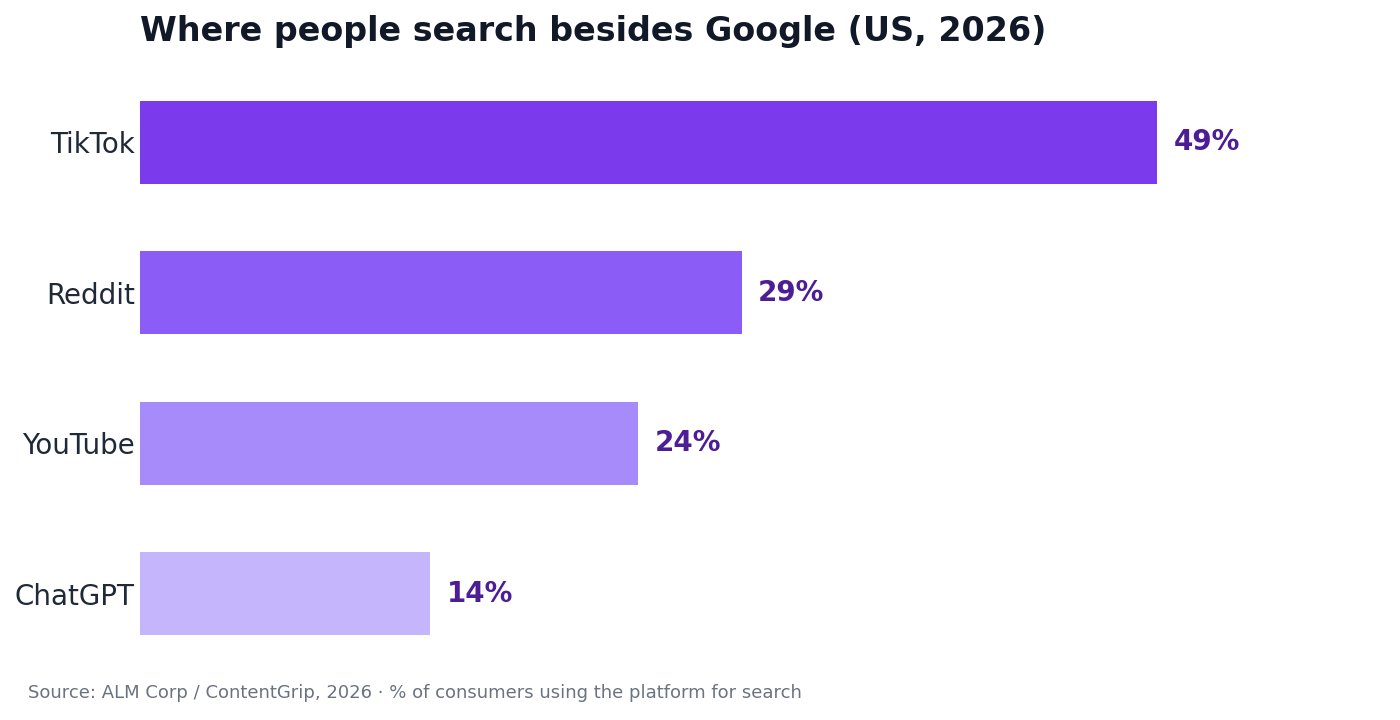
TikTok is used as a search engine by 49% of consumers, and among Gen Z, it's up to two-thirds. But let's have no illusions: the share of those who prefer TikTok over Google itself has dropped from 8% to 4% over two years. I read this not as "TikTok is deflating," but as a division of labor: people search TikTok for inspiration and to see the product with their own eyes, while they use Google to verify facts and prices. I analyzed the mechanics of TikTok's internal search separately in the article TikTok SEO in 2026.
AI assistants — a quiet channel that is already bringing in clients
ChatGPT, Gemini, and Perplexity have turned into a separate entry point. There are no rankings there — only citations. Whether you get into the answer depends on how easy it is for the machine to parse your text: a direct answer in the first paragraphs, facts, markup, and brand mentions elsewhere. For more on this, see the materials on optimizing for Perplexity and getting into AI Overviews.
Marketplaces — if you sell a physical product
Amazon, Rozetka, Prom. Half of buyers go here, bypassing Google entirely. The title, attributes, reviews, and product photos — this is the same SEO, just in a different interface. Alongside this are purchases via AI agents, which I wrote about in the piece on agentic commerce.
How to implement this without bloating your team
The framework we use with clients is based on one idea: don't produce content from scratch for every channel, but break down one strong piece of material into parts. We live this way ourselves — Nikolay's podcast turns into a blog article, Shorts are cut from it, and the key points are sent as answers to industry chats and forums. From one recording, you get four or five entry points instead of one.
Step-by-step, it looks like this. First, find out where your customers actually search — don't guess, ask your last ten buyers directly how they found you and what they watched before buying. This short survey is more honest than any report. Next, take one live customer question and film a ten-minute video on it, with chapters and timestamps. Transcribe it into an article where the first paragraph is a direct answer of 30–40 words: these are the paragraphs AI pulls into its responses. From the same video, cut two or three short clips with the question in the first three seconds. And bring this answer to where people are debating — without link spam, just being helpful. Finally, measure brand mentions and leads instead of rankings.
This isn't about doubling the budget. It's about repackaging what you are already doing. The problem with most businesses isn't that they write too little — it's that one good piece of content lives in one place and quietly dies there.
Where this idea usually fails
Most often — on presence for the sake of a checkmark. Five abandoned accounts do more harm than one active one: an empty profile reads as "business closed." Second — copy-pasting the same text into all channels: what works as an article won't be watched past the second second on TikTok; every platform has its own language. And keep duplicate content in mind — on your own site, it hits you directly.
And finally, the most expensive misconception — deciding that you can now drop Google. Search Everywhere reads as "Google and the others," not "instead of Google." Organic search still provides the cheapest leads. It's just no longer the only source.
Frequently Asked Questions
Is this a replacement for SEO?
No, it is its continuation beyond Google. The technical foundation of the site, semantics, and E-E-A-T continue to work — you simply add the channels where the customer is searching in parallel.
Where to start with a small budget?
With two channels. A website (this is your entry into Google and AI answers) plus one platform where your customer actually hangs out: for services, it's often YouTube; for products, a marketplace or TikTok. Connect the rest only when the first two start generating leads, not before.
How to measure results if clicks from AI and social search are barely visible?
By brand demand, by phrases like "came by recommendation" and "saw your video" in leads, plus AI visibility trackers. And don't be lazy — add the question "how did you hear about us" to your form; it's the cheapest source of truth.
Conclusion
Search hasn't died — it has shattered into pieces. The customer is still searching, but they now have six windows instead of one. Don't try to occupy all six. Answer honestly where exactly the decision to buy your product is made, and get there with a proper answer before your competitor does.
Not sure which channels will yield returns in your niche? Start with a free website audit — let's see where people are already looking for you and failing to find you.
H1 vs Title: how many H1 tags you need and how they differ
H1 in SEO 2026: how many H1 headings are acceptable, optimal length, how it differs from title, empty H1 and H1 as an image. Based on a measurement of 77 pages from the Ukrainian top and data on how often Google replaces your title with the H1.
Read →
Pagination SEO: how to index list pages without breeding duplicates
Pagination SEO in 2026: canonicals on list pages, noindex, rel=next/prev, infinite scroll, crawl budget. Based on a check of 36,000 traffic-driving URLs across twelve Ukrainian retailers, plus a teardown of pagination at Foxtrot, Epicentr and our own blog.
Read →
URL Structure: The Full Guide to Addresses You Can't Change After Launch
How to get URLs right: transliteration or Cyrillic, slug length, duplicates from case and filters, pagination, UTM tags, redirect maps. A breakdown of Rozetka, Comfy, Prom and Makeup URLs plus 2026 research data.
Read →Want to apply this to your site?
We will review the current situation, find the first growth levers, and suggest a practical working format.