Title tag in 2026: how to write titles that support CTR, SEO, and GEO
Rules and formulas for title tags: intent, value, brand, localization, duplicates, cannibalization, and testing in Google Search Console.


SERP title formula
A title should match intent, define the value, and stay useful even if Google rewrites the title link.
The title tag is one of the fastest SEO levers, but it is not magic. Google may generate a title link from several sources, not only from <title>. The job is not to stuff a keyword. The job is to signal the page topic, value, and intent clearly.
Good title formula
| Element | Why it matters | Example |
|---|---|---|
| Intent | matches the user task | “how to set up” |
| Specificity | gives a reason to click | “2026 checklist” |
| Entity | topic, product, service | “robots.txt” |
| Brand | trust and recognition | “SEOquick” |
7 rules
- Write one title for one main intent.
- Avoid duplicate titles across pages.
- Do not promise what the page does not deliver.
- Use the year only where freshness matters.
- For services, use commercial meaning, not generic claims.
- Check CTR in Search Console.
- Connect title with H1 without copying mechanically.
Useful formulas
Service + market + resultHow to do X: steps, mistakes, checklistX vs Y: what to choose for ZX in 2026: what changed and what to doX audit: how to find issues and priorities
SEOquick practice: rewrite titles together with the first screen. If the title promises an audit, the page must show audit criteria, output, and the next step.
Next step
Check pages in Google Search Console, update snippets, then use UNmiss and sem.chat to find questions worth moving into headings and FAQ.
Sources
URL Structure: The Full Guide to Addresses You Can't Change After Launch
How to get URLs right: transliteration or Cyrillic, slug length, duplicates from case and filters, pagination, UTM tags, redirect maps. A breakdown of Rozetka, Comfy, Prom and Makeup URLs plus 2026 research data.
Read →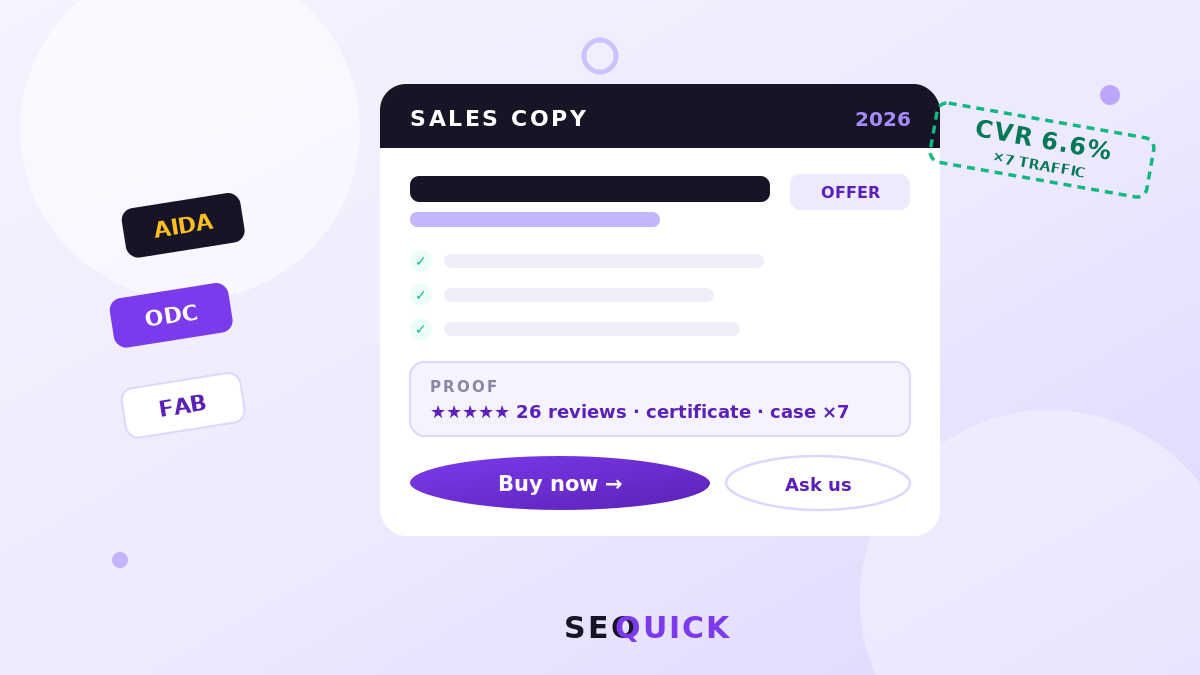
How to Write Sales Copy: Structure, 8 Formulas, Ready-Made Templates and Examples
Sales copy without fluff: the structure of a page that sells, 8 formulas (AIDA, ODC, PMHS…), a real first-screen breakdown, ready-made templates and prompts, SEO logic and metrics. SEOquick’s experience: a ×7 traffic case built on commercial pages.
Read →
H1 vs Title: how many H1 tags you need and how they differ
H1 in SEO 2026: how many H1 headings are acceptable, optimal length, how it differs from title, empty H1 and H1 as an image. Based on a measurement of 77 pages from the Ukrainian top and data on how often Google replaces your title with the H1.
Read →Want to apply this to your site?
We will review the current situation, find the first growth levers, and suggest a practical working format.