Remote Work in 2026: Hybrid, AI Tools, and the Productivity of Distributed Teams
Hybrid has become the norm, AI assistants the baseline tool, and teams are assembled in a distributed way. We break down the 2026 remote-employment market: numbers, tools, hiring, and productivity.

Remote work in 2026 is no longer a "temporary measure" but a full-fledged employment model: hybrid (a few days at home, a few in the office) has become the standard for most teams that can work remotely at all, and AI assistants have gone from novelty to a baseline work tool. Below is an up-to-date picture of the remote-employment market: how many people work remotely, which tools and formats companies choose, how distributed teams are hired and onboarded, and what all of this means for specialists in digital and SEO.
What "Remote Work" Means in 2026
First, let's clarify the terms — over the past couple of years the emphasis has shifted noticeably toward flexibility:
- Remote work: a form of employment in which the employee works from home (or any convenient place) instead of the office provided by the employer.
- Hybrid work: a partially remote format in which the employee works part of the week from home and part in the office. In 2026 this is the most common scenario.
- Fully remote work: activity performed exclusively outside the office; the employee is not provided with a workplace.
- Asynchronous work (async-first): an approach in which the team communicates in writing by default and is not tied to a single time zone — meetings are reserved only for decisions and discussions.
How Many People Work Remotely in 2026
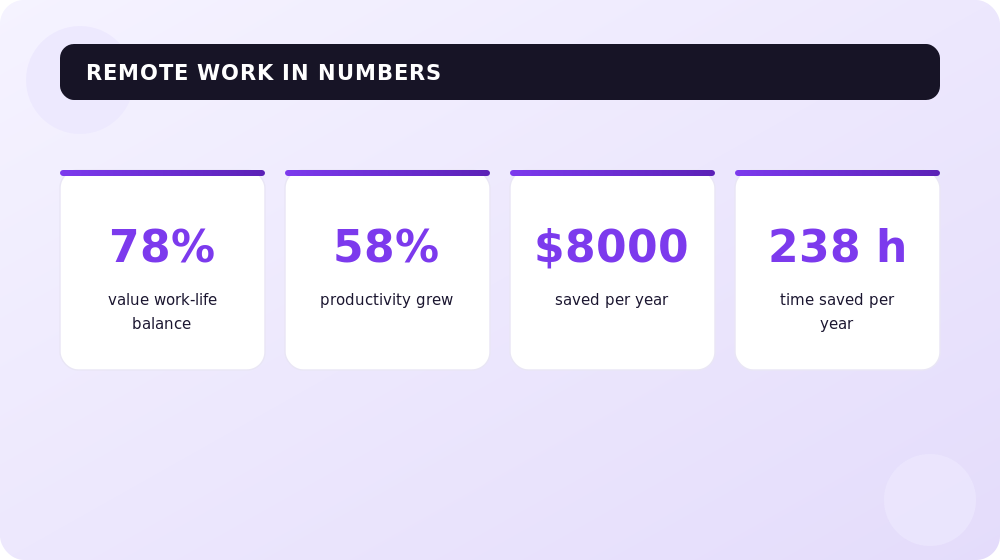
The main shift of 2026: pure "remote" has given way to hybrid, but the overall volume of remote employment remains high.
- In 2026, remote work in one form or another covered about 52% of the global workforce — almost double the pre-pandemic level (FlexOS, 2026).
- Among employees whose work can be done remotely at all, 53% work hybrid, 27% fully remote, and 20% fully on-site (Robert Half, 2026).
- At the same time, the market stays cautious with new postings: in early 2026 about 77% of new listings were on-site, 19% hybrid, and only 4% fully remote (Robert Half, 2026).
- Meanwhile, around 83% of workers prefer a mix of home and office rather than one extreme format (SurveyMonkey, 2026).
In other words, "office versus home" is an outdated question. The real contest is about how exactly to build hybrid: how many days, by what rules, and with which tools.
Who Works "Remotely"
Remote work long ago stopped being a privilege of IT folks, yet some still prefer the office and chats by the coffee machine.
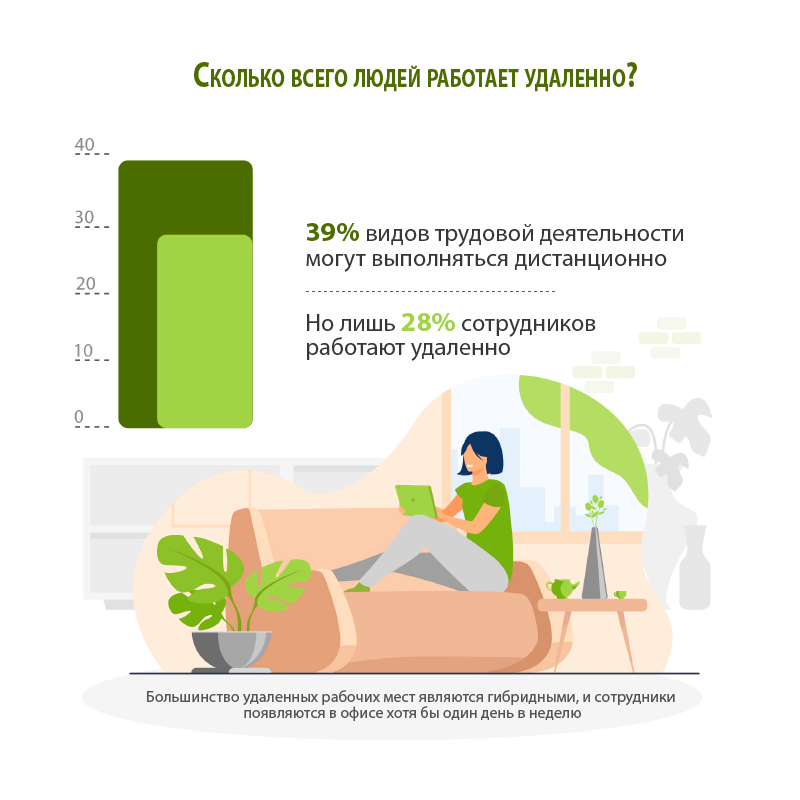
- Remote employees are on average 24% more satisfied with their jobs than those who work only from the office (FlexOS, 2026).
- 79% of remote professionals report lower stress, and 82% report better mental health with a flexible schedule (SurveyMonkey, 2026).
- 29% of employees are ready to look for a new job if their format is made fully on-site (SurveyMonkey, 2026).
For Ukraine and other countries with distributed teams this is especially relevant: the ability to work remotely helps retain specialists regardless of their physical location and keep the team together even in unstable conditions.
Hybrid vs. Fully Remote: What Wins in 2026
The 2024–2025 pendulum with loud "return to office" announcements has, in 2026, effectively settled on a compromise.
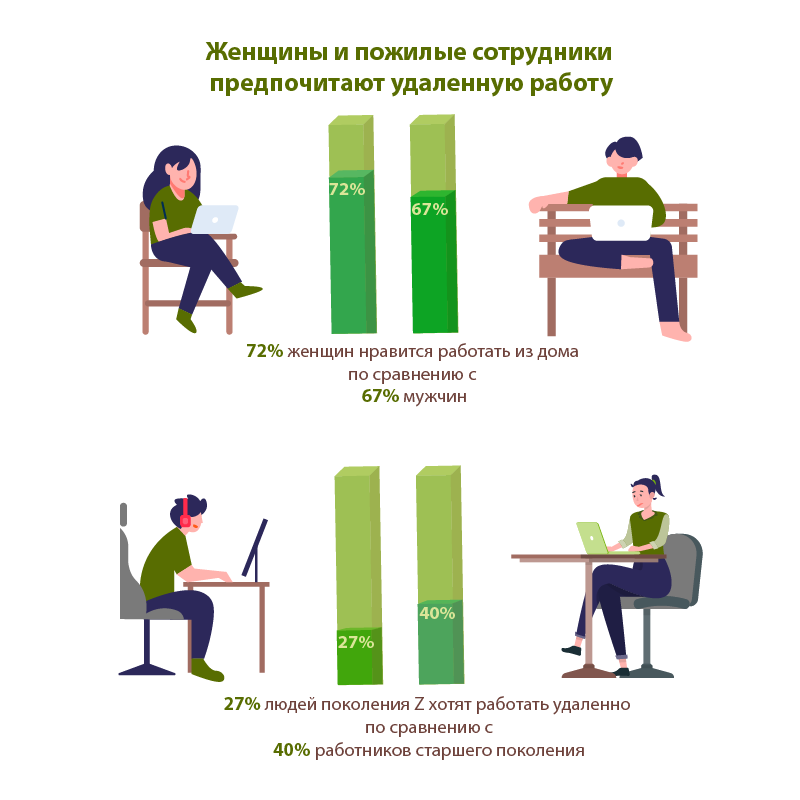
- 88% of leaders managing hybrid or remote teams say they have no plans to force everyone back into the office (FlexOS, 2026).
- Although many CEOs publicly predict a full return to the office by 2027, badge-swipe and geolocation data show employees come in less often than management demands (FlexOS, 2026).
- The share of companies with an official hybrid policy grew from ~20% in 2023 to more than 40% by 2025 (Chanty, 2026).
The takeaway: it's not ideology that wins, but flexibility. Companies that can combine formats and describe the rules clearly come out ahead in hiring and retention.
AI Assistants and Tools for Remote Work
If 2020 was the year of video calls, then 2026 is the year of AI assistants. Artificial intelligence has stopped being a separate "feature" and has embedded itself into the everyday workflows of distributed teams.
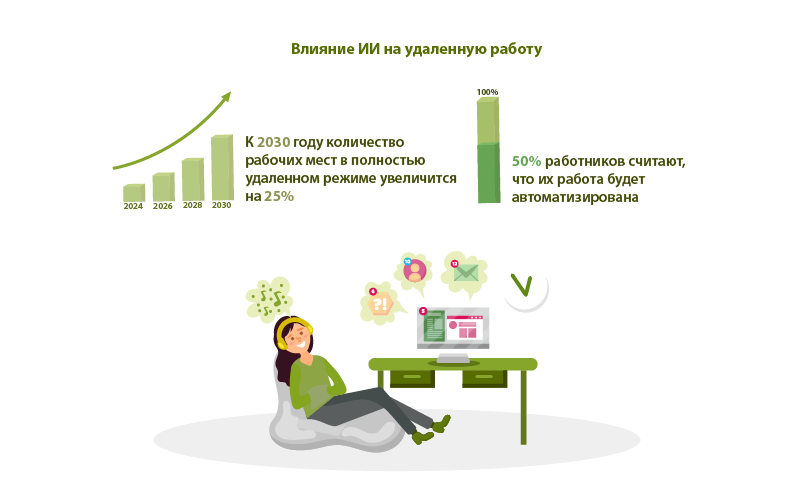
- Companies that embedded AI tools into core processes report a 20–40% productivity gain compared with teams working only on classic software (AI Tools for Businesses, 2026).
- Automating routine saves up to 30% of the time previously spent on repetitive tasks (AI Tools for Businesses, 2026).
A typical distributed-team stack in 2026 looks like this:
- Communication: Slack, Microsoft Teams, Zoom — now with built-in AI features (thread summaries, transcripts, suggestions).
- Knowledge and documents: Notion, Confluence with AI search across the knowledge base — so that "if it isn't documented, it doesn't exist" works in practice.
- Asynchronous video: Loom and similar — short recordings instead of unnecessary calls.
- Meetings and notes: AI note-takers (Otter, Fireflies, etc.) that capture decisions and tasks on their own.
- Process automation: Zapier, Make, and AI agents that take on routine coordination.
The next step, already emerging in 2026, is the move from "assistant tools" to AI agents that independently compile status reports, draft documents, and flag risks — freeing meetings for strategy rather than recapping who did what.
How to Organize Productive Remote Work
The key skill of a distributed team in 2026 is not "more calls" but smart asynchronicity and transparent rules.
- Async by default. Teams that made written communication the baseline report 20–30% more time for focused work. Write an update or record a 5-minute Loom instead of a half-hour meeting.
- Document everything. Decisions, processes, and agreements should live in a shared knowledge base — the only way to preserve context and onboard new people quickly.
- Clear communication rules. Agree on which channel is for what and what response time counts as the norm. Reserve synchronous meetings for decisions, brainstorming, and "human" conversations.
- Goals instead of control. Evaluate results, not "online status." Micromanagement and total monitoring kill the main advantage of remote work — trust and autonomy.
- Mental-health care. A separate agreement on the "right to be offline" and on workday boundaries prevents burnout in distributed teams.
Remote Work in Digital and SEO
Marketing and SEO are among the most "remote-friendly" fields: almost everything a specialist does happens in the browser and the task tracker.
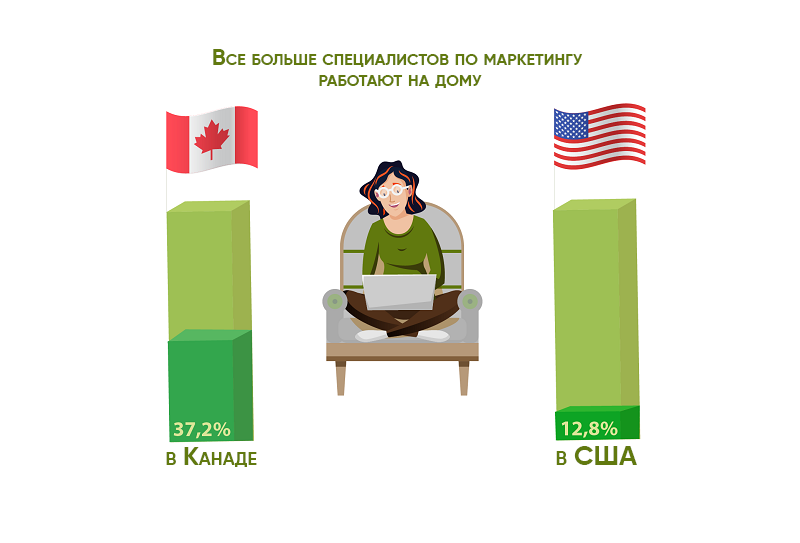
- The most in-demand digital roles of 2026 with strong demand are SEO specialist, paid-traffic specialist, content strategist, email marketer, and SMM consultant (Marquee Staffing, 2026).
- Freelancers in digital began earning more per hour thanks to AI tools for copy, design, and analytics — the workload did not grow proportionally to the income (AmQuest, 2026).
- Narrow specialization (for example, SEO for a specific niche) commands higher rates than a "generalist" profile.
For an agency this means a good specialist can be hired from any city, and a team can be assembled in a distributed way. If you're looking for a job in digital, check out our vacancies; you can learn how our team is organized on the about us page, and explore our comprehensive promotion service on the search engine optimization page.
Benefits of Remote Work for Employees and Employers
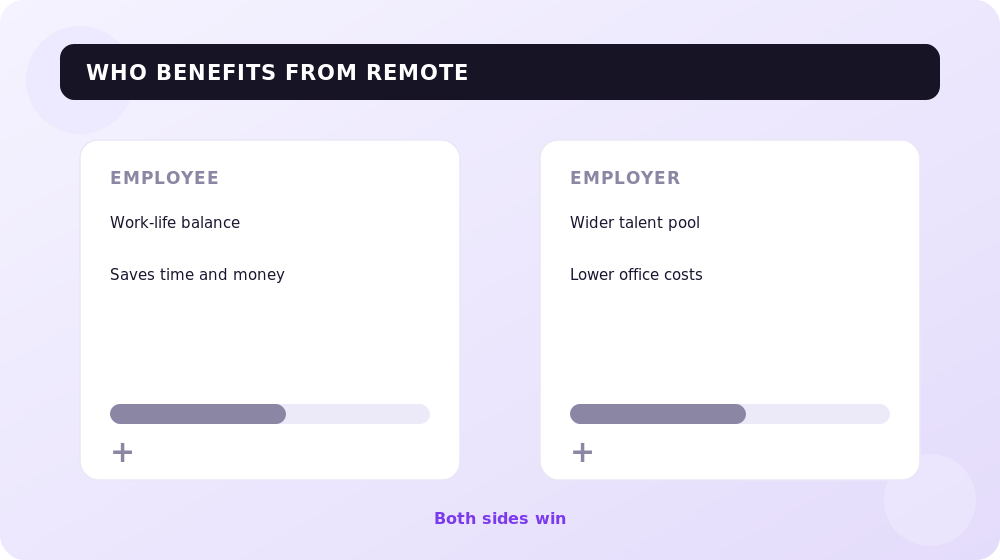
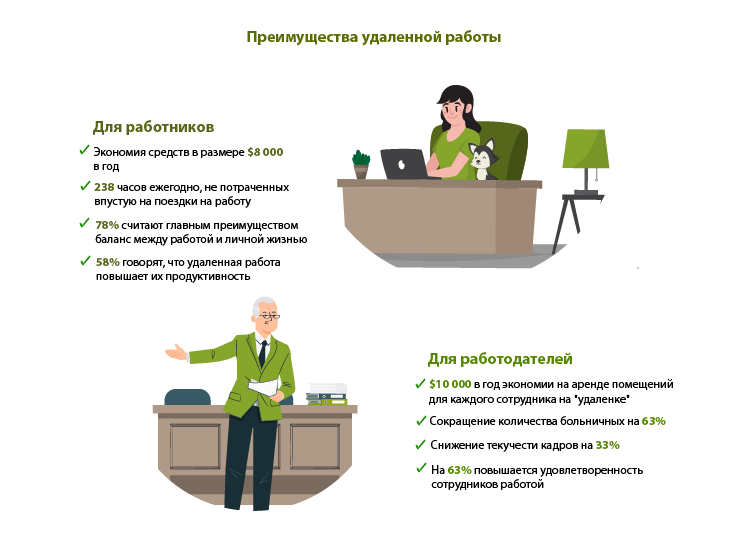
People work from home not because they dislike the office lights — remote work brings measurable benefits to both sides.
For employees:
- A better work-life balance is the main benefit for hybrid employees, along with time savings and a reduced risk of burnout (Gallup, 2024).
- Saving time and money on commuting: dropping daily trips frees up a noticeable part of the day and lowers costs.
- More autonomy and control over one's own schedule — hence the higher satisfaction.
For employers:
- Savings on office rent and upkeep for every fully remote employee.
- Access to talent without geographic limits — you can hire the best, not just the nearest.
- Lower staff turnover: the option to work remotely reduces churn and improves retention (Nature, 2024).
How to Hire and Onboard Distributed Teams
Hiring "for remote" in 2026 is a discipline of its own: without hallway conversations, small problems quickly turn into big ones if processes aren't in place.
- Hire for remote deliberately. Assess written communication and self-reliance. Behavioral questions ("how did you act when a colleague's reply was delayed?") reveal readiness for distributed work.
- Onboarding starts before day one. Good adaptation programs run 30–90 days, with regular check-ins and the goal of full productivity and cultural fit by the end of the third month.
- Build a "new-hire hub." An org chart with photos, a "who to ask about what" guide, recorded tool walkthroughs, and a glossary of internal acronyms remove most of the questions.
- Assign a buddy. An experienced colleague who is in touch daily for the first two weeks and weekly for the first 90 days speeds up adaptation many times over.
- Async-first documentation. If a process is documented and accessible, a new person figures it out on their own, without endless "knowledge-transfer" calls.
Frequently Asked Questions About Remote Work
Remote or hybrid — what do companies choose in 2026?
Hybrid. Among those who can work remotely, about 53% work in a mixed format — the most common scenario. Fully remote persists (about 27%), but it appears less often in new postings than hybrid.
Does remote work boost productivity?
With proper organization — yes. Most hybrid employees report a productivity increase, and teams with an asynchronous approach gain 20–30% more time for focused work. The key is not the number of calls but transparent rules and documentation.
Which AI tools does a distributed team need?
The 2026 baseline: a messenger with AI features (Slack, Teams), a knowledge base with AI search (Notion, Confluence), asynchronous video (Loom), an AI meeting note-taker (Otter, Fireflies), and process automation (Zapier, Make). Companies that embedded AI into their processes report a 20–40% productivity gain.
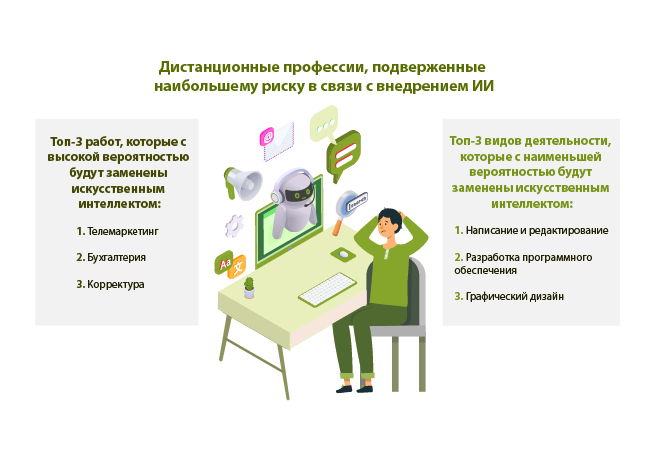
Will AI replace remote professions?
It will augment rather than replace. Automation most strongly affects routine intellectual tasks (telemarketing, basic accounting, proofreading). Creative and engineering roles — writing and editing, development, design — are for now the safest, but they too should master AI tools.
Are digital and SEO suitable for remote work?
Yes, this is one of the most remote-friendly fields: the work is done in the browser and the task tracker. SEO specialists, content strategists, and paid-traffic specialists are among the most in-demand remote roles of 2026.
How to avoid burnout while working remotely?
Set workday boundaries and a "right to be offline," evaluate results rather than time online, and reserve synchronous meetings only for what matters. A flexible schedule with clear rules reduces stress — about 79% of remote professionals report this.

Dropshipping: What Is It, How to Start, and How Much Can You Earn?
Want to learn everything about dropshipping? A fast start with no investment and a steady income. How to find reliable suppliers and where to sell? Tips on promotion and advertising. Hacks for direct trading on marketplaces and social media.
Read →
Stop blogging for the sake of blogging: launch AI tools that earn SEO traffic and leads
Why endless articles no longer work the same way and how to create AI tools, calculators, and interactive pages for SEO, GEO, and conversion.
Read →
Marketing ROI: what it is, how to calculate it, and where teams get it wrong
ROI, ROMI, and ROAS formulas, simple and precise calculation, margin, attribution, payback, CRM, examples, and SEO vs ads decisions.
Read →Want to apply this to your site?
We will review the current situation, find the first growth levers, and suggest a practical working format.