What ecommerce SEO costs and what you pay for
Published prices for the same service span a factor of nineteen — in one country, in one year. Here's what sits behind each figure, our own bands shown first, and the costs that a quote almost never covers.


Short answer: an agency retainer for an online store runs roughly $500 to $1,300 a month — and that is not «cheap versus expensive», it's a different volume of the same work. Five things set the price: catalogue size, niche competition, geography, the state of the site at the start, and whether you have a developer. If you don't have one, buying development, content and SEO together is usually cheaper, from $1,000 a month. And the important part: the quote almost never covers the whole project budget — the missing items are below.
This article is about money. If what you need is how the work is actually done, there's a separate hands-on guide: promoting an online store — semantics, technical work, filters, duplicates, product pages, analytics. And if the question is broader than money — how to vet any vendor — that's the verification procedure.
Here: price, and what stands behind it.
Why the same question gets «$300» and «$3,000»
You ask five vendors what it costs to promote your store. You get five numbers a factor of ten apart. That doesn't mean four of them are lying.
It means they understand the word «promotion» differently, and none of them says so out loud.
For $300 you will most likely be sold a report: once a month someone looks at rankings, edits a few meta tags and sends a spreadsheet. For $3,000 — a team that repackages the catalogue, rewrites categories, closes duplicates, builds links and answers for money rather than positions. Everything in between is the market.
So comparing bare numbers is pointless. Compare volume: how many pages a month, how many links, who writes the texts, who ships code changes. If a proposal doesn't say, you don't know what you're buying, whatever the figure.
What actually drives the price
Five factors. They act independently and multiply rather than add.
1. Catalogue size
A 200-product store and a 40,000-product store are different professions. On two hundred products you can hand-write every category description in a month. On forty thousand, every change is made by template — and every mistake in a template propagates across the catalogue in one crawl.
The threshold where price climbs noticeably is around 3,000–5,000 products. That's where filters, generated pages, duplicates and crawl budget start, none of which exists on a small store.
2. Niche competition
The most underrated factor. In electronics, cosmetics and appliances you're up against marketplaces and a dozen players with budgets you won't outspend. A narrow niche — industrial equipment, parts for one brand, professional supplies — costs the same in labour but pays back faster and holds longer.
This is the one reason I sometimes talk clients out of SEO: not because we can't do it, but because in your niche at your budget paid search will pay back sooner.
3. Geography
One city, one country, or several markets — three different prices. The difference isn't a markup for the flag; it's the cost of links and the volume of content. On Western markets both are several times more expensive, and no vendor can get around that.
4. The state of the site at the start
If the store runs on a sane platform with clean URLs and working filters, the first three months go into growth. If URLs look like ?filter=1&sort=2, three thousand pages have no H1, and filters spawn endless copies — the first three months go into cleanup, and there will be no growth during it.
That's normal and belongs in the expectations. What's not normal is a vendor promising growth from month one while knowing it's a cleanup job.
5. Whether you have a developer
The most common hidden brake. The specialist finds a problem, writes a spec — and it joins the queue behind your programmer, who is busy with checkout. Six months later you've paid for SEO and 20% of it is live.
If you have no developer, or they're overloaded, treat that as its own budget line rather than a detail.
Our bands and what's in them
We ask vendors for pricing transparency, so ours goes first.
| Tier | Monthly budget | Fits |
|---|---|---|
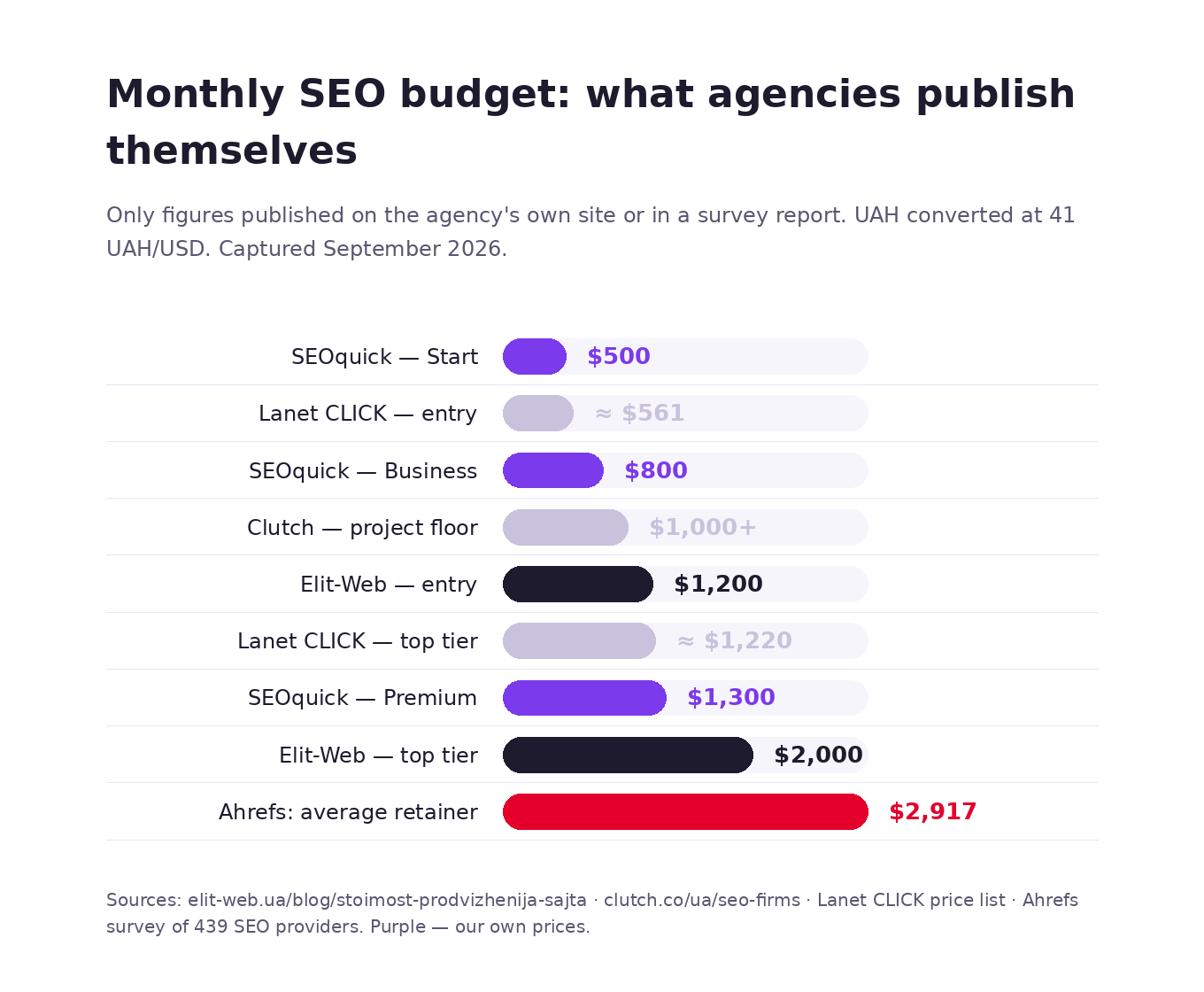
| Start | about $500 | Small catalogue, one niche, no critical technical debt |
| Business | about $800 | Mid-size store, several category directions, competitive niche |
| Premium | about $1,300 | Large catalogue, high competition, several regions or languages |
The detail nobody explains: this is a budget, not a different service set. The work is the same in all three — technical optimisation, pages, texts, links, management. What differs is volume: how many catalogue pages we take on per month, how many articles, how many links. A bigger budget buys more done in the same month, not magic methods sold at a premium.
The one-off setup pool — audit, semantics, structure, landing pages, meta templates, schema, competitor analysis, speed, internal linking, Search Console — isn't invoiced on top. We spread it across months inside the chosen budget. If it doesn't fit into six months, the budget is too small for that site, and it's more honest to say so up front than to stretch cleanup over a year.
Hourly: $15 to $50
The rate depends on who does the work. Going through an export and routine edits is one level of skill. Strategy for a 40,000-SKU catalogue, or diagnosing why a store dropped after an update, is another.
Hourly beats a retainer in two cases: when you have your own team and need an outside view, and when the scope genuinely isn't knowable in advance. In every other case a retainer is more predictable for both sides.
When buying it all together is cheaper
With no developer and no content manager, buying SEO alone makes little sense — there's nobody to implement the recommendations. In that case we take development, content and promotion together, $1,000 to $5,000 a month depending on scope.
It sounds more expensive and often works out cheaper: you're not paying a studio for fixes, a copywriter for descriptions and an agency for SEO separately — and you're not losing months to three vendors pointing at each other.
What the market publishes, and where to check it
Every figure below links to the page where the source publishes it itself. Captured September 2026; prices go stale, so check the links.
| Source | What it publishes |
|---|---|
| Clutch, Ukrainian SEO directory | Minimum project $1,000+; hourly $25–49 |
| Ahrefs, survey of 439 SEO providers | Average retainer $2,917/mo; average hourly $98.90 |
| Searchbloom, US | $2,000–10,000 per month |
| Elit-Web | Packages $1,200 / $1,600 / $2,000 per month; audit from $500; consulting from $99/hr |
| Lanet CLICK | Three packages: 23,000 / 34,000 / 50,000 UAH per month |
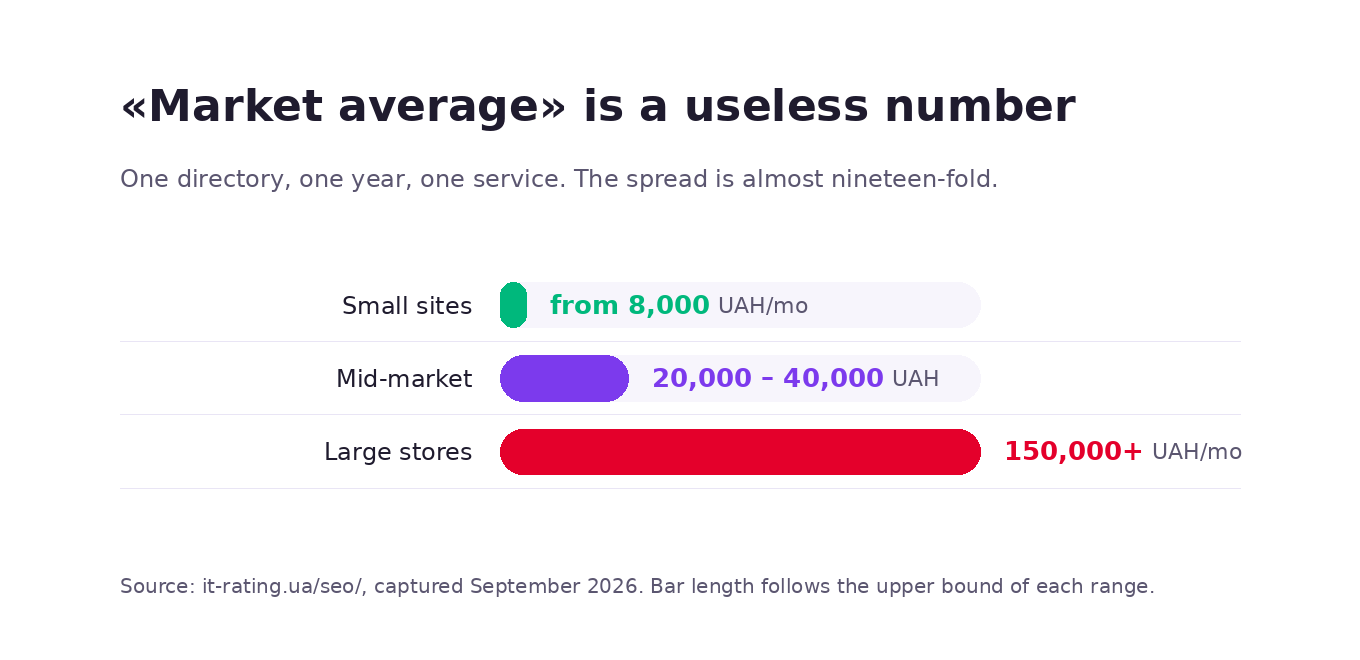
| IT-Rating.ua | Entry from 8,000 UAH/mo for small sites; 20,000–40,000 for mid-market; 150,000+ UAH/mo for large stores; hourly $30–73 |
Look at that last row: from 8,000 to 150,000+ UAH a month. One country, one year, one service. Any «market average» across that spread is a useless number, and if a vendor quotes one at you, ask what sample it was computed on.
Why you can't trust a price from a directory
The most useful thing here isn't the figures, it's the mechanism. Agency directories publish prices that the agencies themselves don't.
Two examples you can verify right now.
Inweb. The IT-Rating card reads «SEO Від: 850 $» — SEO from $850. Open inweb.ua and the pricing section says the price is formed individually. The figure 850 appears nowhere on the agency's own site.
UAATEAM. Directory: «від 900 $». The agency's own FAQ, in plain words: there is no fixed price list.
So where does an exact number in a directory come from? An old email, a three-year-old price list, somebody's estimate. You can't check — no source is cited.
The directories themselves are honest about the model, just in small print. Clutch states on its rankings pages that it may earn a fee for some placements. DesignRush says certain placements are paid and sorts by Sponsored by default. Which means the top rows of a «best agencies» list are not always about quality.
There are counter-examples. UBA.top was built by the Serpstat team on site metrics, reviews and brand metrics, and publishes no prices at all — only scores. Less convenient, but the methodology can be explained.
Practical takeaway: treat any price you didn't see on the agency's own site as hearsay. Ask for the number directly, and ask where it's published.
The five costs that aren't in the quote
This is the part that turns an «$800 a month» project into a $1,400 one. None of it is deception — it just doesn't get said at the start.
1. Content beyond the included volume
The package includes, say, three texts a month. You have 60 categories that need descriptions. That's twenty months. Either you extend the content budget, or you write them yourself, or you accept that categories will close over two years.
Ask directly: how many catalogue pages will have texts within the first six months. Not «how many articles» — how many categories and filter pages.
2. External links
Sometimes the link budget sits inside the retainer, sometimes on top. For a store in a competitive niche that difference can exceed the rest of the quote. Confirm whether links are included and how many per month.
3. Your developer's time
The most underestimated line. Half of the technical recommendations require changes in store templates. If your developer is busy, that work either doesn't happen or gets bought separately.
4. Feeds and Merchant Center
The product feed is a separate piece of work, and it isn't only for ads: how your products appear in Google's shopping surfaces depends on feed quality. It often isn't in an SEO package and surfaces in month three.
5. The platform
If the store runs on an engine that can't control filter URLs, canonicals and meta templates, you will hit a ceiling. After that it's either platform work or a migration. Both are separate money, better discovered before signing.
Ask the vendor for one thing: the list of what is NOT included. A serious one produces it in a minute. If there is no such list, the boundaries aren't defined — and they'll surface at the worst moment.
How to work out whether it pays back
This is where the «300% traffic growth» magic usually starts. Count money, not percentages, and count it before signing rather than after.
You need four numbers, three of which you already have.
- Average order value. From your own system, no rounding up.
- Site conversion rate. Real, from analytics — not «2% is the industry average».
- Margin. Not revenue. Payback is computed on margin.
- How many search visits the work will add. The only number the vendor supplies.
Then it's arithmetic. Say average order value is $40, conversion 1.2%, margin 25%. Every additional 1,000 search visits gives 12 orders, $480 in revenue and $120 in margin. On an $800 monthly budget you need roughly 6,700 extra visits a month just to break even.
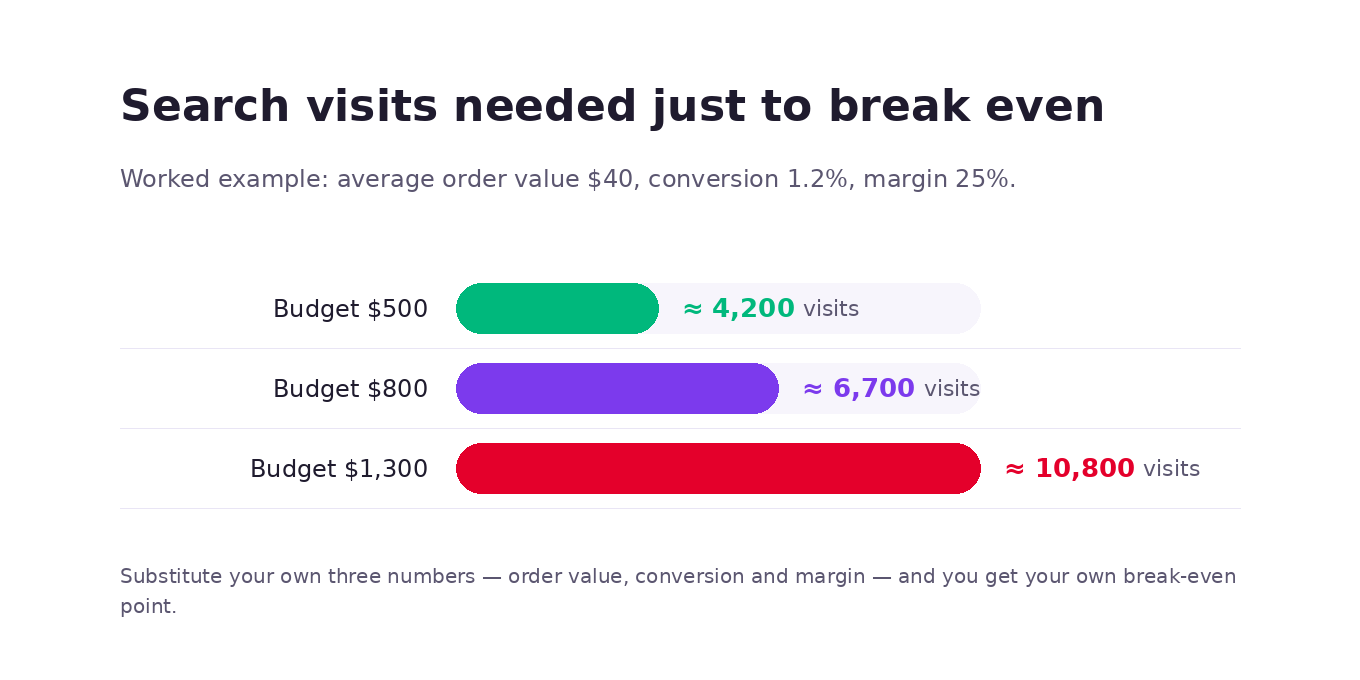
Now look at the vendor's forecast and ask over how many months they expect to reach those 6,700. If there's no answer, you don't have a payback plan — you have a hope.
Two caveats without which the model lies. First: SEO doesn't switch off the way ads do — traffic built over a year keeps working after a pause, so month-by-month payback is the wrong frame; the horizon is six months and up. Second: part of the effect arrives not as orders but as lower ad spend, because you stop paying for clicks on queries you now rank for.
Seven checks specific to an online store
The general vendor criteria are in the separate article — cases, access, team, contract. Here only what's specific to ecommerce and missing from generic checklists.
For each: what to ask, and which answer means walk away.
1. Filters and faceted navigation
Ask: which filter combinations will you open to indexing, which will you close, and on what principle.
A good answer sounds roughly like: we open combinations that have their own demand and enough products, close the rest, and every opened combination gets its own URL, title and description. This is the largest source of growth in a store — and the largest source of infinite duplicates if done by guesswork.
Walk away if: «we'll close all filters» (you lose all long-tail demand) or «we'll open all of them» (you get tens of thousands of empty pages).
2. Duplicates and canonicals
Ask: how many duplicates do we have now and what will you do with them.
One product in three categories, print views, sort orders, pagination, language versions — a store generates duplicates simply by existing. The answer should contain a number and a plan, not the phrase «we'll set up canonicals».
Walk away if: the vendor hadn't looked at your site before discussing price.
3. Catalogue structure
Ask: will you change the category structure, and based on what.
Growth in a store usually comes from creating the pages that are missing rather than optimising the ones that exist: one page, one demand. In our Polish furniture store case the catalogue went from 70 to 170 categories — and that, not title edits, was the driver.
Walk away if: the plan consists only of work on existing pages.
4. Product feed and Merchant Center
Ask: who owns the feed and is it in scope.
«That's for the ads team» signals a vendor who thinks about SEO separately from how products actually reach Google.
5. Product markup
Ask: which Product schema fields will be filled, and where availability and price come from.
Markup that doesn't sync with real stock is worse than none: you're advertising a price and availability that don't exist.
6. Products that no longer exist
Ask: what happens to the page of a discontinued product.
This happens in a store every day and adds up. Delete to 404, keep with a notice, redirect to the category — each option has a cost; what matters is that the vendor has a position at all.
Walk away if: the question produces a pause.
7. Seasonality
Ask: how does seasonality enter the work plan.
Preparing Christmas categories in November is late. A sane store plan is tied to your sales calendar, not to abstract «first three months».
Five types of vendor
| Type | Strength | Weak spot |
|---|---|---|
| Full-service agency (SEO + ads + development) | Fixes what it finds; no second vendor for changes | More expensive; focus spread across services |
| Ecommerce boutique | Depth in catalogue and platform work | Usually won't take development — fixes still queue on your developer |
| Platform specialist (Shopify, Magento, WooCommerce) | Knows the limits of your specific CMS | May push a migration you don't need |
| In-house plus consultant | Cheaper long term, product knowledge inside | Speed limited by your own team |
| Freelancer | Price | No bench; a 20,000-SKU catalogue doesn't fit one person |
The healthy way to choose is not «who is best in general» but «who closes my bottleneck». Strong developer and no strategy — a boutique or consultant. Clear on what to do but nobody to implement — full service. Small store, tight budget — a freelancer with a defined scope beats an agency giving you an hour a week for the same money.
Our store numbers and how to check them
The whole article says «demand a source and a period». So here are our cases in exactly that form: the figure, the tool it came from, and the dates. All cases are public.
Clothing store, Sunshouse
105,089 phrases in the full keyword set, estimated traffic around 38,480 visits a month, top 1–2 on priority queries. Source: Serpstat, Google Ukraine database; ranking report for 23 May – 22 June 2023. Project started in 2022.
Why it matters for a store: the manufacturer outranks marketplaces not with budget but by repackaging the catalogue — categories split into micro-clusters (season, cut, length), one page answering one query. Full case.
Spare parts store, Blenderok
Traffic grew from 15 to 1,716 visits a month; 977 indexed keywords (+212); 39 queries in the top 3. Source: Ahrefs and Serpstat, July 2023 – July 2024.
This is a small case and I'm showing it deliberately. 1,716 visits doesn't sound impressive, but for a parts store it's precise traffic on specific components, and it converts better than any broad traffic. Full case.
Jewellery store, zolotakoroleva.ua
Traffic 169,526 → 960,936; transactions from zero to 1,500; ROAS 2.8 → 5.1. Source: web analytics and Google Ads, December 2024 – December 2025.
The caveat without which this number would be a sleight of hand: ROAS 5.1 and 1,500 transactions are the combined result of SEO and paid search, on a Performance Max budget of $4,000. That is not pure SEO and must not be presented as such. What makes the case valuable is different: it's the only case of ours where the result is measured in transactions and return on ad spend rather than positions. Full case.
Furniture store, Poland
Catalogue expanded from 70 to 170 categories; estimated traffic around 245,257 visits a month; visibility 97.9; manual outreach to 80 domains. Source: Serpstat, Google Poland database. The case doesn't state a work period — only a stage-by-stage breakdown, and it's more honest to say so than to invent dates. Full case.
Home footwear store, Belsta
From roughly 9,000 to 23,000 visits a month in six months; more than 90 external placements. Source: Google organic search and Ahrefs, March–October 2023.
The case also records the drop at the start — it coincided with the March 2023 core update and the product reviews update. That's exactly why cases are worth reading: the interesting part isn't that the chart went up, it's what the hole looked like and how they climbed out. Full case.
And what isn't in the cases
Since I'm demanding honesty from the market. We have failures. There are problem niches where we got nowhere. There are projects where we couldn't outbid competitors in paid search — yes, those exist.
Mistakes got corrected over long engagements, and after ten mistakes one success would come along that covered them. That's not a polished line for a website, it's how long-term work actually goes. A vendor for whom «everything always works» is either in their second year or not telling you everything.
When you don't need store SEO
- A 20-item catalogue with no plans to expand. Organic has nothing to grab onto — paid will pay back faster.
- A product with zero search demand. If the category name isn't being searched, build demand first, then do SEO.
- Budget for three months. That's not an SEO budget, it's money lost: on a store the first visible results come from six months. Spend three months on paid instead.
- A platform migration coming up. Migrate first, promote second, or half the work leaves with the old URLs.
- The problem isn't traffic. If you have 20,000 visits and four orders, you need conversion and assortment work, not more traffic.
Frequently asked questions
Can I pay for results rather than work?
Such offers exist, but read how «result» is defined. If it's «top 10 for a list of queries», the list is usually built from queries you nearly rank for already. We covered this in guarantees in SEO.
How many months until a store breaks even?
It depends on the arithmetic above, not on anyone's wishes. By our cases, visible growth on stores starts from six months: Belsta six months, Blenderok a year. If someone quotes three months, ask which case that happened on and with what dates.
Agency or in-house specialist?
In-house is cheaper long term if there's enough work for full-time employment, and more expensive if there isn't: you pay for idle time and they work without a second opinion. On catalogues up to a few thousand products an external vendor is almost always better value.
Why does the price depend on whether I have a developer?
Because roughly half the work on a store is template changes — filter URLs, canonicals, markup, speed. With nobody to implement, you're paying for recommendations sitting in a queue.
What does an audit cost separately?
On the market, audits start from $500 — that's how Elit-Web publishes it. Ours is part of the setup pool and spread across the monthly budget rather than invoiced separately. You can also start with our free site audit tool.
What to do next
If you read this far you have three things: an understanding of what makes up the price, the list of costs that usually surface later, and seven questions that reveal whether a vendor has actually worked with stores.
- Want to understand the work itself — read the hands-on guide to promoting an online store.
- Choosing a vendor and need the general procedure — how to choose an SEO agency, ten criteria with a check for each.
- Need a number for your specific catalogue — book a call: we'll look at the site and say which band it falls into and why.
And one last thing. Whatever price you're quoted, ask for the list of what it does not include. That single question saves the most money.
Making Money Online in 2026: Which Methods Actually Work
An honest breakdown of making money online in 2026: why 'easy money with no investment' is a myth, 5 models that actually work, and how to monetize your own site with affiliate and CPA — by SEOquick.
Read →
How to choose an SEO agency in 2026: a verification procedure
Not another ranking. Ten criteria with a specific check for each, how to tell a number you can trust from one you can't, what the market actually charges with links to the agencies' own price pages, what belongs in the contract, and when you don't need an agency at all.
Read →
Why AI Cites Your Site But Never Names Your Brand
I analysed 751 Google AI Overview answers for my own domain and found the factor that decides whether your brand gets named: where your link sits in the source list. Plus six prompts to audit your brand in ten minutes.
Read →Want to apply this to your site?
We will review the current situation, find the first growth levers, and suggest a practical working format.