Keyword Cannibalization: How to Find and Fix It in 2026
Two of your pages fight for one query — and both slip. That is keyword cannibalization: an old on-page problem that got more dangerous in 2026 because of AI search. I explain how to find cannibals and consolidate them without losing traffic.


Keyword cannibalization is when multiple pages on a single site compete for the exact same query. Google doesn't know which one to show, blurs the relevance between them, and eventually, everyone sinks. You fix this with a semantic duplicate audit, merging weak pages via 301 redirects, and a rock-solid structure where one intent = one page.
This is one of the most underrated internal optimization headaches. People rarely think about it until traffic on a critical page starts bouncing around for no reason. I covered cannibalization on the SEOquick channel back in an audio podcast—the topic is old, but in 2026, it’s hit a whole new level of relevance. What follows is a full breakdown with numbers, sources, and real-world examples.

What is keyword cannibalization in plain English?
The term comes from marketing, describing a situation where one of a company's products eats the sales of another. In SEO, it’s the same deal, just with pages:
“Keyword cannibalization refers to the negative impact of using the same keywords across different documents on a site. It doesn't lead to filters or manual penalties from search engines—but it confuses the search engine, and it requires optimization.”
I first learned the term from Sergey Koksharov when I was just starting out in SEO—from his 2014 article. So, the problem is over a decade old, and its roots go even deeper. Key point: cannibalization isn't a sanction. Google isn't fining you. It just can't decide which of your pages to show for a query and makes the choice for you—usually not in your favor.
Why is cannibalization more dangerous in 2026 than before?
Before, the cost was "page dropped from 3rd to 8th place." Today, the stakes are higher. Search has become zero-click: according to SparkToro and Similarweb, in 2026, only about a third of Google searches end with a click to a website. Clicks are scarcer—and splitting them between two of your own pages is now a luxury you can't afford. The scale of the problem is underestimated: in a Studio 36 Digital study (January 2026, 100 sites, 2500 queries), the average site ranks 4.7 URLs for a single top keyword, 68% of sites have serious cannibalization (5+ URLs per query), and "excellent control" (1–2 URLs per key) is found in only 12%.
And there's a new twist: cannibalization now kills AI citability. When AI Overviews and ChatGPT pick a source for an answer, they rely on a clear signal: "this page is about this query." Two blurry cannibals send a weak signal to each, and the AI will likely cite a competitor with one strong page. Now, when landing in an AI answer is more important than rank, diluted relevance costs more than ever.
Who does this affect most?
Cannibalization is rarer than duplicates or broken links, but its risk group is clear—large sites with many pages and messy architecture. In practice, we see it constantly with real estate agencies with tons of similar listings and sections; specialized online stores where category logic is flawed and overlapping blocks pop up; online course sites; and tour operators—even those with configured microdata. A real example from my practice: I was talking to a potential client selling tours. We found the problem by accident—it turned out he was running a blog on the side, and the articles were optimized for "tours to [country]," the exact same query the sales page targets. Two pages for one topic. The client didn't even believe it was a problem at first. But it was.
How cannibalization tanks traffic: The domino effect
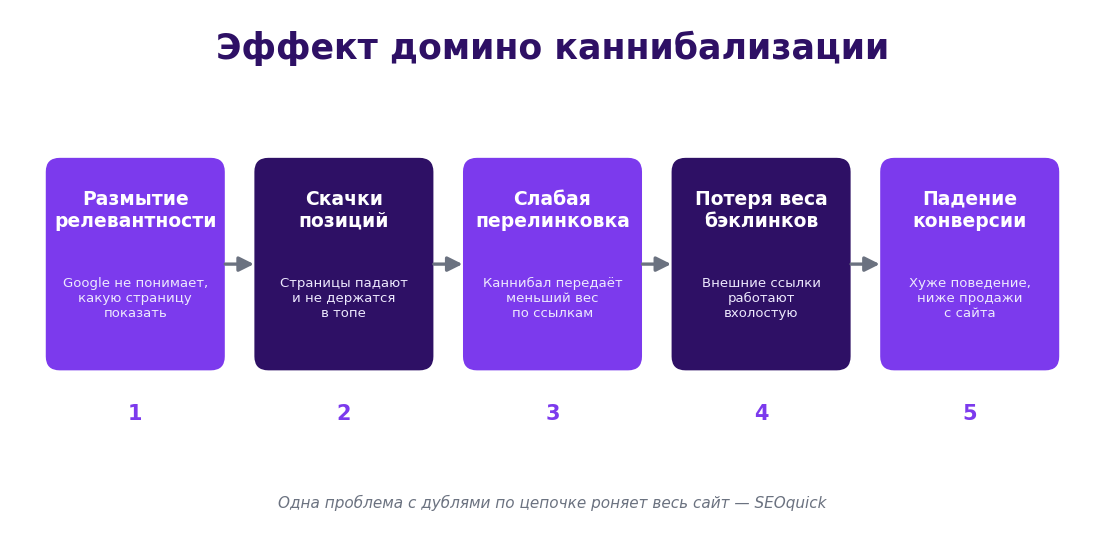
It starts with what I call relevance dilution. Imagine four pages about the same thing: "automatic garage doors," "garage automatic doors," "sliding garage doors," "automatic sliding garage doors." Which one should show for which query? They're all relevant, and the search engine literally says, "I don't get it." Then two things happen—either it picks a page itself (often the wrong one), or it shows nothing at all.
“It seems like such a small chain, like dominoes, but it causes a massive amount of problems.”
And here’s the chain. Rankings jump and drop. Because of the dip, the cannibal page passes less weight through internal links—your whole internal linking strategy starts firing blanks. If a high-traffic, "money" top-level page gets cannibalized, both internal weight and the weight from external backlinks you bought for it go down the drain. Plus, the content itself loses value: three or four pages for one key kill user behavior metrics and slash conversions.
How to find cannibal pages on your site?
Cannibals are hard to catch—they wear masks: the content is different, but the keyword is the same. The simplest way is a Google operator: type site:yoursite.com "keyword phrase", and if multiple URLs pop up for one phrase, that's your first red flag. Next is Google Search Console: in the Performance report, filter by a specific query and see which pages get impressions and clicks; if there are two or three and rankings are jumping—suspect cannibalism. Screaming Frog helps catch semantic duplicates: crawl the site, export all H1s, and look for headers that are essentially the same on different URLs. For non-obvious duplicates, you need a clusterizer—upload "keyword - relevant page" pairs, and it will group queries by meaning and show overlaps. Our keyword clusterizer can do this and it's free: plug in synonyms, and it'll find where they overlap. Ahrefs and Semrush also track overlapping URLs for a single key.
How to eliminate cannibalization?
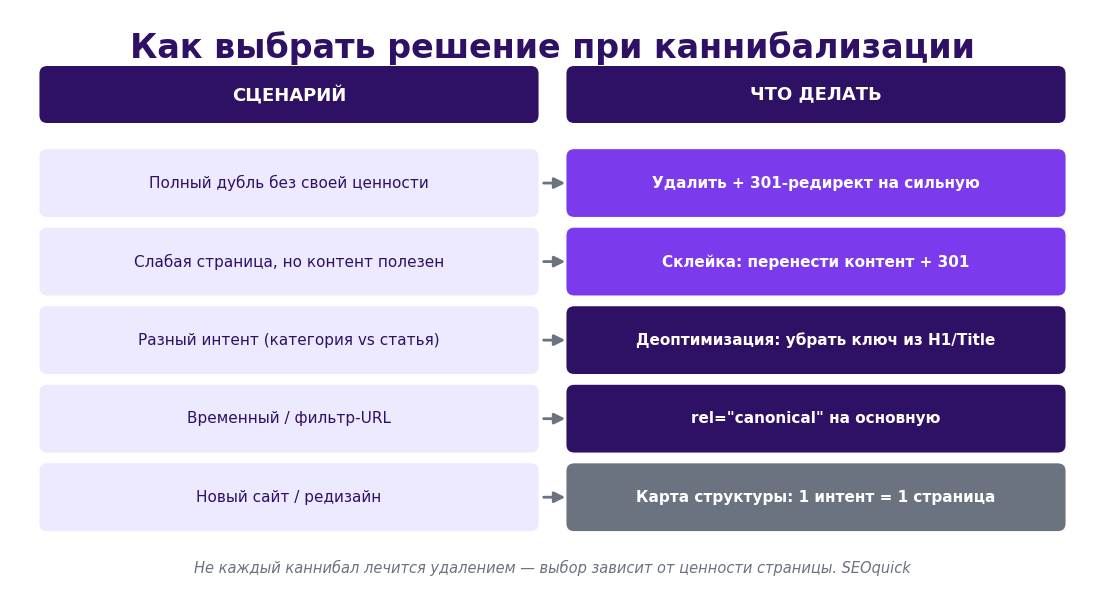
Once the cannibals are found, the tool is chosen based on how much the pages overlap. The main method is a 301 redirect with a merge: take the strongest page for the query and point the weak cannibals to it, moving the best bits of content over. The effect can be dramatic—Backlinko saw a 466% year-over-year growth in clicks after consolidating two cannibalizing articles with a single 301 redirect. If both pages are needed (e.g., a commercial category and an info article), de-optimization helps: remove the exact key from the H1, Title, and Description of the "extra" page and pivot it toward long-tail or a neighboring intent. Sometimes, just revising the structure and meta tags so each page has its own unique intent is enough. But if you're looking at a full-blown cannibal with no unique value—there's only one fix:
“If you see a page is a full-blown cannibal, you have to delete it and set up a 301 redirect. There is no other solution to this problem.”
And a vital caveat for 2026. Swapping words usually creates a duplicate, but there's an exception—travel directions. Google has learned to account for word order and meaning, so "flights from New York to London" and "flights from London to New York" are different queries, not duplicates. Tour operators need to be extra careful here: automatic non-obvious duplicate checkers often fail on these pairs.
How to prevent cannibalization on a new site?
It’s cheaper to prevent than to cure. If you're building a new site or redoing the structure—start with a map: draw the structure in a mind map (XMind, MindMeister—whatever) and map keys to sections so there are zero semantic repeats. One intent—one page. You need to hunt for non-obvious, semantic duplicates, not just exact matches. In practice: gather semantics, cluster them by meaning, and assign each cluster to one page; if two clusters pull toward the same topic, that’s a future cannibal—better to solve it at the structure stage than a year later when traffic tanks. We covered how to group keys properly in our keyword clustering guide.
FAQ
Does Google penalize for keyword cannibalization?
No. It’s not a filter or a manual action. Google just can't figure out which competing page to show and blurs relevance between them—this causes rankings and traffic to drop, but there’s no algorithmic "punishment."
Is cannibalization the same as duplicate content?
No. With cannibalization, the content is usually different—the intent and keyword are what match. Duplicates are when the text itself matches. The problems are related, but the fixes are different.
Do pages in different languages count as cannibalization?
No, if hreflang is set up correctly. Google sees language versions of the same article as alternatives to each other, not competitors, so the EN/ES/FR versions won't get in each other's way.
If you're not sure you can find the cannibals yourself—drop us a line: we’ll help identify the problem pages and draw up a merging plan. And to avoid breeding new cannibals, keep your structure under control and check our blog for fresh breakdowns.

H1 vs Title: how many H1 tags you need and how they differ
H1 in SEO 2026: how many H1 headings are acceptable, optimal length, how it differs from title, empty H1 and H1 as an image. Based on a measurement of 77 pages from the Ukrainian top and data on how often Google replaces your title with the H1.
Read →
Pagination SEO: how to index list pages without breeding duplicates
Pagination SEO in 2026: canonicals on list pages, noindex, rel=next/prev, infinite scroll, crawl budget. Based on a check of 36,000 traffic-driving URLs across twelve Ukrainian retailers, plus a teardown of pagination at Foxtrot, Epicentr and our own blog.
Read →
URL Structure: The Full Guide to Addresses You Can't Change After Launch
How to get URLs right: transliteration or Cyrillic, slug length, duplicates from case and filters, pagination, UTM tags, redirect maps. A breakdown of Rozetka, Comfy, Prom and Makeup URLs plus 2026 research data.
Read →Want to apply this to your site?
We will review the current situation, find the first growth levers, and suggest a practical working format.