Online Reputation Management 2026: A Guide to SERM, Reviews and AI Reputation
SERM, reviews, and handling negativity in 2026: from monitoring mentions and Google Business Profile to how ChatGPT and AI Overviews read your brand.

Online reputation management (ORM/SERM) in 2026 is the systematic work of shaping what people and AI models see about your brand in search, on maps, on review sites, and in AI answers. The goal is simple: to make sure the first results in Google, AI Overviews, and ChatGPT's answers tell the truth about you — and ideally in your favor. Below we'll cover where to look for reviews, how to monitor mentions, how to handle negativity, and how to make algorithms and AI "read" you correctly.
Let's start with a story that repeats every day.
Olga has an online clothing store. She plans to expand her assortment, so she is looking for a new supplier.
She browses a couple of sites and postpones the decision for a while.
Then, on social media, a familiar logo catches her eye.
One of the suppliers has launched targeted advertising.
Olga clicks the link, fills out a lead form, and sends her contacts to the manager.
Less than 20 minutes pass before the phone rings.
A polite manager tells her about the terms, sends price lists to her email, answers her questions.
Olga is impressed and is already ready to place an order.
But before the deal, she does what almost everyone does in 2026: she checks the company. And not only on Google — she asks ChatGPT: "Is it worth working with this supplier?"
The first site is a review aggregator, the rating here is three out of five. Not great.
Some people are happy with the quality, others only criticize the brand. There are more of the latter.
The company's website — everything is perfect here. Only enthusiastic reviews and photos of happy customers. It looks suspicious.
And the AI assistant, summarizing the search results and review sites, answers cautiously: "Reviews are mixed, there are complaints about quality and delivery times."
Weighing all the pros and cons, Olga declines the cooperation.
Now let's look at the situation from the supplier's side.
He spent money on a convenient website, advertising, setting up retargeting, and a team of managers.
He does everything right. But he loses a large wholesale order because of a damaged reputation — and because that negativity is now also being retold by AI models.
The example is real, the problem is common. Do you also invest large sums in promotion but lose clients? A couple of negative reviews that no one works with may be to blame.
Here's what the statistics say:
- 93% of consumers claim that reviews influence their purchase decision.
- 89% of people read companies' responses to reviews, and 88% are more likely to choose a business that responds to reviews.
- 82% of consumers deliberately look for negative reviews, and on average they need to study about 40 reviews to believe the rating.
- The probability of buying a product on average increases by 270% if it has at least five reviews.
- 82% of consumers don't trust companies with a rating lower than three stars out of five, and increasing the rating by just 0.1 points can boost conversion by 25%.
- An alarming 2026 trend: by industry estimates, up to 30% of online reviews today are fake or manipulated — so authenticity has become more important than quantity.
- And the key new dimension: 37% of users already start their search with AI tools rather than Google.
Reviews matter. A lot. These are product reviews, stories about the experience of dealing with the company, publications in the media, and how AI retells you. How to find reactions to your brand and turn them into profit — we'll tell you next.

Hey! Yes, you. Looking for traffic to your site? SEOquick will attract 100% organic for you!
SEO is your long-term and reliable source of traffic from the Google and Bing search engines
We'll do comprehensive SEO promotion: content, reputation, internal optimization, link building
Our SEO is white-hat, our goals are getting you to the TOP! We know exactly what and how. And that's just what you need, isn't it?
Where to look for reviews about a company online
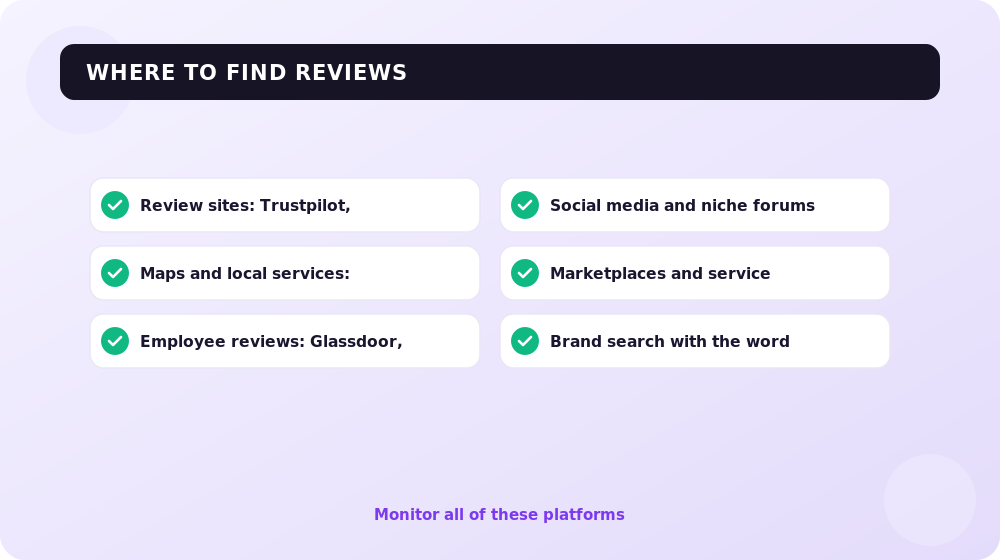
No reviews on your site or social media page? That doesn't mean there aren't any somewhere else.
By and large, reviews can be left anywhere. Below are the most important platforms. They definitely need to be monitored.
1. Review sites
Review sites can be either highly specialized or "about everything in the world". Some share revenue with authors, so their audience writes a lot and in detail.
Global and Ukrainian examples:
- Universal review sites — Trustpilot, Google reviews.
- Tourism and HoReCa — Tripadvisor, Turpravda, Booking.com.
- B2B and software — G2, Capterra, niche directories.
- Marketplaces and product platforms — Rozetka, Prom.ua, hotline.ua, and reviews right in product cards.
- Employee impressions — DOU, Glassdoor.
The main advantage of these platforms is their scale. If a user enters a company name and adds "reviews", the giants will be first in the results. And it's exactly these sites that AI most often uses as a source: up to 85% of brand mentions in AI answers come from third-party domains, not from your site.
Create official company accounts here and motivate clients to leave honest reviews. If negativity appears — respond, solve problems, show that your reputation matters to you.
No one is writing about you? There's a trick: find active authors on the platform and offer them the product or service for review — this influence marketing still works today.
2. Maps and directories: Google Business Profile
A must-have for local business. And not only. Search engines aren't fond of sharing traffic: according to SparkToro, more and more queries stay click-free — the person gets the answer right in the results.
The key service here is Google Business Profile (formerly "Google My Business"). Its cards get into the local pack and occupy a large part of the top, and the reviews in it directly affect both ranking and trust.
What's important to know in 2026:
- "Business responsiveness" is one of the significant local signals: replying to a review within 24 hours signals to Google that the profile is managed by a real person.
- 81% of consumers expect a response within a week, and a business that responds to 25%+ of reviews earns on average 35% more.
- In 2026, Google tightened its review policy: review gating, incentivized reviews, and fake accounts lead to penalties up to removal of the rating.
Fill out cards for all branches in as much detail as possible, monitor reviews, and respond actively. It's useful to also check related services — Apple Maps, industry directories, local directories in your region.
3. Product aggregators and marketplaces
It's convenient to compare prices on such sites — all online stores and manufacturers need to "know them by sight". In Ukraine these are hotline.ua, Price.ua, Prom.ua, Rozetka. Reviews here are left about both stores and products, and the cards often rank higher than your site.
Monitor all platforms where your products are sold — for marketplaces, the seller rating directly affects sales.
4. Forums, UGC platforms, Reddit, and media
People share impressions where they spend time. Life used to thrive on forums; today discussions increasingly happen on UGC platforms, in Telegram channels, and especially on Reddit. The latter is critical: AI models use Reddit, G2, and Capterra as a "collective opinion", and that's exactly where AI takes its wording about your brand.
If you respond adequately to such posts, you can earn the community's respect. The most large-scale option is publications in the media: negativity that has reached major outlets is the hardest to fight (we'll cover how next).
5. Social media
The most convenient way to leave a review about a company is on social media — on a business page, a personal page, or in themed groups. Reputation here is no less important than your image in search: users trust these platforms and can always open the author's profile.
People expect a company to respond quickly to mentions. Don't disappoint them — and your reputation won't suffer.
Now you know where users most often leave reviews. What's left is to figure out which platforms your business needs — more on that in the next chapter.
How to search for reviews about your company and monitor mentions
Reviews can be left anywhere, and monitoring dozens of platforms manually is a thankless task. All companies are different, and the choice of platforms depends on the niche. Two scenarios:
- If you already have reviews on different sites — gather the most important platforms and concentrate on them.
- If you have few reviews — study where and what is written about your competitors.
How to search for reviews on Google
Type the company name + "reviews". Enter queries with all spelling variants of the brand: Cyrillic, Latin, with and without spaces. To gather synonyms on one page, use the OR operator ("Brand reviews OR Brand reviews"). Review the first two or three pages — they are the most important — and write down all sites with reviews in a separate file.
To quickly collect all resources from the results, use our video instruction.
After this, register on the found sites, enable notifications, and respond to reviews — informatively and politely.
How to search for reviews on social media
The minimum program is to react to all official mentions and branded hashtags.
On Facebook and Instagram, start by setting up notifications about comments, tags, and mentions; tags in posts are placed in a separate profile tab. On other platforms the principle is the same: subscribe to notifications and periodically search manually for the brand name and hashtags. Don't forget about TikTok and Telegram — reviews there often hide in comments and forwarded posts.
If the company is small, you can handle this load on your own. Large brands should consider automation.
Tools for tracking mentions and AI monitoring
Why visit dozens of platforms when you can work in one window? There are many solutions on the market, and in 2026 they increasingly include AI sentiment analytics and crisis prediction:
- Brand24, Brandwatch, Mention — monitoring of mentions in social media, the press, and on sites with automatic sentiment assessment.
- Specialized AI visibility services (for example, monitoring what ChatGPT, Gemini, and Perplexity say about you) — a new class of tools without which reputation monitoring is already incomplete.
If you're not yet ready for a paid service, start for free: set up Google Alerts — enter your brand name and receive new mentions by email. Frequency, sources, language, and country are available in the settings. This is a simple but effective foundation for monitoring.
How AI "reads" your brand: reputation in ChatGPT and AI Overviews
In 2026, reputation gained a new dimension. Previously, a client googled "brand + reviews" — now they ask a neural network: "Is it worth buying from X?" And AI answers not in your words, but with a summary of what it found online.
This is not abstract. According to a 2026 study, Google's AI Overviews are 44% more likely to show negativity about a brand than ChatGPT. So you need to control not only the classic search results, but also how the algorithms "retell" you.
A few important principles:
- AI cites third parties. About 85% of brand mentions in AI answers come from third-party domains. So reviews on Trustpilot, G2, Reddit, and Google matter more than self-praise on your own site.
- Algorithms account for sentiment. Modern models assess whether positive, negative, or neutral mentions prevail. A consistently positive background increases the chance you'll be recommended.
- Models have different sources. ChatGPT and Claude largely rely on training data, Perplexity does live web search, Gemini pulls data from Google. You need to work on all fronts at once.
- Structured data helps. Clear, factual wording and schema markup increase the chance that your text specifically makes it into the AI answer.
What to do in practice: monitor the consensus on Reddit/G2/Capterra, maintain a single, consistent positioning across all platforms, build quality mentions on authoritative domains, and regularly check what neural networks say about you for branded queries. Essentially, it's the same reputation work — it's just that now a machine reads it too. If you want a systematic approach to brand visibility in AI, start with our set of AI tools and comprehensive search promotion.
How to create and improve your reputation online
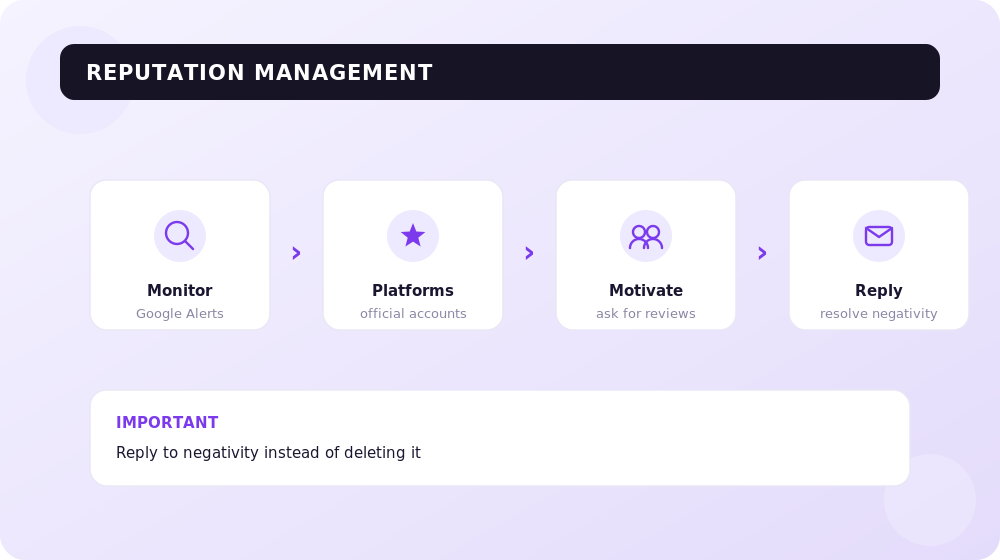
Now you know where and how to look for reviews. It's time to figure out how to use this data to build a reputation.
The optimistic scenario: you have 100+ reviews, most of them positive. What to do? Keep it up: actively respond to all inquiries, look for new platforms, and expand your reach. To do this, study where reviews about competitors are written.
What to do if there are no reviews
The absence of reviews is no better than low ratings: the user has questions — what if you delete negativity? Strategies that will help:
- Personally ask each client to share their impressions — offer a discount or bonus for the activity.
- Collaborate with bloggers and micro-influencers: product in exchange for an honest review to subscribers.
- Add a widget to the site that motivates leaving recommendations, and a QR code at an offline point leading to your card.
- Encourage user-generated content (UGC): good photos and videos with the product are also reviews.
- Do crowd marketing: provide value and unobtrusively recommend your business.
- Send reminders by email, SMS, and in messengers after a purchase.
- Launch a contest for the best review or a themed activity around the brand.
Resist the temptation to fake reviews. This not only kills trust — a modern user easily spots a fake — but is also directly prohibited: in 2026 the FTC began fining for fake reviews amounts exceeding $50,000 per violation, and platforms remove manipulation and strip ratings. Authenticity today is not ethics, but necessity.
How to handle negativity online
The most unpleasant scenario — there are many reviews, but most are negative. Don't think your business is "that bad": people simply share negative experiences more often. This is normal — negativity just needs to be handled competently.
First and foremost — monitor it. There's nothing worse than an angry comment the brand didn't react to. Recommendations:
- Avoid canned brush-offs and templates: get into the situation and give a meaningful answer.
- If a review stings — don't reply in the heat of the moment. Cool down, collect your thoughts. Negativity is a lesson, not a personal insult.
- Gather information and genuinely help solve the problem; involve colleagues if needed.
- Apologize — politeness will melt even an aggressive client. By industry data, 78% of buyers trust a brand more after seeing a considered reply to negativity.
- Move the resolution to private channels, but record the outcome publicly — other readers will see the problem was solved.
- Grow a loyal community that will voluntarily defend you against unfounded accusations.
If a review is clearly planted (competitors, haters, bots), ask the platform's administration to remove it. If that doesn't work — in the official response, calmly emphasize that the author could not be reached and the details are unconfirmed. But don't try to delete deserved negativity — it's unprofessional and almost always backfires.
How to improve your reputation and push out negativity
The first impression forms on one or two pages of search results. To improve your reputation, you need to push positive and neutral materials to the top:
- Work on your site: add reviews, design an "About us" page, watch your usability — a convenient, clear site works for trust on its own.
- Bring fresh new reviews to platforms with negativity — current entries are viewed more often and rise higher.
- Collect reviews on different types of platforms: search and AI love a variety of sources.
- If negativity reached the media, publish a correct rebuttal in an equal or larger outlet.
- Push out negativity not only from the main results, but also from the "Images" and "Videos" tabs.
- Enlist the support of industry experts — their opinion weighs more for people and AI than comments from anonymous users.
Review and AggregateRating schema markup
A technical touch that reinforces everything listed above. Review and AggregateRating markup in JSON-LD lets you show star ratings right in the snippet. This isn't cosmetic: rich results with stars get 15–35% more clicks.
Important 2026 nuances: the markup must be on a supported type (Product, Recipe, Course, etc.), must contain a correct ratingCount, and above all must reflect real reviews. For LocalBusiness and Organization types, Google no longer shows stars in the snippet, so plan your markup for products and services, not for the organization as a whole. And remember: the markup itself doesn't guarantee stars — you need page authority and real data.
FAQ: common questions about reputation management
How does SERM differ from ORM?
ORM (Online Reputation Management) is managing reputation across the whole internet: reviews, social media, the press, mentions. SERM (Search Engine Reputation Management) is a narrower part, working specifically with search results: what a person sees on Google's first page for a branded query. In 2026, a third layer was added to this — managing how the brand is represented in AI answers.
How quickly should you respond to reviews?
81% of consumers expect a response within a week, but the optimum is 24 hours. A fast response increases trust and serves as a positive local signal for Google. You should respond to all reviews — both negative and positive.
Can you fake reviews to quickly raise your rating?
No. It's prohibited by platform rules and regulators (the FTC fines for fake reviews), is easily recognized by users and neural networks, and ultimately destroys trust. Up to 30% of reviews online today are fake — which is exactly why genuine reviews are valued more and more.
How do I find out what ChatGPT or Gemini says about me?
Ask the neural networks direct branded questions ("Is it worth working with X?", "Best companies in niche Y") and record the answers. Use AI visibility services for regular monitoring. Remember: AI takes up to 85% of data from third-party sites, so you need to improve answers through reviews and mentions, not only through your own site.
What to do if negativity reached a major media outlet?
This is the hardest case. Prepare a correct official rebuttal and publish it on an equal or more authoritative platform so your version takes a higher position in the results. In parallel, strengthen the positive background on review sites and social media and involve PR specialists if needed.
How long does building a reputation take?
It's not a one-time campaign but an ongoing process. The first results of monitoring and responding are visible within 1–2 months, but a stable positive background in search and in AI answers forms over months of regular work. But the investment pays off: reputation becomes the foundation for a steady flow of clients.
Conclusions
As in life, your online reputation can make your business a superstar or destroy it. You need to monitor it closely — in search, on review sites, and in neural networks' answers.
Start with monitoring comments and mentions — they usually appear:
- on your site and social media pages;
- on review resources (Trustpilot, G2, Google reviews);
- on product aggregators and marketplaces;
- on maps and in directories (Google Business Profile);
- on forums, Reddit, and in the media;
- on social media and Telegram.
It's convenient to find them through search, built-in social media notifications, Google Alerts, and special services (including AI monitoring). If there are no reviews — motivate clients to leave them in honest ways, without manipulation. React to negativity promptly and professionally, and flag planted reviews for the platforms' administration.
In 2026, a new layer was added to the classic work — managing how AI "reads" your brand. This is the same care for reputation, it's just that its audience now includes algorithms too. Your attention and sincere desire to solve the problem will let you build an excellent reputation — and the investment in it will pay off with regular clients and a solid foundation for growth.

Local SEO for Small Businesses in Ukraine: How to Attract Customers in Your City
How can a small business in Ukraine reach the top of Google's local search and get into AI answers? Google Business Profile setup, website, reviews — a guide.
Read →
SEO Trends 2026: 10 Changes You Need to Prepare For Right Now
The key SEO trends of 2026: AI Overviews on 48% of queries, 68% zero-click, the rise of ChatGPT and Google AI Mode. What is changing in search and how to prepare your site — a breakdown by SEOquick.
Read →
How to create content for AI answers: AEO and GEO guide for 2026
How to create pages that can be used in AI Overviews, ChatGPT, Gemini, and other answer systems: structure, sources, entities, and UX.
Read →Want to apply this to your site?
We will review the current situation, find the first growth levers, and suggest a practical working format.