Types of Promotions on Facebook and Instagram in 2026: 10 Tips to Grow Reach and Brand Awareness
We break down 7 promotion types for Facebook and Instagram, the Awareness objective in ODAX, Reels and Advantage+ — plus 10 tips to grow reach and brand awareness in 2026.

Promotions on Facebook and Instagram are a working branding tool: they expand your follower base, warm up the audience, and showcase a new product for relatively little money. In 2026, the key to reach is the Awareness objective within the ODAX objective system, short vertical videos (Reels), and Advantage+ automation — while the impact on awareness is measured through Brand Lift, not just by likes.
The mechanics change, but the essence doesn't: a promotion helps solve several business tasks at once without leaving the user's feed. For example:
- Increase the number of followers of a community or business page — expand the base of potential customers.
- Warm up the audience, win their loyalty, and nudge them toward purchases.
- Show a large number of people the company's new product.
Promotions on social media mean working with a huge audience whose attention isn't as expensive to attract as it seems.
The scale is impressive: according to Statista, in 2026 more than 5.2 billion people already use social media — roughly two-thirds of the planet's inhabitants who have internet access.
At the same time, ~90% of Meta's ad inventory is vertical, and almost everyone logs in from mobile. That means any modern promotion must be "mobile-first" and vertical above all.
The main social networks whose promotions we're discussing today are Facebook and Instagram.

Where are all the customers? Where there's traffic. Want SEOquick to bring it to you?
Paid search advertising is a fast way to get customers to your website here and now.
Let us set up a Google AdWords campaign for you, relevant to your business.
And you'll only pay for the impressions and clicks that bring a target audience to the site.
What reach is and why you should increase it in 2026
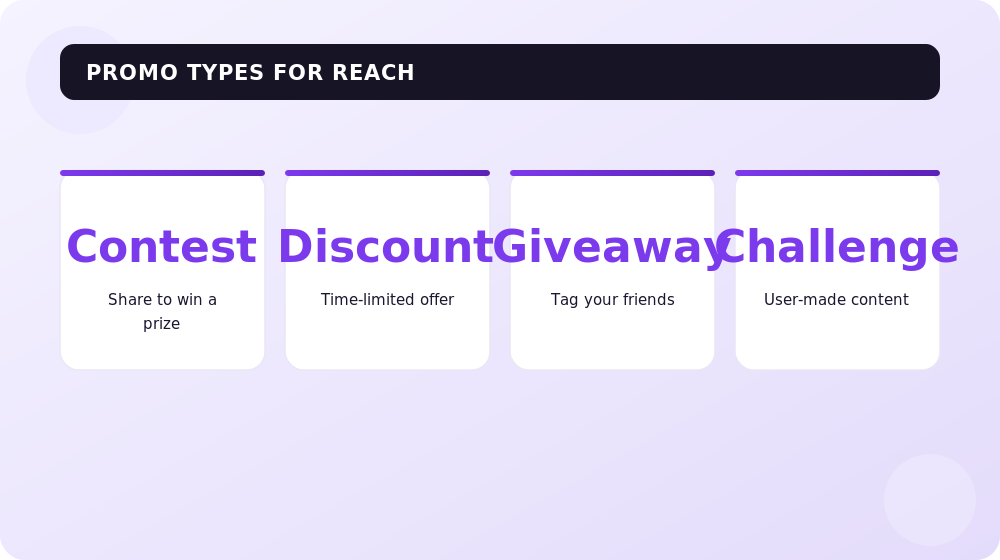
What the difference is between follower reach and total reach, how reach connects to traffic, and why it's definitely worth working on this metric — let's break it down step by step.
Reach is the number of users who will see a promotion or any other publication of yours in their feed.
Follower reach is the people who already subscribe to you and will see the publication. Total reach adds all the new people who will also see the post (if it gets shared or you promote it with ads). The higher the total reach, the higher the chance of getting traffic — and traffic, together with loyalty, brand awareness, and sales, is the goal of promotions.
Awareness in ODAX: how Meta measures awareness in 2026
With Meta's move to the ODAX (Outcome-Driven Ad Experiences) system, advertisers are left with six campaign objectives: Awareness, Traffic, Engagement, Leads, App Promotion, and Sales. For branding promotions you need exactly the Awareness objective: the algorithm optimizes delivery so the ad reaches the maximum number of people most likely to remember it — Meta optimizes for reach and ad recall.
A simple 2026 rule: at the start, when you need to build an audience and awareness, choose Awareness or Traffic; once the audience is gathered and warmed up, switch to Leads or Sales. Don't split a small budget across a dozen objectives at once: at under $10,000 per month, specialists recommend keeping to one or two objectives.
We cover paid channels in more detail in our paid and targeted advertising section.
Do you need sales and awareness? Fill out the form below and we'll help you set up a channel that works for both reach and conversions.
7 main types of promotions for Facebook and Instagram
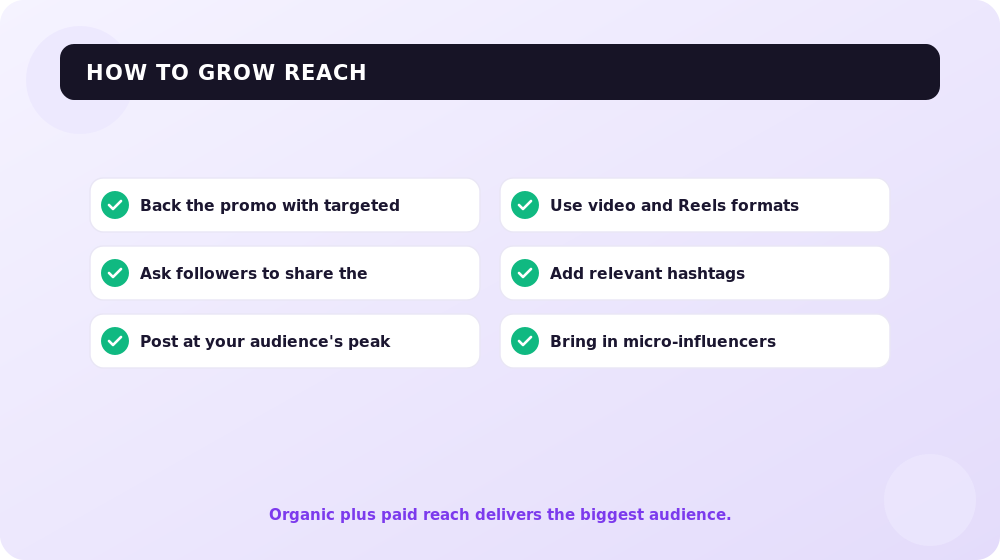
How a contest differs from a discount promotion, what "exclusive for followers" means, and how to use cross-marketing profitably — it's all in this chapter.
The main types of promotions for social media include exclusives for followers, lotteries, promotions with coupons and discounts, contests, bonus promotions, cross-promotions across both platforms at once, and promotional cross-marketing. There are no clear leaders or outsiders here — the choice depends on the situation, the field, and the specific task.
Type 1. Exclusive for followers
This type of promotion assumes that only current followers of the page or community participate. The goal is to stimulate a "warm" audience to purchase here and now. For this, promo codes, special prices for followers, or the chance to be the first to order a new item are used.
A feature of an exclusive is that the promotion isn't duplicated offline. ONLY for our own. ONLY for followers. ONLY on social media. The emotional effect is strong: followers feel special, and that raises the value of your page in their eyes and warms up their loyalty.
Type 2. Lottery
This is a very easy promotion: it's enough to fill out a simple form, answer an easy question, or perform a minimal action — and a person becomes a participant. The goal is to increase activity on the page and draw the attention of "dormant" followers. The winner is chosen at random: if each participant is assigned a number, you can use a random number generator — that way the lottery will be as transparent as possible.
A lottery with a discount stimulates sales, and well-crafted terms help you earn offline too: for example, the CHENSON restaurant made visiting the venue on Saturday evening a condition for participating — and filled its tables at the right time. And if participants fill out forms, you'll collect data and be able to successfully target ads at them.
Type 3. Coupons and discounts
One of the most widespread types of promotions. Brands give coupons and discounts for specific actions: for a review on a third-party platform, for the best epithet directed at the company, or for taking part in a discussion. Sometimes they're combined: "Buy at a discount now and get a coupon for your next purchase." The goal, of course, is to stimulate sales.
Type 4. Contests
Organizing a contest is harder than running a lottery, but the result is most often worth the effort spent. You need a prize — preferably valuable in participants' eyes and from your product line.
Participation assumes active actions: take and post a photo, cook a dish, come up with a slogan. The downside is popularity among "professional" prize hunters, whom you'll have to filter (for example, exclude accounts that took part in more than 3 contests in six months). But contests are great both for warming up an existing audience and attracting a new one: every contestant gains a group of supporters who increase the reach of the posts.
Important in 2026: under Meta's page rules, the terms must state that the promotion isn't sponsored or administered by Meta, and you can't require shares to a personal timeline or tagging friends as a condition of entry. A page like, a comment, and tagging a friend in a comment are allowed.
Type 5. Bonus promotions
Bonuses for actions are a good motivating mechanic. Most often this is the equivalent of an internal currency that can be spent only on your products. Bonuses accumulate, can be gifted to a friend (drawing them into your circle of followers), and also tend to expire — any deadline motivates action. Bonuses are great at stimulating repeat purchases. For example, the company Vinga offered customers a bonus of 500 UAH toward protective gear when buying a hoverboard — closing two tasks at once.
Type 6. A cross-promotion across two platforms
"Cross" promotions aren't encountered often, and that's a shame: they quickly expand the audience by tapping the capabilities of Facebook and Instagram at once. The mechanics: to receive a prize, the participant must show activity on the other platform — for example, follow the organizer's profile on Instagram or make a themed post with the promotion's hashtag. This option suits the most varied business segments.
Type 7. Promotional cross-marketing
The essence is that two non-competing companies "exchange" their target audiences. For example, a jewelry brand cooperates with a supermarket, and a bank with a car dealership. The task is to expand the organizer's audience and grow sales for the company providing the prize. The main thing is that the audiences overlap: a wedding-dress salon hardly has any reason to partner with a tombstone-sales business.
Example: the outerwear factory "Kalyaev" ran a cross-marketing promotion with the jewelry brand SUNLIGHT. No action was required from "Kalyaev"'s followers — it was enough to simply use a promo code (an exclusive for followers). This way "Kalyaev" increased loyalty and warmed up its audience with zero investment, while SUNLIGHT stimulated purchases. It's all logical and rational.
How to increase promotion reach on Facebook and Instagram: 10 tips for 2026
You've figured out the types and mechanisms — now for the main thing: how to attract maximum attention to your promotions so you don't end up painfully regretting wasted time.
Social networks, following search engines, are getting smarter: they show users interesting and useful content, betting on meaningful interaction. Based on this, we build our reach strategy.
Tip 1. Learn more about your audience. In Meta's ad account (Ads Manager) you can see the gender, age, and interests of the audience, as well as create custom and lookalike audiences and precisely target your posts at them. The better you know your audience, the higher the chance of launching a promotion people will actively share — and reach will grow.
Tip 2. Use Advantage+ and automatic placements. Advantage+ placements automatically distribute delivery across Meta's network (Feed, Stories, Reels), which is especially effective in reach campaigns. Since 2026, Advantage+ Creative enhancements are turned on by default for new campaigns. Don't split your budget across a dozen narrow segments — Meta's algorithm increasingly wins on consolidation.
Tip 3. Bet on Reels and vertical video. This is the main branding format in 2026. Reels and short vertical videos deliver higher completion rates on average, and vertical 9:16 video with sound shows a noticeably lower cost per action than static banners. According to Sprout Social, short video remains the most engaging format — let a manager or company spokesperson briefly (under 60 seconds) and lively talk about the promotion.
Remember: upload videos directly to Facebook and Instagram rather than giving links to third-party services. "Native" video is received positively by the platforms, while links to external clips, on the contrary, "cut" reach.
Tip 4. Build up interest in advance. A few days before the start, run a poll and let followers choose the prize themselves from several options. A sense of involvement almost guarantees that people will spread information about the promotion more actively and invite others.
Tip 5. Think through all announcement channels. These aren't only posts in the group: place information with a link on a website page, send reminder emails to your base, teach a chatbot to talk about the promotion. And if the goal is sales, add paid promotion.
Tip 6. Involve employees in promoting the campaign. Algorithms show posts from real people in the feed more willingly than posts from business pages. Ask (or motivate) employees to share the company's posts about the promotion — this increases reach for free.
Tip 7. Multiply by two — prizes and audience. Invite participants to tag a friend who, in case of a win, will also receive a prize. The audience of the announcement post will mechanically grow almost twofold because friends will see the publication in their feeds.
Tip 8. Use partner content and UGC. User-generated content (UGC) in 2026 outpaces "polished" ad creatives: according to Backlinko, posts with UGC get noticeably more engagement than brand content. Ask winners to record a short video or make a post about the prize — such content gets shared eagerly, and the part of the audience that missed the promotion will follow the next ones more closely.
Tip 9. Don't work "from a stencil." Social networks are a separate communication channel. There's no point copying promotions here from the website or an offline store. Plan original activities so as not to become "stale" to your audience — a person is hardly going to want to share a promotion they're seeing for the tenth time.
Tip 10. Choose the best time and measure the result. In Ads Manager you can see when the audience is online — test your publishing time. And the main thing in 2026 — measure not just likes: for branding campaigns Meta offers Brand Lift tests, which, based on polls, compare those who saw the ad with a control group and show real growth in awareness, ad recall, favorability, and purchase intent.
Recommended reading:
Audience analytics and retargeting: video walkthrough
In a business page's ad account you can not only track the audience but also create one, precisely targeting posts at those whom it's important to engage. How to set up retargeting (remarketing) for those who already interacted with the promotion — see the video below.
Third-party analytics services and the platforms' built-in statistics will round out the picture — they'll tell you how the audience reacts to different formats and when it's most active. For how to comprehensively boost reach through the combination of content and promotion, read our video marketing section.
FAQ: promotions on Facebook and Instagram in 2026
Which campaign objective should you choose for a branding promotion in 2026?
In the ODAX system, choose the Awareness objective — it optimizes delivery for maximum reach and ad recall. Once the audience is gathered, switch to Traffic, Leads, or Sales depending on the task.
Reels or a regular post — what's more effective for reach?
For reach and awareness in 2026, vertical 9:16 video (Reels) wins: about 90% of Meta's inventory is vertical, Reels have higher completion rates and often a lower cost per result than static. Regular posts remain for reminders and communicating with a loyal audience.
How do you measure whether a promotion really increased brand awareness?
Likes and reach are the top layer. A real shift in perception is measured by a Brand Lift test: Meta polls those who saw the ad and a control group and shows the lift in ad recall, awareness, favorability, and purchase intent.
Can you require a share or tagging friends as a condition of entry?
No. Under Meta's rules you can't require sharing a post to a personal timeline or tagging friends as a mandatory condition. You're allowed to ask for a page like, a comment, or tagging a friend in a comment — and you must state that the promotion isn't associated with Meta.
What is Advantage+ and should you use it for promotions?
Advantage+ is a set of Meta AI tools that automatically distributes delivery and improves creatives. For reach campaigns this is convenient: the algorithm itself finds the best placements (Feed, Stories, Reels). Since 2026, Advantage+ Creative enhancements are on by default.
How long should a promotion on social media last?
Optimally 7–14 days. That's enough to gather participants, but the post doesn't have time to become an eyesore. Long promotions get lost in the feed or cause rejection — it's better to repeat short activities with new mechanics.
Instead of a conclusion
We keep working with social media, rely on successful experience, and add promotions to the promotion strategy. But the main thing that will make a promotion go viral is an original and timely idea.
An example of a very successful non-commercial promotion is the group flash mob "Izoizolyatsia" on Facebook: created at the end of March 2020, it reached almost 400,000 members within two weeks, and its posts gathered an incredible number of reactions. It's important for businesses to take such experience into account when developing ideas for original promotions.
From practice: to search for ideas, use keyword statistics for your topic, group them creatively, and look for hints — this method of generating ideas works.
Facebook and Instagram are active media; by working with them skillfully, you can solve a whole pool of tasks: from drawing attention to a brand to growing sales and profitability. Write promotions into your marketing strategy if they aren't there yet: discounts, gifts, contests, and cross-marketing can become an excellent source of traffic to the company's pages. And without traffic, there will simply be no one to sell your product to.
Facebook Contests in 2026: 10 Mechanics and 9 Rules for Effectiveness (With a Case Study)
How to run a contest or promotion on Facebook without a ban: current Meta 2026 rules, mechanics, contest targeting via Advantage+, and a real case study that cut the cost per result in half.
Read →
Instagram Targeting in 2026: Advantage+, AI, and Ads Manager Setup
How to set up targeted Instagram ads in 2026: Advantage+ campaigns, the Andromeda AI engine, audience types, Reels, budgets, and privacy after iOS ATT.
Read →
Google Ads Keywords in 2026: Research, Match Types, Negative Keywords
How Google Ads keywords actually work in 2026: real match type behavior, keyword research, campaign structure, negative keywords and PMax.
Read →Want to apply this to your site?
We will review the current situation, find the first growth levers, and suggest a practical working format.