Ecommerce SEO in 2026: A Checklist for AI Search and Zero-Click
In 2026, the shopper increasingly never reaches your site: they ask Google AI Mode or ChatGPT 'which one should I buy,' get a ready answer, and leave. To survive AI search and zero-click, old-school SEO is not enough — you need the feed, schema, citable product pages, and a polished checkout. Here is the checklist, point by point.


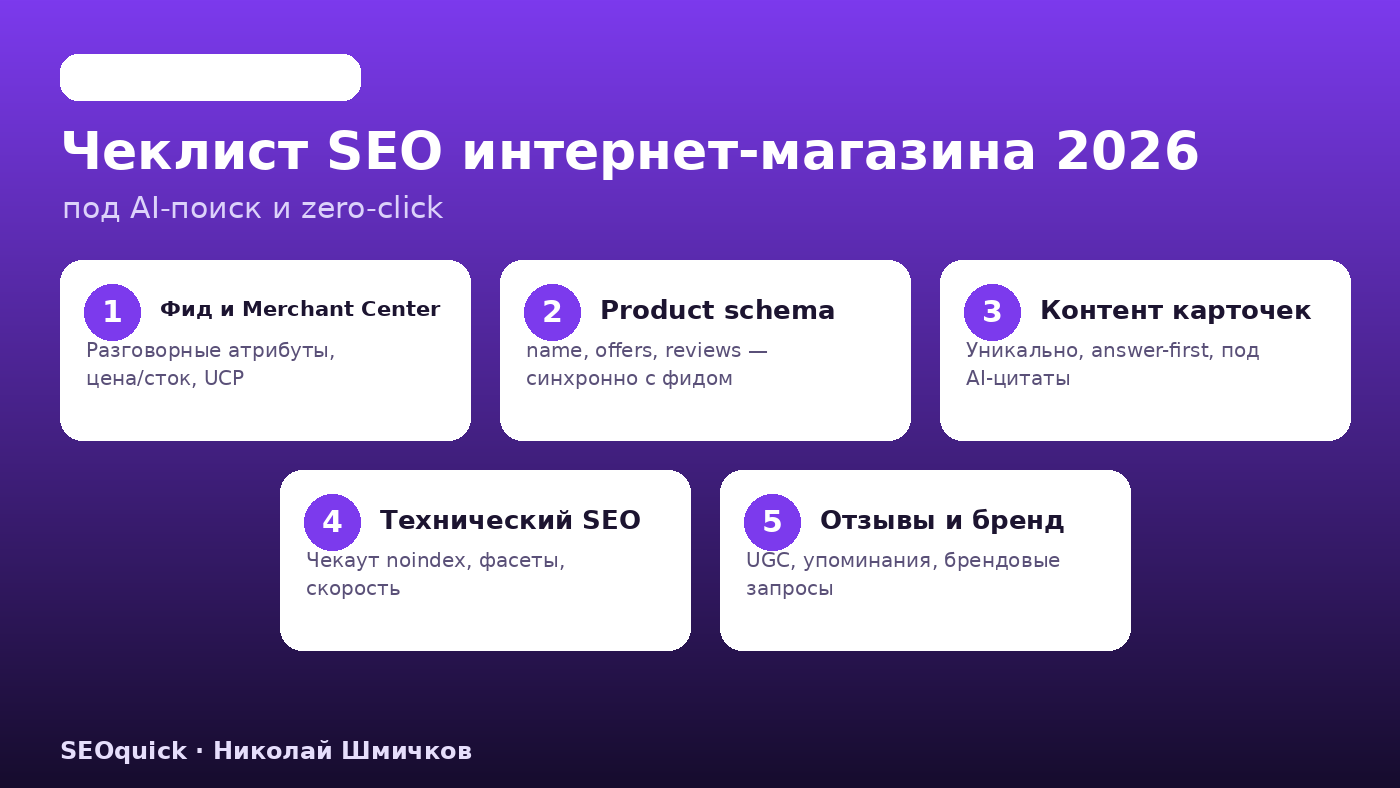
E-commerce SEO in 2026 hits three surfaces at once: classic search results, Merchant Center storefronts, and AI answers (AI Overviews, AI Mode, ChatGPT). What you need in practice: a clean product feed with conversational attributes, correct Product schema, unique quotable content on product pages, a technically isolated checkout with noindex, and a strong brand with reviews. Otherwise, AI will recommend a competitor, and the buyer simply won't reach you.
The rules changed fast. Google AI Mode surpassed one billion monthly active users by May 2026, and AI Overviews now pop up for about 14% of product queries — compared to just 2.1% back in November 2025, a fivefold increase. More often than not, people don't scroll through ten blue links: they get a curated selection of products right in the AI response. This is zero-click for e-commerce — you get the impression, but no click. Below are the points on how to rebuild your store for this, with real numbers and from our experience with checkout audits.

What changed for e-commerce in 2026
The old model of "page at the top equals a sale" is breaking at the seams. AI search has turned into a storefront: AI Mode pulls recommendations from the Shopping Graph, which is fed by your Merchant Center feed and the Product markup on your pages. Meanwhile, queries in AI Mode are on average three times longer than regular ones — you can't optimize a feed for short keywords anymore.
Then zero-click eats your traffic: the buyer sees comparisons and specs right in the answer, so there's no reason to click through to the site. This means the SEO task is to become the source that AI quotes, not the one it summarizes without a link. Against this backdrop, agentic commerce has arrived. In Q1 2026, AI traffic to Shopify stores grew 8x year-over-year, and orders from AI search grew nearly 13x. McKinsey estimates $900 billion–$1 trillion in US retail revenue from agentic commerce by 2030. The flow is simple: found in AI, bought on the site — that's why both the feed and the checkout itself are equally vital.
Product Feed and Merchant Center
The feed is what AI Mode literally reads. A poor feed means you won't get recommended, no matter how polished your site is. First thing, fill in the Conversational Attributes — six new fields from Google Marketing Live 2026. They help AI understand the product when a buyer asks like a human: not "sneakers size 10," but "comfortable sneakers for running on asphalt in winter." Next is basic hygiene: live price and availability, GTIN, brand, condition. AI surfaces show commercial info immediately, and a mistake in price or stock kills trust instantly.
Check the new AI Performance Insights report in Merchant Center — it shows your share of voice on AI surfaces against competitors. And get ready for agentic commerce protocols: Universal Commerce Protocol (UCP) from Google at NRF 2026 extends Merchant Center to the cart and checkout right inside AI Mode. By the way, Google is building a separate format for agencies — here's how Nikolay Shmichkov comments on it:
"Google introduced a separate Merchant Center format for agencies and partners working with multiple e-commerce clients. Effectively, this means Google is building a dedicated infrastructure specifically for the agency model — Merchant Center isn't just an ad add-on anymore, but a standalone operational hub."
Product schema and structured data
Schema.org Product is the second channel where AI and rich results pull product data. A nuance often confused: markup doesn't boost rankings; it grants the right to show up in rich snippets and makes the page readable for AI. The minimum is Product markup with name, image, brand, sku/gtin, and offers (price, currency, availability). Add AggregateRating and Review, but only if reviews are real and visible on the page — Google punishes fake markup. And keep it synced: price and availability in schema must match the feed and what the user sees, otherwise the rich result just drops off.
The upside of this channel is speed. Improvements in schema and product data usually show results in 2–4 weeks because crawlers re-index pages quite fast.
Product page content for AI quotes and zero-click
To get quoted rather than summarized, your product and category texts must answer questions directly and to the point. A description copied from a supplier collapses into a competitor's text and won't make it into the AI response — write what's not in the feed: who the product is for, what it pairs with, how it differs. Make the first paragraph of a product page or guide a direct answer: specs, target audience, key difference. AI pulls short, extractable phrases, not fluff.
Run two tracks in parallel. Sharpen buyer's guides and comparisons for AI quoting, and the product pages themselves for transactional keywords; it's not "either-or," they work together. More on this in the AEO, SEO, and GEO breakdown and the material on how to prepare your site for Google AI Mode. And don't shy away from AI content as such: Google doesn't penalize for AI, but for uselessness and manipulation (I broke this down in the text about what actually gets penalized in 2026).
Technical SEO: Checkout, Cart, Facets
Two fronts here. First is crawling: faceted navigation with filters and sorting spawns thousands of near-identical URLs and burns crawl budget, so decide early which pages Google should even see. The second front is the cart and checkout, and a common mistake here is closing them in robots.txt. Nikolay Shmichkov explains in the video why you shouldn't do that:
"Don't block them in robots. Because if you block the checkout in robots, the Google bot won't be able to read its content but can still index the link to it. The right solution is to use the robots noindex meta tag directly on the cart and checkout pages. The bot will enter, see the noindex, and leave."
But tech is only half the battle. The checkout itself must sell, not lose orders. According to 2026 Baymard Institute data, the average cart abandonment rate is 70.22% (mobile 80.02%, desktop 66.41%). The top reasons for leaving are hidden extra costs (39%) and forced registration (24%). Meanwhile, a properly tuned checkout recovers up to 35% of lost orders, totaling $260 billion in the US and EU. In our checkout audits, the same set of fixes repeats: guest checkout by default instead of forced registration; cut the fields — the average checkout crams in about 23 fields, while 12–14 are enough for usability, and every extra one costs money; isolate the payment page by removing the header, footer, and catalog. Nikolay Shmichkov puts it this way: "You put the user in a tunnel where the only exit is completing the purchase." Add Apple Pay and Google Pay: by Western estimates, wallets boost conversion by about 15%, and a clearly shown (not hidden) list of payment methods — up to 32%. Manual card entry is bad form, and specify delivery time with a concrete date, not "3–5 days": "Communicate with people, not machines."
Reviews, UGC, and Brand Power
AI answers gravitate toward verified entities — brands that people write about, discuss, and trust. Real reviews and UGC on product pages give AI both a trust signal and a source of quotes about a specific product. Off-site presence — mentions on Reddit, YouTube, in roundups, and media — matters because AI gathers opinions from across the web, not just your domain. And branded queries: the more people search for you by name, the higher the chance AI will name you. Brand strength today is one of the deciding factors for AI visibility. You need a systematic plan — check out the e-commerce SEO promotion service.
FAQ
Is classic SEO for stores dead in 2026? No. Transactional queries still go through organic results and product pages — it's just that two more surfaces appeared alongside them: feed/Merchant Center and AI answers, and you now need to work on all three at once.
Should I close the cart and checkout in robots.txt? No. Only with a noindex meta tag on the pages themselves, and leave robots open for scanning — otherwise Google will see the link but won't see the noindex inside.
Does Product schema boost rankings? Not directly. It grants eligibility for rich results and makes the page readable for AI — which indirectly pulls up both visibility and CTR.
Conclusion
Store SEO in 2026 is a blend of old and new, not a choice between them. A clean feed with conversational attributes opens up AI Mode. Product schema provides rich results. Unique content makes you quotable. A polished checkout turns a visit into an order. Nikolay Shmichkov says it simply about the end of the funnel: "An ideal checkout isn't magic; it's the meticulous removal of barriers." It's exactly the same with all store SEO — the winner is the one who methodically removes barriers for both the buyer and the algorithm.
Need a store audit for AI search and a spec for rebuilding product pages and checkout? Write to us — we'll break down your case.
H1 vs Title: how many H1 tags you need and how they differ
H1 in SEO 2026: how many H1 headings are acceptable, optimal length, how it differs from title, empty H1 and H1 as an image. Based on a measurement of 77 pages from the Ukrainian top and data on how often Google replaces your title with the H1.
Read →
Pagination SEO: how to index list pages without breeding duplicates
Pagination SEO in 2026: canonicals on list pages, noindex, rel=next/prev, infinite scroll, crawl budget. Based on a check of 36,000 traffic-driving URLs across twelve Ukrainian retailers, plus a teardown of pagination at Foxtrot, Epicentr and our own blog.
Read →
URL Structure: The Full Guide to Addresses You Can't Change After Launch
How to get URLs right: transliteration or Cyrillic, slug length, duplicates from case and filters, pagination, UTM tags, redirect maps. A breakdown of Rozetka, Comfy, Prom and Makeup URLs plus 2026 research data.
Read →Want to apply this to your site?
We will review the current situation, find the first growth levers, and suggest a practical working format.