Making Money Online in 2026: Which Methods Actually Work
'Make money online with no investment in one click' is a myth the internet is full of. Here's the honest version: which online income models actually make money in 2026, how much you can earn, and how to monetize your own site with affiliate programs.


Real online earnings in 2026 aren't about "easy money with zero investment"—it's about building a skill or an asset: freelance services, content sites with affiliate programs, content creation (UGC), and digital products. You’ll have to invest either time, money, or expertise—otherwise, it’s not a job; it’s a lottery or a scam.
The query "make money online without investment" gets tens of thousands of hits a month, and most people end up stuck in schemes that eat up time at best, and money at worst. I’ve rewritten this article from scratch: the 2018 material is completely obsolete. What follows is an honest breakdown of what actually works in 2026, backed by numbers, sources, and the site monetization practice we do at SEOquick every single day.
The truth about "earning without investment"
Let’s be blunt: money doesn't appear out of thin air. Most videos and articles about "earning without investment" are just selling you someone else's courses or funneling your traffic to affiliate links. You can make money doing that—it’s just that "free and effortless" doesn't exist. A more honest phrasing would be: no cash investment—yes, but not without investing time and skill. You invest either money (ads, product), time (learning, blogging), or expertise (selling what you already know). Anything promising income while bypassing all three resources is a red flag.
Which earning models actually work in 2026
The online economy is massive: the gig economy is approaching hundreds of billions of dollars, and the creator economy has already surpassed $500 billion globally. Within it, a few models hold steady, bringing in cash rather than disappointment.
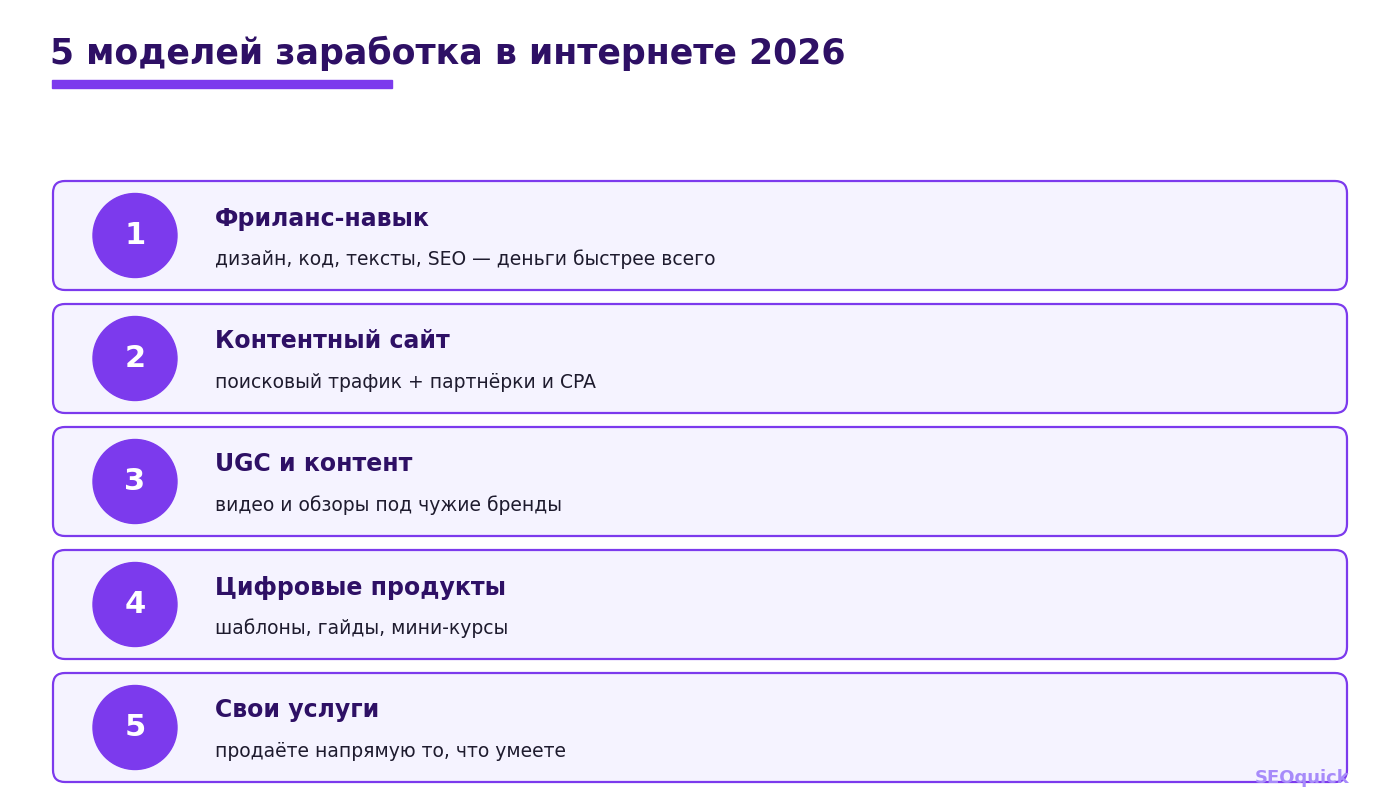
A freelance skill—design, copywriting, development, targeting, SEO—is the fastest path to money. The top 10% of freelancers earn over $100,000 a year, and a specialist with a rate of $25–50 per hour hits $1,000 a week in 20–40 hours of work. Right next to that is the content site with affiliate programs: you write useful articles, gather search traffic, and monetize it through affiliate programs and CPA—this is our specialty, and I’ll get back to it in detail below. The underrated model of the year is content creation and UGC: filming short videos and reviews for other brands where you don’t need your own audience, just the skill to film something that sells. Then there are digital products—templates, guides, presets, mini-courses: build it once, sell it many times, and some authors make $500–5,000+ a month on a few items. And the most profitable option—selling what you already know directly: a landing page plus SEO, and you aren't dependent on freelance platforms.
How to make money on your site: Affiliates and CPA
The model we handle professionally is earning from an information site. The logic is straightforward: you write a high-quality article, it hits the top for commercial-informational queries like "best bicycles 2026," and you drive that warm traffic to stores via an affiliate program.

Key takeaway from the video: besides selling your own services, the most profitable site income is selling traffic and leads to third-party stores through an affiliate program. Between your article and the store stands a middleman—the CPA network, which tracks clicks and pays you a percentage of sales.
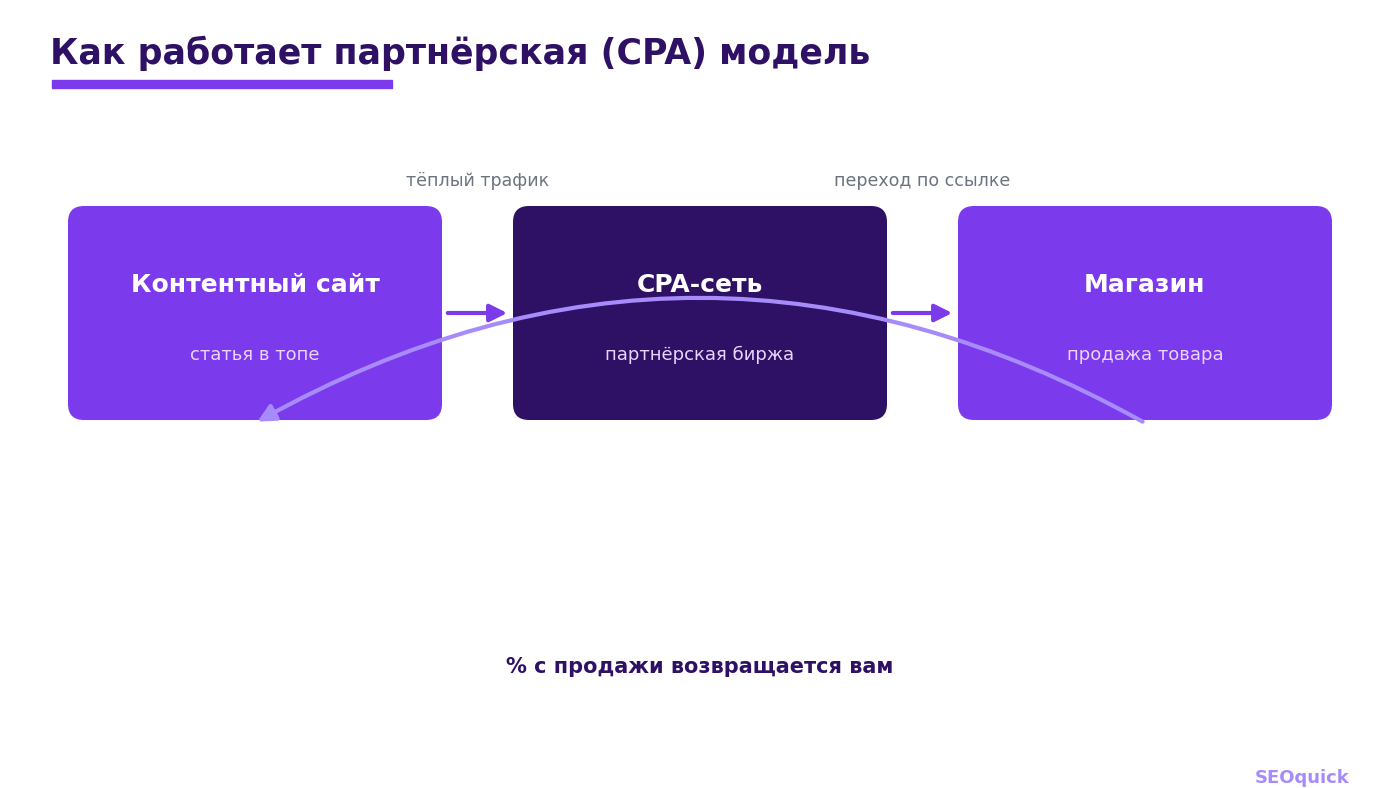
There’s a nuance here that trips up beginners. Contextual advertising like Google AdSense pays peanuts: the banners are irrelevant, and banner blindness kicks in. Affiliate links convert way better because they lead a person exactly to the product they’re looking for. Major programs include Amazon with 4–15% commission, AliExpress up to 7% in most categories and up to 70% during sales, plus industry-specific CPA networks. But for this to work, the site needs speed, content quality, and E-E-A-T—we’ve written about trust in our breakdowns of duplicate content and AI content quality.
How much can you actually earn and how fast
Honest benchmarks are more useful than pretty promises. Freelancing gives money the fastest: first income within weeks, $1,000+ a month in 2–4 months with active searching. A content site is a marathon: the first tangible traffic comes in 4–8 months, and stable affiliate income takes about a year. Digital products and UGC are somewhere in the middle. A specific trend for 2026 is the "human plus AI agents" combo: according to Upwork, a freelancer working with AI tools speeds up projects by up to 70%. Those who know how to prompt AI earn faster—I’ve gathered the tools in my AI for SEO 2026 list.
Where to start as a beginner with zero cash
If there's no budget, your only resources are time and skill. The order is simple: pick one model, don't grab five at once; master one skill to a "I charge money for this" level; create two or three cheap or free case studies for your portfolio; hit the platforms or go directly to clients. In parallel, you can run a content project as an asset for the future—it’ll fire off later, but it’ll work for you for years. And stay away from "quick income schemes": sustainable online earnings are built just like an offline business—through the value you provide to people.
FAQ
Is it realistic to earn without investing money? Yes, but only by investing time and skill. The "absolutely no effort" option is a scam or a lottery; there is no third option.
Which method is the fastest? Freelancing with a high-demand skill: you can get your first income in the very first weeks, whereas a content site takes months to gain momentum.
How much can you make on affiliates? Anywhere from zero to tens of thousands of dollars—it all comes down to traffic and niche. Without stable search traffic, the affiliate model simply doesn't work.
Conclusion
Earning online in 2026 is real, but it follows the laws of any business: first you invest time, skill, or money—then you get income. Forget about "easy money in one click." Pick one working model, master the skill, build an asset. And if you decide to earn on a content site through affiliates—that’s exactly the topic where we can help.

H1 vs Title: how many H1 tags you need and how they differ
H1 in SEO 2026: how many H1 headings are acceptable, optimal length, how it differs from title, empty H1 and H1 as an image. Based on a measurement of 77 pages from the Ukrainian top and data on how often Google replaces your title with the H1.
Read →
Pagination SEO: how to index list pages without breeding duplicates
Pagination SEO in 2026: canonicals on list pages, noindex, rel=next/prev, infinite scroll, crawl budget. Based on a check of 36,000 traffic-driving URLs across twelve Ukrainian retailers, plus a teardown of pagination at Foxtrot, Epicentr and our own blog.
Read →
URL Structure: The Full Guide to Addresses You Can't Change After Launch
How to get URLs right: transliteration or Cyrillic, slug length, duplicates from case and filters, pagination, UTM tags, redirect maps. A breakdown of Rozetka, Comfy, Prom and Makeup URLs plus 2026 research data.
Read →Want to apply this to your site?
We will review the current situation, find the first growth levers, and suggest a practical working format.