Duplicate Content: The Silent Traffic Killer — How to Find and Fix It
Google won't hand you a penalty for duplicate content — but it's exactly what quietly eats your traffic. Here's what counts as a duplicate, why duplicates dilute your signals and hurt AI search, and how to find and fix them with Search Console and Screaming Frog.


Google doesn't penalize your site for duplicate content—but that doesn't mean it's safe. Duplicates dilute link signals, eat up your crawling budget, and stop AI search engines from identifying you as the source. Google estimates that up to 25–30% of all web content is duplicated, and it’s almost always a technical glitch rather than malicious intent.
There's still a ton of confusion in the SEO community about duplicate content: some scream about "bans," others shrug it off, saying Google will figure it out. The truth is in the middle, and it’s more important than it looks. I’ll break down the topic based on a video from our SEOquick channel: what counts as a duplicate, why it kills organic traffic, and how to find and fix it—with numbers and sources to back it up.

What counts as duplicate content
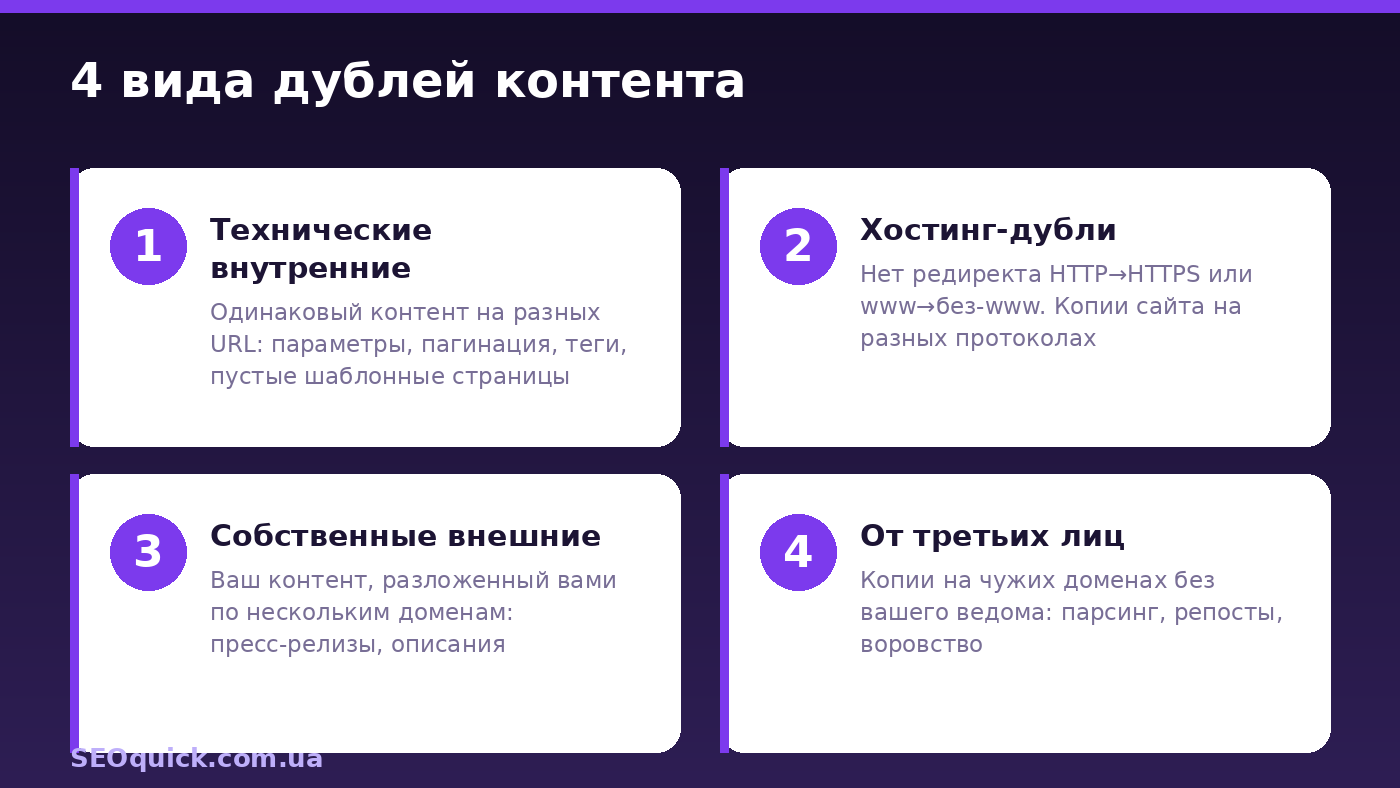
Through Google's eyes, there are four types of duplicates, and they’re treated differently. The most common are technical internal duplicates: same content on different URLs within one site. We’re talking pages with parameters (?utm=, filters, sorting, ?page=), empty template pages without metadata, pagination, and blog tags or categories that the engine churns out automatically. Next are hosting duplicates—server config errors: no redirect from HTTP to HTTPS or from www to non-www, leaving you with identical versions of the site living on different protocols and subdomains. Then there are your own external duplicates—your own content spread across multiple domains, like a press release or description used on different projects. Finally, third-party external duplicates—copies of your content on someone else's domain without your permission: RSS scraping, press release reposts, rewrites, and straight-up theft.
Does Google penalize for duplicate content?
Short answer—no, there is no specific "duplicate penalty." Google's John Mueller has said it a thousand times: a site isn't punished for duplicate content; the search engine just clusters similar pages, picks one to show, and hides the rest. Google's documentation confirms this: the system merges duplicates and picks a canonical URL itself. The downside? You won't know which page Google hid or why. And here’s the key nuance Nikolay points out in the video:
"Technically, Google itself isn't hurting you, but its algorithm calculation system for your site is. Every duplicate page that hits the index because of your mistake lowers the overall rating of your resource."
Formally, you don't get "minus points," but your total authority gets spread thin across dozens of junk pages. Mass-copied external content is a different story: it lowers the perceived quality of the site and your ability to rank for competitive queries. So, duplicates are a serious technical error that hits your promotion strategy hard.
Why duplicates quietly kill organic traffic
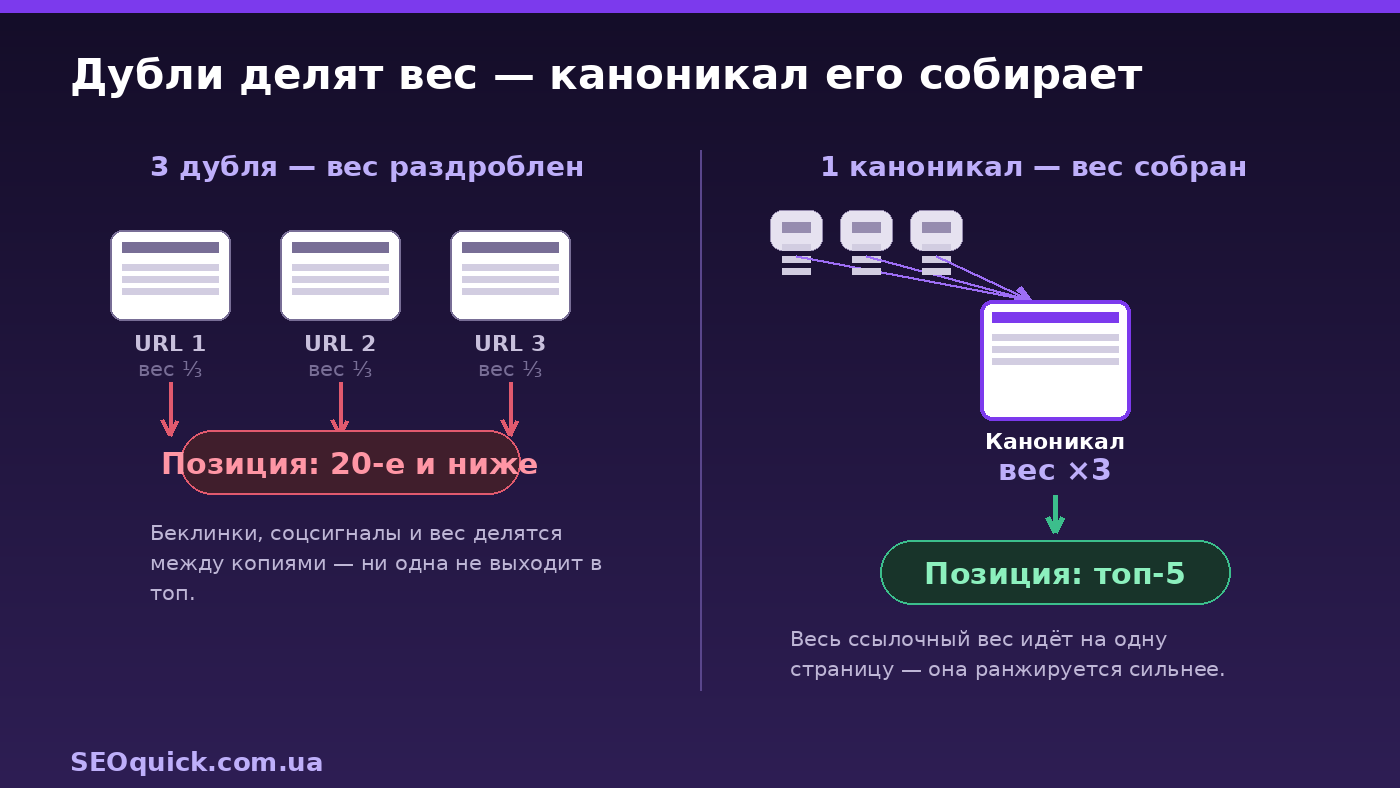
A site doesn't crash overnight from duplicates—they kill it slowly. First, signal dilution: when one piece of content is available at multiple URLs, the search engine splits ranking signals between versions instead of consolidating them into one powerhouse page; backlinks to different duplicates don't stack authority, and social shares get scattered. According to industry estimates, sites with significant duplicate issues lose 15–20% of organic traffic compared to similar sites with correct canonicalization. Second, crawl budget: the bot wastes time on useless copies instead of working pages, making new content index slower. And third—a new and underrated risk for 2026—invisibility to AI search: ChatGPT, Perplexity, and Claude choose an authoritative unique source when generating answers. When your content is fragmented across several URLs, the system can't clearly identify you as the original source and quotes your competitor instead. We wrote about how to get into AI answers in our guide on GEO-optimization for GPT.
How to find duplicates
The fastest way to gauge the scale is with search operators: use site:yourdomain.com inurl:page to find pagination pages in the index, or site:yourdomain.com intitle:"title fragment" to find pages with identical titles—this is often how junk versions on a random subdomain pop up. Screaming Frog is more precise: the Content → Near Duplicates report shows pages with high similarity. Unlike a grammar checker, this report doesn't lie—it finds places where there's too little content or it's nearly identical, and "thin content" is a frequent cause of bad rankings. But the most honest source is Google Search Console, "Indexing" section, "Why pages aren't indexed" block. Look for two statuses: "Duplicate without user-selected canonical" means Google thinks the page is a duplicate and you didn't set a canonical; and "Duplicate, Google chose different canonical than user" means you set a canonical, but Google disagreed with you (see Google's troubleshooting guide). Usually, Google is right, and you need to rethink your canonical logic.
How to fix duplicate content
Once found, fix them by type. Hosting duplicates are cured only by 301 redirects: HTTP to HTTPS, www to non-www, all mirrors to one version. Internal links and Search Console should point only to the canonical version. For everything else, use canonicals: put a self-referencing canonical on every page (even on itself) and a cross-domain canonical if you're legally republishing someone else's stuff. Just don't provide different canonical URLs via different methods (one in the sitemap, another in rel=canonical)—Google will get confused. For syndication, Google actually recommends a "noindex" on the partner's copy rather than a canonical. Language versions are handled by hreflang: our site is bilingual (RU/UA), and without hreflang, Google might see similar languages as duplicates. So, in the <head>, we define the main language, alternatives, and x-default (more details in our piece on technical SEO for Ukrainian sites). Close parametric pages with UTMs and filters using robots.txt rules, and delete technical pages that shouldn't exist in the first place. A classic nightmare is a forgotten test version of the site in the index, and here Nikolay is blunt:
"Lock your Dev version behind a login and password only. A noindex tag won't save you there, I guarantee it."
If your original content is being stolen, set up DMCA protection—the service works directly with Google on copyright violations. Plus, publish your stuff first so Google logs you as the source.
FAQ
Does Google penalize for duplicate content?
No, there's no specific penalty. Google clusters similar pages and shows one, but duplicates dilute signals and crawl budget, making the site rank worse overall.
Canonical or 301—which one?
If the user doesn't need the duplicate URL—301 redirect; it's a strong signal. If the page is needed (like a filtered version) but shouldn't rank—canonical to the main one.
Do duplicates affect AI search answers?
Yes. Content fragmented across different URLs makes it harder for ChatGPT, Perplexity, and Claude to identify you as the primary source, lowering your chances of being cited. In 2026, that’s more expensive than a lost ranking position.
Duplicate content isn't about a "Google ban," it's about a slow leak of traffic that's easy to miss. Find them via Search Console and Screaming Frog, glue them together with redirects and canonicals—and your site's authority will actually go where it works. Want to check your site for duplicates? Send us your URL, and we'll do a free audit.

H1 vs Title: how many H1 tags you need and how they differ
H1 in SEO 2026: how many H1 headings are acceptable, optimal length, how it differs from title, empty H1 and H1 as an image. Based on a measurement of 77 pages from the Ukrainian top and data on how often Google replaces your title with the H1.
Read →
Pagination SEO: how to index list pages without breeding duplicates
Pagination SEO in 2026: canonicals on list pages, noindex, rel=next/prev, infinite scroll, crawl budget. Based on a check of 36,000 traffic-driving URLs across twelve Ukrainian retailers, plus a teardown of pagination at Foxtrot, Epicentr and our own blog.
Read →
URL Structure: The Full Guide to Addresses You Can't Change After Launch
How to get URLs right: transliteration or Cyrillic, slug length, duplicates from case and filters, pagination, UTM tags, redirect maps. A breakdown of Rozetka, Comfy, Prom and Makeup URLs plus 2026 research data.
Read →Want to apply this to your site?
We will review the current situation, find the first growth levers, and suggest a practical working format.