Agentic SEO in 2026: How AI Agents Do SEO Tasks for You
Agentic SEO is when the routine work is done not by a human but by an autonomous AI agent: it gathers data, rewrites meta tags, tracks rankings and suggests fixes on its own. Sounds like autopilot, but in 2026 it is more of a co-pilot. Let's break down what agents already do, how much they save and where Gartner promises loud failures.


Agentic SEO is an approach where autonomous AI agents plan and execute SEO tasks themselves: analyzing pages, searching for keywords, rewriting meta tags and content, monitoring rankings, and reacting to drops. In 2026, this isn't "full autopilot," but a team of specialized agents under human control: you set the strategy, and the agent handles the routine work many times faster.
I hear "SEO is dead" every year—and honestly, I'm ready to agree. But not with the idea that search is dead; rather, that the old way of working is dead: manually opening ten tools, downloading reports, moving data from one to another, and wasting days on it. That’s the part agents are taking over. Next, I'll cover what they can actually do, which tasks they save time on, and why I don't recommend giving them everything without supervision.

What is Agentic SEO in plain English
A standard AI tool answers a single prompt: you ask for a headline—you get a headline. An agent works in a loop: it receives a goal, breaks it down into steps, executes them, looks at the result, and corrects itself. For SEO, this means you can tell an agent "rank this page for this cluster," and it will go through the whole journey—scrape the SERP, find gaps, suggest a structure, rewrite meta tags, and come back to check rankings in a week. The keyword here is "self": not "generate text," but "take the task to the finish line, only bugging me at the crossroads." As I put it in the video:
"The future of SEO will belong to tools that allow you to do and automate practically everything within a single platform—you don't need to use five to ten tools, download data from one, and transfer it to another."
This is a close neighbor to the topic of "stop endless blogging for traffic" and optimization for GPT and AI search: the agent specifically saves man-hours on routine.
What SEO tasks AI agents are already doing
Agentic SEO covers almost the entire pipeline—from research to publication. According to Frase's breakdown, modern agents work in six stages: research, creation, optimization, monitoring, publication, and automation of repeatable scenarios (Frase, 2026).
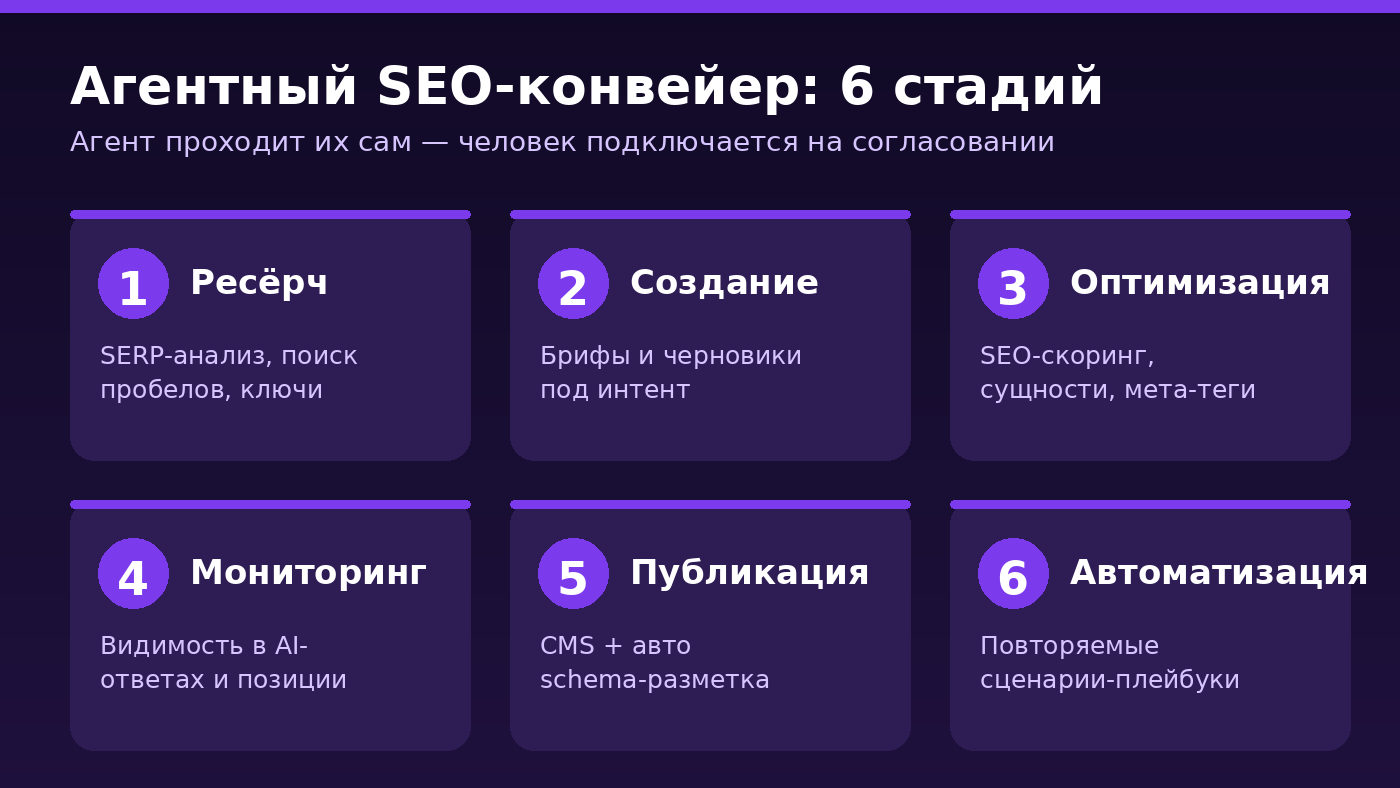
In practice, agents are already analyzing SERPs and finding competitor gaps, clustering keywords and tagging intent, preparing briefs and drafts, calculating SEO scores and working with entities, monitoring visibility in AI answers, and publishing to CMS with automatic schema markup. And this isn't a rarity: 56% of organizations are already embedding AI into SEO processes, and 91% of marketers use AI tools daily (DemandSage, 2026).
Why one agent is worse than a team of agents
A typical rookie mistake is putting one "universal" agent on everything: let it research, write, and optimize. The output will be mediocre at every step. Practitioners agree: specialized agents, each for its own task, give consistently better results than one for everything (Search Engine Land, 2026). I know this from working with people—I've been working with freelancers since 2008 and developed a rule that maps perfectly to agents:
"A person must be strong in one topic. If a freelancer writes about everything at once—plus design, plus development—I don't work with them because the quality won't be there. Google today can distinguish trash from truly good content."
It's the same with agents. One scrapes competitor pages and looks for keyword gaps, the second clusters topics and tags intent, the third prepares briefs and subheadings, the fourth looks for internal linking opportunities—and the human strategist checks and approves the publication. This is the working architecture of agentic SEO.
Example: Agentic workflow in practice
Let me show you a real-life scenario we run ourselves: boosting a sagging e-commerce category. Before, this took a specialist hours; with agents, it's minutes of active work plus a check. The agent pulls the top 10 for the target query and extracts the structure of the leading pages, compares it with yours and highlights missing blocks and entities, generates new title and description options based on CTR, rewrites content directly in the editor with a readability check—and, most importantly, hands it all over in one link that you share with the promotion specialist. As I show in the breakdown:
"Our tool analyzes pages completely and generates new title options using artificial intelligence. The coolest feature is sharing the report with one link: the specialist immediately sees the speed, keywords, and content, and gets to work."
A separate note on meta tags—an underrated but profitable task. On one project, we boosted organic traffic from 100k to 200k per month just by rewriting meta tags that were previously done "just for show." An agent runs through this overhaul for every page in one pass, and this is where automation pays off instantly.

How much it saves: 2026 figures
Savings here aren't a slogan; they're a measurable value. Organizations that implemented agentic AI reduced time on key processes by 25–40% and push tasks to production twice as fast (Frase, 2026), while 83% of SEO specialists in companies with 200+ people noted an efficiency boost after implementing AI (SEO.com, 2026).
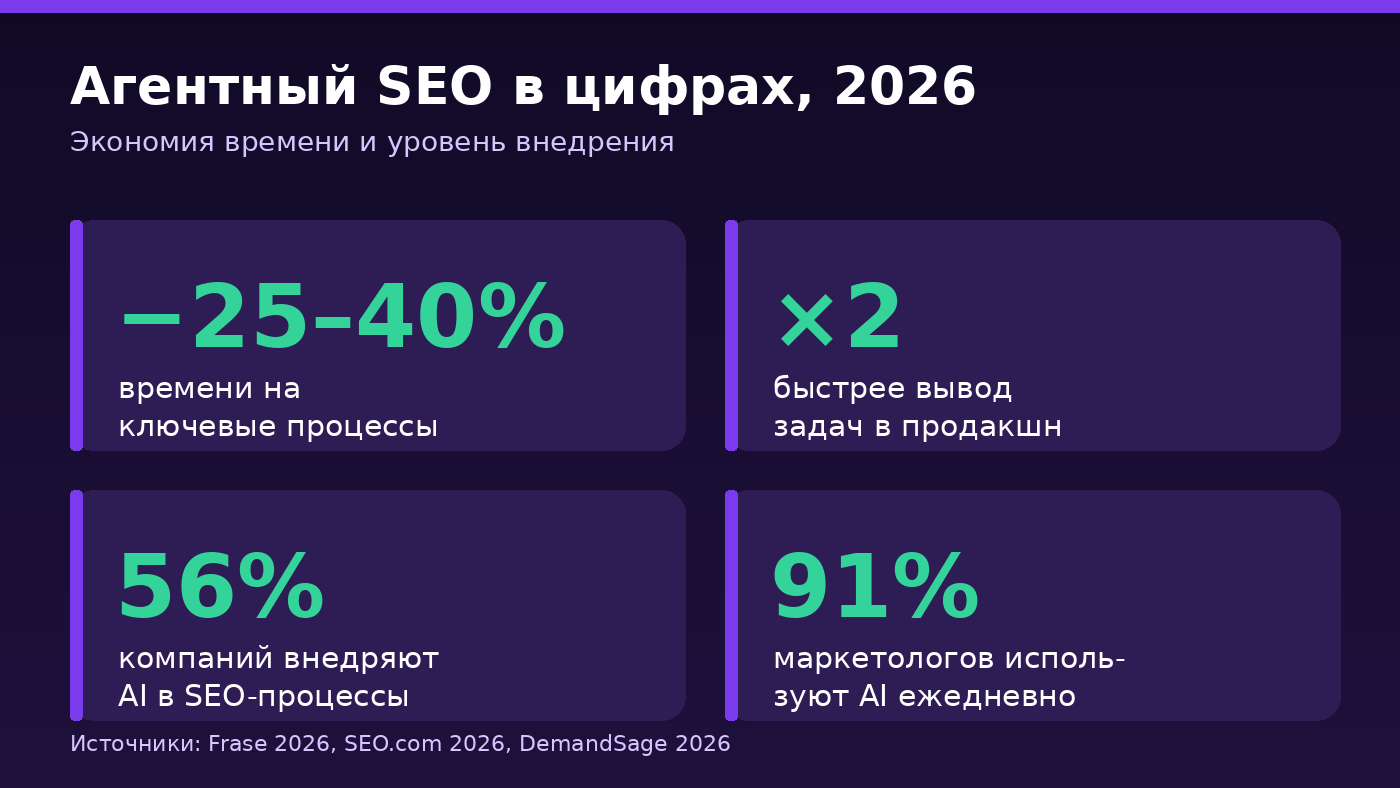
But the ones saving money aren't those who "just turned on AI," but those who rebuilt the process. The agent offloads the routine, and the freed-up time needs to be invested in strategy, expertise, and the bottom of the sales funnel—where decisions are made by humans, not algorithms.
Where Agentic SEO breaks: Gartner's warning
Now for the reality check, without which the article would be dishonest. Gartner predicts that more than 40% of agentic AI projects will be scrapped by the end of 2027—due to bloated costs, fuzzy value, and weak risk control (Gartner, June 2025). They also talk about "agent washing": many vendors just slapped an "agent" label on old chatbots and RPA. Out of thousands of "agentic" vendors, Gartner calls only about 130 real. The conclusion is simple: an agent isn't a "make it good" button; it's a powerful executor that, without a clear strategy and verification, will lead you into a beautiful void. The same Gartner expects that by 2028, up to 15% of daily work decisions will be made autonomously by agents—meaning the tech is real, but maturity comes through discipline, not hype.
How to implement Agentic SEO without causing harm
If you want to try it, here’s the order that won't burn your budget. Start with one task—not "automate all SEO," but "agent rewrites meta tags for priority pages": a narrow task gives a measurable result. Build a team of specialized agents, not one generalist—research, clustering, content, and linking should be separate roles. Definitely keep a human at the crossroads: approving publication, final fact-checking, and tone—that's on you, your defense against "agent washing" on your own side. Calculate ROI, not actions performed—the metric is growth in traffic and sales at the bottom of the funnel, not the number of generated headlines. And don't chase search volume: the top of the funnel is going to AI answers anyway, so direct the agent toward commercial queries that bring in money.
FAQ
Will Agentic SEO replace SEO specialists?
No. In 2026, it's collaborative intelligence: the human sets the strategy, the agent handles the routine. On the contrary, Gartner's prediction about 40% of projects failing makes a skilled specialist even more necessary—someone has to control the agents.
How does Agentic SEO differ from a regular AI tool?
A regular tool answers a single prompt. An agent works in a loop: it plans, executes several steps, evaluates the result, and corrects itself, bringing the task to completion with minimal human intervention.
Is it safe for the site?
It's safe if a human approves changes before publication. Autonomous publishing without verification is the main source of failures, so keep the control layer on your side.
Summary
Agentic SEO in 2026 isn't magic or an autopilot; it's a powerful co-pilot. It takes over the routine that used to take days: research, meta tags, monitoring, drafts. The savings are real—those same 25–40% of time—but they go to those who rebuilt the process and left the strategy to the human. If you want to figure out which tasks in your project can be handed over to an agent right now—book a free consultation, let's look at your site together.
H1 vs Title: how many H1 tags you need and how they differ
H1 in SEO 2026: how many H1 headings are acceptable, optimal length, how it differs from title, empty H1 and H1 as an image. Based on a measurement of 77 pages from the Ukrainian top and data on how often Google replaces your title with the H1.
Read →
Pagination SEO: how to index list pages without breeding duplicates
Pagination SEO in 2026: canonicals on list pages, noindex, rel=next/prev, infinite scroll, crawl budget. Based on a check of 36,000 traffic-driving URLs across twelve Ukrainian retailers, plus a teardown of pagination at Foxtrot, Epicentr and our own blog.
Read →
URL Structure: The Full Guide to Addresses You Can't Change After Launch
How to get URLs right: transliteration or Cyrillic, slug length, duplicates from case and filters, pagination, UTM tags, redirect maps. A breakdown of Rozetka, Comfy, Prom and Makeup URLs plus 2026 research data.
Read →Want to apply this to your site?
We will review the current situation, find the first growth levers, and suggest a practical working format.