A/B Testing in 2026: How to Boost Site Conversion with a Split Test (Step-by-Step Guide)
In 18 years of practice we have learned one thing: gut-feel guesses lose to numbers. An A/B test shows which version of a page actually brings more leads — and in 2026 it does so faster thanks to AI and server-side experiments.

A/B testing (split testing) is a way to compare two versions of a page or element on live traffic and decide, by the numbers, which one drives more conversions. To run it correctly in 2026 you need to: state one testable hypothesis, calculate sample size and duration in advance (at least 14 days and hundreds of conversions per variant), run only one experiment per page, wait for 95–99% statistical significance, and never "peek" at interim results. The free Google Optimize is gone (sunset in 2023), so tests now run on third-party platforms (VWO, Optimizely, AB Tasty, Convert, GrowthBook), often with AI-suggested hypotheses and server-side experiments.
A split test removes intuition and "I think" arguments from marketing. You change one element — a headline, button text, an image, the number of form fields — and watch which version actually brings more leads and calls. In niches with expensive traffic (lawyers, healthcare, real estate) a few-percent conversion lift pays back your ad budget faster than acquiring new traffic.
The relevance of testing only grows in 2026: competition and click prices are high, and a user opens 5–10 tabs in a minute and picks the most convenient site. So the task is to squeeze the most out of the traffic you already have, not to pour in more.

Hey! Yes, you. Looking for traffic to your site? SEOquick will bring you 100% organic!
SEO is your long-term and reliable source of traffic from the Google and Bing search engines
We'll deliver comprehensive SEO promotion: content, reputation, on-page optimization, link building
Our SEO is white-hat, and our goal is to get you into the TOP! We know exactly what to do and how. That's exactly what you need, isn't it?
A/B Testing — What It Is in Simple Terms
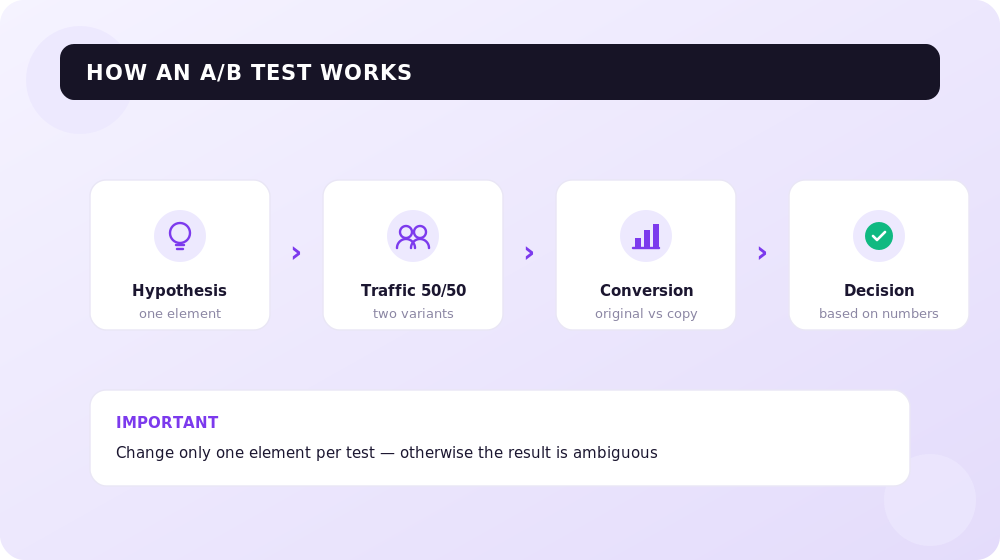
An A/B test is a controlled experiment. Take page A (the control), make a copy B (the variant), change exactly one element in B, and split incoming traffic evenly: 50% see A, 50% see B. If you test three variants, split by 33.3% each. Then compare which version more often leads to the target action: a lead, a call, a sign-up, a purchase.
An example from e-commerce practice: 1000 people land on a site, 25 place an order — a 2.5% conversion rate (roughly average for online stores). After changing the "Order" button to "Complete order" and simplifying the form, conversion rose to 3.2%. That's +28% more leads on the same ad budget — money you would otherwise have spent on new traffic.
The core value of an A/B test is decisions based on numbers, not on a designer's taste or the owner's opinion. You state a hypothesis, run the experiment, track conversion in both variants, and conclude from the data.
The main goals of split testing:
- tune the site to real customer behavior, not to guesses;
- squeeze the most out of incoming traffic;
- raise the conversion rate of a specific page;
- measure the impact of any change on a business metric;
- lower customer acquisition cost (CAC).
Keep one limit in mind: according to a large 2026 study, only about 12–15% of tests produce a statistically significant winner, and the median conversion lift of a winning variant is a modest +1.88%. Mature programs running dozens of tests a month accumulate +20–40% conversion gains per year precisely by stacking small wins.
Principles and Statistical Significance
The foundation of any test is a precisely fixed hypothesis. Not "let's change the button," but a testable statement with a metric.
"If we change the CTA text from 'Order' to 'Complete order', clicks on the button will increase, and the page conversion will rise by 8%."
Copying someone else's case studies ("8 ideas for an A/B test") is pointless: the result is always individual and depends on your audience and offer. A hypothesis must be grown from your own data.
How to Form a Hypothesis
Watch how people actually behave on the site: heatmaps, session recordings, scrolling, the points where users abandon a form. If most drop off at the third field, that's a hypothesis about shortening the form. Gather signals from analytics (organic traffic and behavior), customer surveys, and tools for usability auditing (UX/CX/CRO).
Sample Size and Duration
This is where most tests die. Sample size cannot be eyeballed — it depends on the baseline conversion rate and the minimum detectable effect (MDE) you want to catch. Practical guidelines:
- Conversions matter more than visits. A minimum of around 300 conversions per variant; for a reliable result aim for several thousand if traffic allows (AB Tasty guidance).
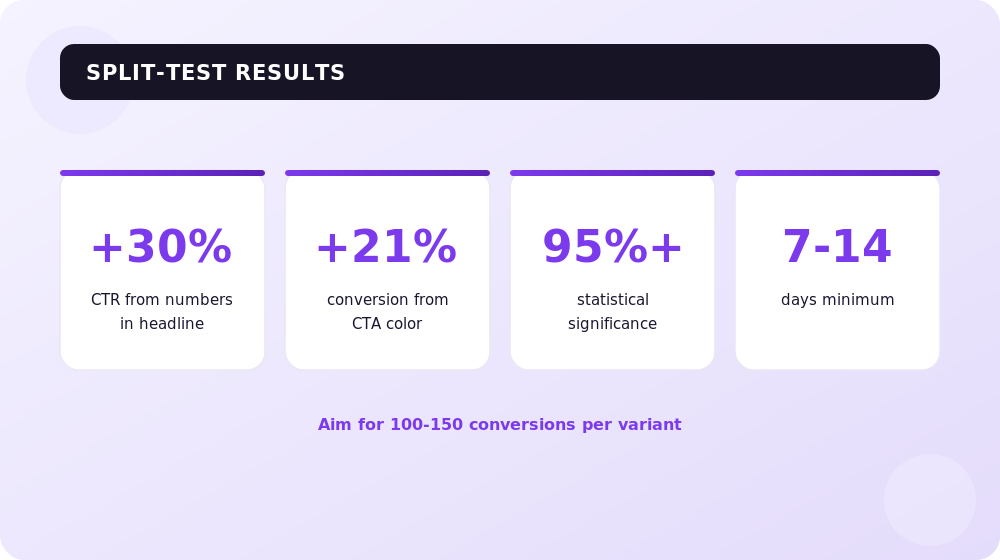
- Duration — at least 14 days, even if the calculator says sooner. The test must capture at least one full weekly cycle: people often browse a product on weekdays (at work) and order on weekends.
- Don't stretch beyond 4–6 weeks — otherwise cookie expiry, seasonality, and external events (currency swings, holidays) interfere.
Statistical significance should be 95% or higher; for important decisions many practitioners recommend 99% (details from Crazy Egg). Modern platforms compute significance automatically.
The Biggest Mistake — Peeking
You must not stop a test the moment variant B "pulls ahead." If you peek and call a win at the first touch of significance, your false-positive rate balloons from 5% to 20–30%. That is p-hacking. In the frequentist approach, sample size is fixed in advance and you only look at the result at the end. If you want to legally stop early, use a Bayesian engine: it answers "what is the probability that B is better than A" and allows correct early stopping without inflating error. Most modern tools offer both modes.
And remember the golden rule: one test — one hypothesis — one changed element. Change the headline, button, and image at once and you won't know what actually worked.
Important: before launch, confirm that the goal (lead, click, purchase) is correctly configured in analytics and that every button and link works in variant B. A 0% vs 15% gap is almost always broken markup, not a "brilliant hypothesis."
What to Test: Hypothesis Prioritization (ICE and PIE)
There are always more ideas than traffic. To avoid spreading resources thin, prioritize hypotheses. Two working frameworks:
- PIE — Potential (how much the metric could grow), Importance (the value of the page and traffic), Ease (effort to implement). Each factor scored 1–10, then averaged. Handy for choosing which page to improve.
- ICE — Impact, Confidence, Ease. The strength here: Confidence forces you to lean on data (heatmaps, surveys, GA4) rather than "I think." Handy for ranking specific tests within a page.
In practice, many teams pair them: PIE selects priority pages, ICE ranks the hypotheses on them. What usually delivers the fastest effect:
- Headlines above the fold — the first thing a user sees. The more precisely a headline addresses the customer's pain, the higher the engagement; numbers in an offer have historically lifted click-through.
- CTA buttons — text, size, placement, contrast. A contrasting button that doesn't blend into the background often delivers a double-digit lift in clicks.
- Lead forms — the number and necessity of fields. Short forms almost always win; the classic Expedia case: removing one extra field brought the company millions of dollars in annual revenue.
- Images and video above the fold — a real photo instead of stock, human faces, a product demo video.
- Pricing and trust blocks — how the price is displayed, installments, reviews, guarantees, payment icons.
- Radical redesign — but only via split URL and with preliminary small tests, not blindly.
Important: other people's lift percentages are a reference, not a target. Lean on your own hypothesis and your own problem. Reproducing someone's case "one to one" is impossible — your audience is different.
A/B Testing Tools in 2026
Here is the biggest change of recent years: the free Google Optimize is gone — Google sunset it on September 30, 2023, and never built experiments into GA4. Instead, Google recommends third-party platforms integrated with GA4 (official partners — AB Tasty, Optimizely, VWO). If an old guide tells you to "set up an experiment in Google Optimize," that advice is outdated.
What to use in 2026:
- VWO, Optimizely, AB Tasty — enterprise platforms with a visual editor, targeting, server-side tests, and AI. They start at roughly $299/mo and up; in early 2026 VWO and AB Tasty merged.
- Convert, Kameleoon — powerful mid-to-upper-tier alternatives with a focus on privacy and GDPR.
- GrowthBook, PostHog — open-source solutions for teams with developers: free, working via feature flags and server-side.
- Crazy Egg, Mida — affordable options for small stores and those who test occasionally.
The upside of paid platforms is the visual editor: blocks are rearranged in 3–5 minutes without HTML/CSS knowledge, there is targeting (e.g., showing variant B only to a specific-country audience) and support. The downside is price and an English-only interface. Free open-source tools require a developer but give full control and server-side experiments.
AI and Personalization in Experiments
The headline trend of 2026 is AI as CRO infrastructure, not a toy. What it changes in practice:
- Hypothesis and copy generation. AI tools suggest headline and button-text variants based on analytics data — so you test not 1–2 but 5–10 meaningful versions.
- More speed. Per industry data, teams combining A/B testing with AI-assisted variant generation run nearly 5x more experiments and noticeably raise their test-to-win ratio.
- Predictive personalization. Algorithms tailor content to a segment (new/returning, mobile/desktop, traffic source) and can change the offer before the user leaves.
- Autonomous experiments. Platforms can run dozens of variants in parallel and reallocate traffic toward the leader on their own (multi-armed bandit).
An important caveat from practice: AI accelerates but does not cancel statistics. A test on an AI-generated variant still has to reach its sample size and significance, otherwise you are just automating p-hacking.
GA4 and Server-Side Experiments
Since GA4 has no experiments engine of its own, the classic setup is: a third-party platform runs the test, and you analyze conversions and segments in GA4 as goal events. Configure goals in advance — otherwise the test has nothing to land on.
Server-side is the second big shift. Instead of swapping elements in the browser (a client-side test), the variant is built on the server via feature flags. Upsides:
- no page flicker, where the user sees the control for a fraction of a second before the swap — which itself hurts conversion;
- you can test backend logic: search algorithm, recommendations, pricing, checkout steps;
- tests work in mobile apps and with server-side rendering.
The downside is that you need a developer. For content and design hypotheses, client-side visual editors are enough; for product and performance changes, go server-side.
Common A/B Testing Mistakes
- Peeking and stopping early — covered above; the number-one killer of validity.
- Several changes at once without a multivariate design: you can't tell what worked.
- Too little traffic and conversions — the test never reaches significance and conclusions are random.
- Too short a run — the weekly cycle isn't captured and the day of week skews the result.
- Non-homogeneous traffic. If the control gets paid search traffic and the variant gets email or social, you are comparing different audiences, not pages. A simple check: run an identical page on both arms — if conversions still differ, the traffic is non-homogeneous.
- Ignoring the environment. Season (December, holidays), competitor promotions, currency swings — all of this distorts the result.
- Technical bugs. A broken button in variant B, flicker, a script conflict — always run QA before launch.
- Stopping after the first win. CRO is a stream of hypotheses, not one lucky test.
The Link Between A/B Testing, SEO, and Conversions
CRO and SEO pull in the same harness. First, behavioral factors: if after a test people stay longer on the page and bounce less, that indirectly strengthens rankings. Second, speed is a shared denominator. A technical audit and Core Web Vitals hit conversion directly: per 2026 data, every extra 100 ms of load time cuts conversion by about 7%, and stores with good CWV see conversion gains in the 5–33% range.
A key SEO-safety note: use proper A/B tools that do not show different content to Googlebot and to users (that's cloaking). Testing platforms do this correctly by default, but with home-grown scripts the risk is real.
The takeaway is simple: SEO brings the traffic, and A/B tests turn it into leads. While competitors overpay for every new visitor, you squeeze more out of the same traffic — the cheapest growth there is.
Frequently Asked Questions About A/B Testing (FAQ)
How long should an A/B test run?
At least 14 days to capture a full weekly cycle, but no longer than 4–6 weeks because of seasonality and cookie expiry. Compute the exact duration with a calculator based on your baseline conversion and target effect (MDE).
How many conversions are needed for a reliable result?
A guideline of at least 300 conversions per variant; for confident decisions aim for several thousand if traffic allows. It's conversions that matter, not visits.
What replaces Google Optimize in 2026?
Optimize was sunset in 2023. Replacements: VWO, Optimizely, AB Tasty, Convert, Kameleoon (paid), GrowthBook and PostHog (open-source/free). Conversions are analyzed in GA4 as goal events.
How does an A/B test differ from multivariate (MVT)?
A/B compares 2 versions with a single change — giving clear causality. Multivariate testing changes several elements at once and measures their combinations, but needs far more traffic. Split URL is for comparing two entirely different pages (a radical redesign).
Bayesian or frequentist — which to choose?
Frequentist gives the familiar p-value but requires fixing the sample size in advance and not peeking. Bayesian answers the business question "the probability that B is better than A" and allows correct early stopping. For marketing, Bayesian is often more convenient; most platforms support both.
Can you run A/B tests for free?
Yes: open-source GrowthBook and PostHog are free, and Mida has a free tier. But "free and simple, like Optimize" no longer exists — open-source tools usually require a developer.
Conclusions
A/B testing in 2026 is not "change the button color at random" but a discipline: a hypothesis from data, prioritization by ICE/PIE, honest statistics without peeking, the right sample size and duration. The tools have changed (Optimize is gone), AI variant generation and server-side experiments have been added, but the core principle is unchanged — numbers make the decisions, not taste.
While competitors overpay for acquisition, you can get more leads and calls from the same traffic. If you want to tie CRO to organic growth without losing rankings, we'll help you build both your tests and your search promotion into a single system.
Robots.txt in 2026: how to create, test, and avoid breaking indexation
A practical robots.txt guide: what to block, what not to block, why robots does not remove pages from Google, and how to connect it with sitemap.
Read →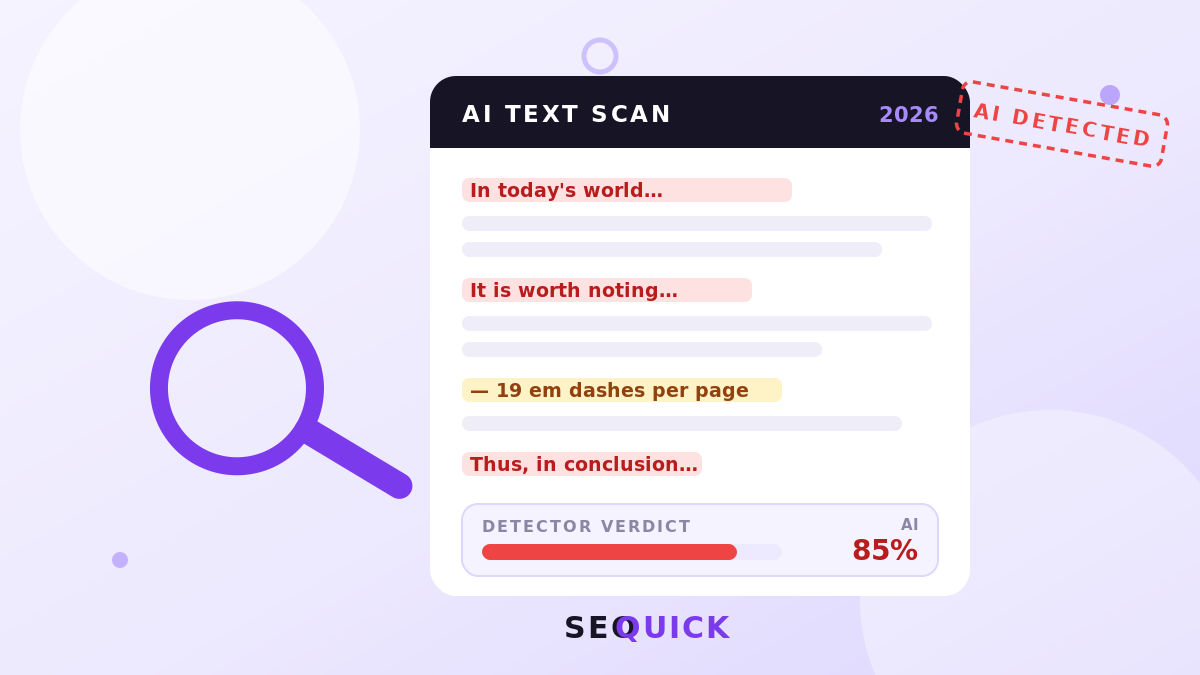
How to Detect AI-Written Text: Language Markers, Code-Level Evidence, and Detection Tools
An AI-text detection system from the creators of the Unmiss AI detector: GPT phrase markers, machine logic, special-character evidence in code, tools, and a 7-step checklist. Plus what Google thinks about it.
Read →
Image SEO Optimization: alt, Dimensions and Weight for Core Web Vitals
How to optimize images for SEO in 2026: why alt text matters, how width and height stop layout shifts (CLS), which formats (WebP, AVIF) to use, and how not to break LCP with lazy loading. A guide from SEOquick.
Read →Want to apply this to your site?
We will review the current situation, find the first growth levers, and suggest a practical working format.