Website Monetization in 2026: 15 Working Methods and How to Prepare
A complete guide to website monetization in 2026: 15 working ways to earn, the impact of AI search on publisher revenue, and a diversification strategy.

Website monetization in 2026 isn't a single revenue stream — it's a portfolio of 3–4 channels: ad networks (AdSense, Ezoic, Mediavine), affiliate marketing, selling info products and subscriptions, e-commerce, and lead generation. Market data shows that the sites earning consistently are precisely the ones running several monetization methods at once, where one channel hedges another. Below: how to prepare your site, which methods to choose, and why in the age of AI search diversification has stopped being a recommendation and become a survival requirement.
Building any online resource costs money: creation, annual domain and hosting fees, and above all promotion and content. Even if you built the site yourself on a website builder, you spent time on it.
Monetization lets you at minimum recoup these costs and at best build a stable income. And if your site exists to promote your own products and services, extra revenue never hurts.

| ~80% of search queries in 2026 end without a click to any site (zero-click) | 33% drop in global search traffic to publisher sites in the year to November 2025 |
| $15–40+ RPM in premium niches (finance, B2B, tech) on Mediavine-tier networks vs $1–10 on AdSense | 82% of high-earning sites use several monetization methods simultaneously |
In 2026, a single revenue source is no longer enough. Let's look at how to prepare your site, which methods deliver, and how to assemble them into a resilient portfolio.

What does your competitor have that you don't yet? That's right — traffic. SEOquick to the rescue!
We'll bring a flood of traffic to your site through SEO.
We'll do it using strictly white-hat methods, with no filters or penalties from Google.
We'll run deep optimization: strengthen content, grow links and reputation. And it'll all work out!
Where to start monetization in 2026
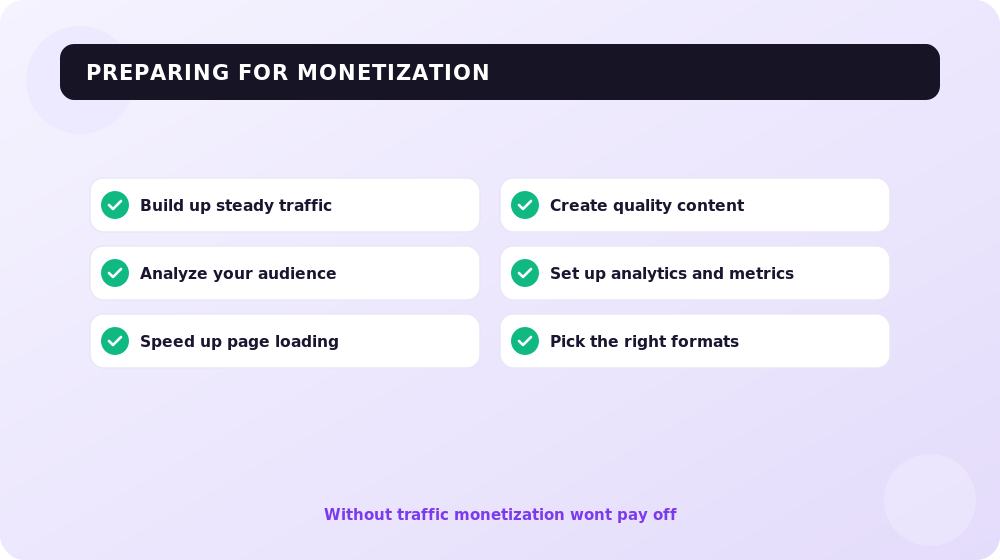
Before picking a specific method, you need to understand: which sites monetize well, when to start, how to prepare the site, what revenue to expect, and whether you can combine several channels.
Which sites monetize well
Income requires two things: traffic and the right monetization method. The site can be informational, news, or commercial — the format is secondary.
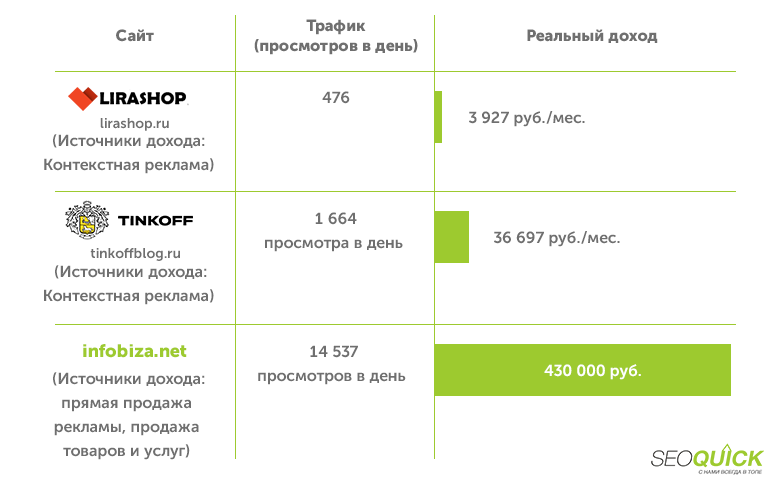
You'll only earn good money from ad networks with sufficient traffic volume. What if your audience is small but loyal and "yours"? Then bet on quality: a narrow audience that's valuable to advertisers earns from paid placements, affiliates, and subscriptions even with modest traffic numbers.
The key is the ratio of "traffic volume and quality — chosen monetization method," plus site reputation, which we'll cover below.
When to start monetizing
There are no hard deadlines, but there is one rule: don't launch monetization right after the site goes live. You'll scare off both visitors and advertisers — nobody studies ads on an unknown site.
Early on, invest in search engine optimization and build a steady traffic flow. Good news: Google AdSense has no formal minimum traffic threshold — content quality matters more. But a sensible benchmark before applying is around 100 unique visitors a day (≈3,000 a month). Once your audience grows, plug in higher-paying ad networks and direct advertisers.
A typical publisher growth path in 2026 looks like this:
| Ad platform | Traffic threshold (visits/mo.) | Effect |
| Google AdSense | from 0 (start) | RPM ~$1–10, baseline start |
| Ezoic | from 10,000 | RPM 50–100% higher than AdSense |
| Mediavine / Raptive | from 50,000 | RPM $15–40+ (Raptive — up to $25–50) |
Each move to the next network typically delivers a 50–100% RPM increase. In early 2026, Mediavine lowered its entry barrier: the Journey tier accepts sites from 1,000 sessions a month.
How to prepare your site for monetization
Beyond traffic, reputation and compliance with search engine requirements are critical. Run internal SEO, don't buy links on junk sites, and partner with topically related resources.
Preparation checklist:
- run internal optimization for search engine requirements (Google, Bing);
- boost quality signals: domain authority, no penalties, good Core Web Vitals;
- regularly publish unique expert content your audience cares about;
- use only white-hat promotion: SEO, content marketing, topical partnerships;
- add adjacent channels — social, email, paid — so you don't depend on Google alone.
How AI search is changing publisher revenue
The big shift of 2026 is AI Overviews and AI Mode in Google. Search increasingly answers the query right in the results, and the user never visits a site. The numbers are stark: around 80% of all searches now end without a click, and for queries that trigger an AI Overview the median zero-click rate reaches 80%.
For publishers this means falling traffic. Industry research shows global search traffic to publisher sites dropped ~33% in the year to November 2025, while the top-position CTR for AI Overview queries collapsed from 7.3% to 1.6%. The hardest-hit formats are informational "how to do X" pages — AI cannibalizes them almost entirely.
The takeaway is simple: a model where "all revenue = ads from search traffic" is risky in 2026. You need to (1) rebuild content for citability in AI answers (Answer Engine Optimization), (2) develop channels independent of Google — email, subscriptions, direct sales, and (3) keep several income sources. By the way, your own AI tools can help with content and analytics.
What revenue to expect
Income depends not only on traffic volume but also on niche and geography. In 2026, average CPMs sit at $0.30–$2 for general topics and $5–$15+ in high-value niches (finance, tech, health). Traffic from the US and Canada monetizes 2–3x higher than other regions.
A rough benchmark: a site with 20,000–40,000 monthly pageviews at a mid-range RPM earns ~$100–200/mo. In low-CPC niches, hitting $1,000/mo. may take up to 500,000 pageviews, while in finance or law it can take as few as 40,000.
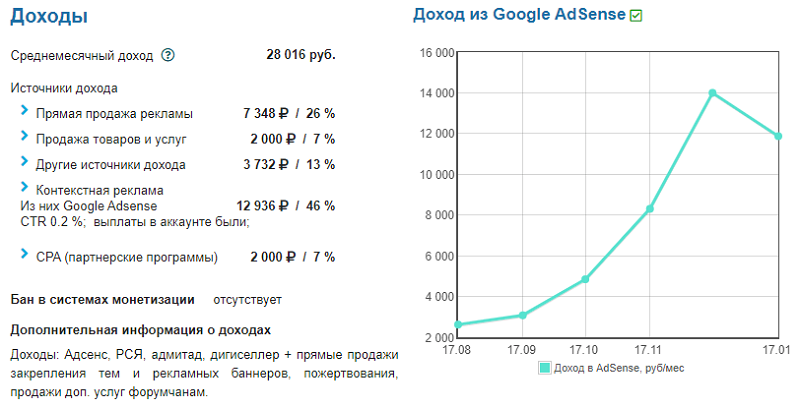
An approximate revenue structure for a multi-channel site (proportions, not exact figures):
| Revenue source | Share of revenue |
| Contextual and display ads | ~46% |
| Direct ad sales | ~26% |
| Other sources (donations, data, surveys) | ~13% |
| Product and service sales | ~7% |
| CPA / affiliate programs | ~7% |
By the way, selling the site itself is also a monetization method: a site earning $500/mo. is valued at roughly $5,000–10,000. But that's a one-time deal, so we don't include it in the main list.
Can you combine several methods?
Not only can you — you should. In 2026, 82% of high-earning sites use several channels at once. But don't overload the site with ads: a glut of banners kills trust and Core Web Vitals.
Start with 1–2 methods, track audience reaction and the profitability of each channel, test, and gradually expand your portfolio. Want to grow free traffic first and push your site up in search? Fill in the form below and we'll discuss a plan to grow your business.
Monetization methods for sites with traffic
This group of methods works once you already have a steady flow of visitors.
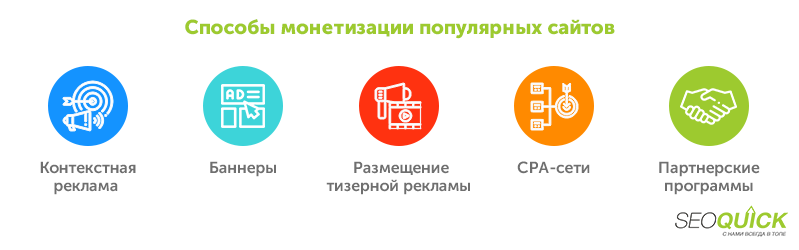
1. Contextual and display ads (AdSense, Ezoic, Mediavine)
The most common method is serving ads from ad networks. Almost everyone starts with Google AdSense: you register, place the code on your site, and get paid for impressions and clicks.
But in 2026, AdSense is only the bottom rung. Header bidding technology and networks like Mediavine, Ezoic, and Raptive run a simultaneous auction among several ad buyers and consistently deliver several times higher RPM. So the strategy is simple: start with AdSense, then move to a higher-paying network as traffic grows.
For ads to make money you need steady traffic and good usability. Setting up campaigns gets easier every year — we have a detailed guide to contextual advertising.
2. Affiliate marketing
You recommend a partner's product or service and earn a percentage of the sale or a fixed payout per referred customer. It's one of the highest-margin channels: per industry data, affiliate beats display advertising on profitability in most niches.
Commission benchmarks for 2026: the median is around 20%, digital and info products pay 20–50%, and SaaS pays 20–30% recurring. The recurring model (a commission on every subscription renewal) gives the most stable income: in programs that pay on renewals, up to 70% of all payouts are renewals.
In Ukrainian practice, both global programs (Amazon Associates, air/travel affiliates) and local ones work — the affiliate programs of Rozetka, Prom.ua, and other marketplaces, plus CPA networks in finance, education, and e-commerce.
3. CPA networks and lead generation
CPA (cost per action) means payment for an action: a registration, a request, a call, an app install. Advertisers post offers in a network, the webmaster picks a relevant one and places it on the site, and income accrues for each target action by a visitor.
Lead generation is especially profitable in high customer-value niches: real estate, finance, insurance, education, medicine. If your content attracts people with clear commercial intent, selling leads is often more profitable than banner ads on the same traffic.
4. Sponsored and native content
If you have a popular blog with a relevant audience, brands will pay to publish articles and native integrations. You set the price yourself — it depends on volume, placement duration, and traffic quality.
You can sell articles directly or through marketplaces like PRNEWS.IO, which act as a deal guarantor. The article topic should at least loosely match your site's theme — otherwise both trust and SEO suffer.
5. Selling ad space directly
With steady traffic you can sell ad space without intermediaries. Set up a dedicated page with terms: banner formats and sizes, placement, price per impressions or per period (e.g., a month), and the topics you work with.
The upside of direct sales is that you dictate the price and terms, and the margin is higher than ad networks' because there's no intermediary commission.
Recommended reading:
Earning methods that work for almost everyone
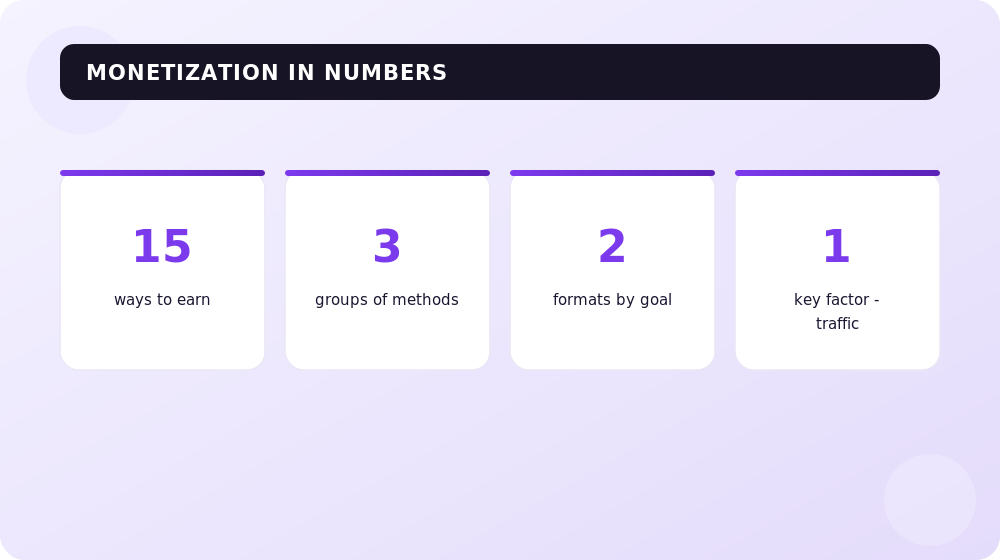
These methods depend less on traffic volume and on search algorithms — which makes them more resilient to the click decline caused by AI search.
6. Paid subscriptions and membership
This is the main publisher trend of 2026. Instead of depending on ads and search traffic, you sell access to content or a community directly to the reader. The creator economy has crossed $250 billion and, per Goldman Sachs, is forecast to grow to ~$480–528 billion by 2030.
Platforms like Substack (takes ~10% of revenue), Patreon (5–12% depending on plan), Ko-fi, and beehiiv let you launch a paid subscription without building your own software. Many creators combine them: Patreon for tiered membership, Substack for the newsletter, YouTube memberships for video. That's diversification in action.
7. Info products: courses, webinars, guides
Selling your own info products is one of the highest-margin channels: digital goods have margins close to 100%. Online courses, webinars, e-books, templates, paid expert consultations — all of these monetize your expertise directly, without intermediaries.

In 2026, people pay more readily for private access, personal contact, and structured knowledge than for mass free content. To build quality content for your product, use our keyword research tool.
8. Email marketing and newsletters
Email is a channel you fully own that doesn't depend on Google's algorithms. Build a base of loyal readers with useful emails, then monetize: affiliate links in emails, sponsored integrations, announcements of your own info products and subscriptions.

In an era of declining search clicks, your own email list is one of a site's most valuable assets.
9. Paid content and paywall
You give away some material for free and charge for the continuation or for exclusives — a one-time fee or a subscription (monthly/yearly with a discount). It's passive income, but it requires genuinely valuable content readers are willing to pay for.
10. Accepting voluntary contributions (donations)
If your project has built a loyal audience and provides value for free (access to materials, tools, services), invite people to support it with donations. It won't be stable income, but it will partly cover running costs.
In Ukraine, a donation button is easy to implement via payment services like LiqPay or Fondy. You can set a target amount or let people choose their own contribution size.

E-commerce and additional earning methods
These methods turn your site into a full-fledged business asset.
11. Selling products and services (e-commerce)
A commercial site earns from selling products and services directly. But an informational portal can become a store too: selling physical goods, digital products, consultations. To boost homepage conversion, study our tips on designing a landing page. In Ukraine, convenient platforms to start selling are Rozetka, Prom.ua, and OLX.
12. Dropshipping
A resale scheme without your own warehouse: the goods are stored at the supplier, and after an order in your store the supplier ships the parcel directly to the buyer. Your income is the markup. Dropshipping lowers the barrier to e-commerce: no investment in inventory or logistics is needed — a site and traffic are enough.
13. Web-push advertising
Short notifications that appear over the window on a PC or smartphone (image, text, link, button). They require the visitor's consent. Implemented via the OneSignal plugin for WordPress or services like Push4site and Gravitec.net. A good supplementary channel that monetizes even those who have already left the site.
14. Renting out pages and sections
Owners of large sites rent out individual pages or sections. A company with a related topic gets a platform with a ready audience and wide reach, saving on its own promotion, while the site owner gets regular payment.

15. Surveys and collecting anonymized data
You can place paid advertiser surveys — for example, motivate users by gating paid content behind survey completion. Anonymous, non-personal data (country, device, demographics) can also be monetized, as it's of interest to analytics firms. Important: personal data must not be disclosed — act strictly within the law and your privacy policy.

Frequently asked questions about website monetization
How much traffic do you need to start earning from a website?
Formally, AdSense has no minimum, but a sensible start is around 100 unique visitors a day (≈3,000/mo.). To move to higher-paying networks, Ezoic needs 10,000+ visits a month and Mediavine/Raptive need 50,000+ (though the Journey tier accepts from 1,000 sessions). Affiliates, info products, and subscriptions, however, can be launched almost immediately — there, audience quality matters more than volume.
Which monetization method is the most profitable in 2026?
There's no universal answer: in premium niches (finance, B2B) ads on Mediavine deliver $15–40+ RPM, while affiliate marketing and selling your own info products often beat ads on margin. The most reliable approach is a portfolio of 3–4 channels, like 82% of high-earning sites use.
How do AI Overviews and AI search affect publisher revenue?
They reduce visits to sites: around 80% of searches end without a click, and publisher traffic fell roughly 33% in the year to November 2025. This hits models entirely tied to ads from search traffic. The solution is Answer Engine Optimization (optimizing for citation in AI answers) plus developing independent channels: email, subscriptions, direct sales.
Can you use several monetization methods at once?
Not only can you — you should. Diversification is the key condition for resilience in 2026. Don't overload your site with ads; start with 1–2 channels, measure the profitability of each, and gradually expand your portfolio.
How much can you earn from a website in Ukraine?
It depends on niche, traffic geography, and the mix of channels. A site with 20,000–40,000 monthly pageviews at a mid-range RPM earns roughly $100–200/mo. on ads alone; in high-value niches and with affiliates, subscriptions, and info products added, the income is several times higher. Traffic from the US/Canada monetizes 2–3x higher than Ukrainian traffic.
What should you prepare on a site before launching monetization?
Do technical and internal SEO, ensure good Core Web Vitals, fill the site with unique expert content, build a steady traffic flow, and collect an email list. The higher your site's quality and trust, the more monetization methods become available to you and the higher advertisers' rates.
Conclusions
Website monetization in 2026 is about a portfolio, not a single source. Ads (moving from AdSense to Ezoic and Mediavine as you grow), affiliate marketing, info products, subscriptions, e-commerce, and lead generation complement each other and hedge against risk.
The main challenge of the year is AI search, which drives down clicks to publisher sites. That's why betting on channels independent of Google (email, subscriptions, direct sales) and on optimizing content for AI answers has stopped being optional. Start with 1–2 methods, test, measure profitability, and gradually build a resilient multi-channel model.
Making Money Online in 2026: Which Methods Actually Work
An honest breakdown of making money online in 2026: why 'easy money with no investment' is a myth, 5 models that actually work, and how to monetize your own site with affiliate and CPA — by SEOquick.
Read →
Agentic Commerce: How to Prepare Your Online Store for AI Agents That Shop
Agentic commerce in 2026: the ACP and UCP protocols, why in-chat checkout stalled, and what a store owner must fix in the feed, prices and stock so an AI agent picks you.
Read →
Google AI Mode in 2026: What It Is and How to Prepare Your Site for Conversational Search
What Google AI Mode is, why CTR is falling and how to get cited in its answers. A SEOquick breakdown: 1B users, 93% zero-click queries and a working 2026 checklist.
Read →Want to apply this to your site?
We will review the current situation, find the first growth levers, and suggest a practical working format.