10 Google Ads Myths That Quietly Drain Your PPC Budget
Clients come to us with the same misconceptions over and over: 'collect 10,000 keywords', 'buy cheap clicks', 'Performance Max will handle everything itself'. I've gathered the 10 most persistent Google Ads myths and broken down each one: where it came from, why it doesn't work, and how things actually are.


This article was born as a cry from the heart after hundreds of client conversations — and since 2018 the cry hasn’t quieted down; only the myths have been updated.
Some clients fell for cheap traffic from CPA networks, others took PPC training courses and now demand “10,000 keywords, just like we were taught”. And with the arrival of Performance Max and AI Overviews, a new wave of misconceptions has emerged — this time about artificial intelligence.
Here I’m covering myths specifically — false beliefs clients bring to the table before launch. If you’re interested in technical setup mistakes, we have a separate guide for those: 25 common Google Ads mistakes.
In short: Google Ads myths are misconceptions about how paid search works: that keyword quantity beats quality, that cheap clicks are profitable, that AI campaigns can’t be controlled, or that a specialist is no longer needed. In reality, your budget is set by the auction, results are driven by relevance and conversion data, and Google’s automation demands more human oversight, not less.
MYTH 1. The more keywords in a campaign, the better
A classic: “My competitor has 10,000 keywords — collect just as many for me!”
I hate to disappoint you: Google doesn’t give discounts for word count. The number of keywords is determined by your niche and real demand, not by ambition. This myth was invented by training-course sellers: a report with 10 campaigns and thousands of keywords looks more impressive than 2–4 tidy campaigns. Clearly, someone has been “working hard”!
In practice, 90% of keywords in such campaigns never get a single impression, while the rest duplicate each other and compete against one another in the same auction. Cleaning up an account like that costs more than building a new one.
The truth: since 2021, Google itself has shifted the market to meaning-based semantics: match types work through neural-network query understanding, not literal word matching. Today the winning structure is “compact ad groups + precise offers + negative keywords”, not a sack of keywords.
MYTH 2. Irrelevant indirect queries also sell
“We deliver groceries — add the keyword ‘buy laundry detergent’ for us!” Or: “I sell auto repair shop tools — give me more generic keywords.”
Sounds logical: the audience is similar, right? But in search, a person is solving a specific task here and now. Someone searching for detergent wants detergent — not your vegetable box subscription.
Later you’ll have to filter those queries, switch them off, and sometimes cut out entire campaigns — along with the budget they burned.
The truth: indirect demand is the job of display formats, remarketing, and Demand Gen, where you pay for audience reach rather than an expensive search click. In a Search campaign, every keyword must match the offer on the landing page.
MYTH 3. Long-tail queries are cheaper than high-volume ones
A very persistent myth from the era of “scrape 100K keywords with a keyword harvesting tool”.
In hot commercial niches, a 3–4-word query (“buy dual-circuit boiler installment plan”) often costs more than a short one: the intent is hotter, and competitors fight for it harder. Click price is determined solely by the auction — the competition at the moment of the query — not by phrase length.
The second trap: if you trim your keyword list by click price, you’ll end up with junk queries that real buyers simply never search for. It’s hard to believe a contractor will invent queries that competitors haven’t found but your customers actually type.
The truth: long-tail keywords are valuable not because they’re “cheaper” but because they hit the intent more precisely. And always ask your contractor to show conversions for those keywords — not clicks, but sales.
MYTH 4. Cheap clicks will bring sales
“I can buy traffic at UAH 1–4 per click (a few cents in Ukrainian hryvnia), while the direct keyword costs UAH 200. That’s 50 times cheaper!”
No. What you need to count is not the cost per click, but the cost per customer. According to WordStream (2025), the average CPC in Google Ads is $5.26, and in expensive niches like legal services it reaches $8.58 — precisely because those clicks pay off.
A cheap click is cheap for one of these reasons: the query is informational, the audience is cold, or the ad position is at the bottom of the page where CTR approaches zero. You’ll drive a crowd of “readers” to your site, calculate your cost per lead and LTV — and realize that a six-figure budget went nowhere.
The truth: cheap traffic has its place in Display, Demand Gen, and video — for warming up audiences and remarketing. In Search, pay for hot intent even if the click is expensive: what matters is ROAS, not CPC.
SEOquick experience: in a full-funnel campaign for a window installation company in Odesa (Ukraine), we achieved a 10.93% CTR and a cost per conversion of UAH 73.71 (about $2) — not with cheap clicks, but with rigorous traffic cleaning: the account has 7,093 negative keywords. Details in our case study on full-cycle PPC campaign setup (in Russian).
MYTH 5. “Tell me exactly how many calls I’ll get and what budget I need”
A favorite question at the first meeting. The honest answer: nobody can tell you exactly — and run from anyone who promises to.
Any forecast runs into a chain of unknowns:
- Competitors’ bids — closed information; the auction changes daily.
- The real CTR of your ads — you’ll only learn it after launch.
- Your website’s conversion rate — depends on the offer, prices, and usability, not on the ads.
- Seasonality and demand — Google’s planner gives a range, not a guarantee.
Budget is cost per click multiplied by the number of clicks: three unknowns multiplied by a fourth. Any “exact” figure before launch is fantasy.
The truth: the correct format is a 2–4-week test period, after which you have your own data: real CPC, CTR, cost per lead. From there, forecasting becomes math instead of fortune-telling.
MYTH 6. Performance Max will replace your specialist
A fresh myth of the automation era: “Google optimizes everything itself — why pay a human?”
PMax does indeed distribute budget on its own across Search, Shopping, YouTube, Display, Gmail, and Maps. But “on its own” doesn’t mean “correctly”. The machine optimizes whatever you told it to optimize. Feed it the goal “all conversions” without offline data — and it will happily pile up micro-conversions and junk leads.
A specialist working alongside PMax handles what the algorithm can’t: asset group structure, feed and creative quality, brand traffic exclusions, goal selection, and lead quality control through the CRM.
The truth: PMax is a tool that amplifies a specialist, not one that replaces them. The difference between “launch and pray” and deliberate management is severalfold.
SEOquick experience: for a jewelry e-commerce store, we rebuilt Performance Max with regional segmentation — ROAS grew from 2.8 to 5.1, impressions ×5.6, and in the Odesa segment ROAS reached 116. Same algorithm — the structure made the difference. Case study: promoting a jewelry online store (in Russian).
MYTH 7. AI campaigns are a “black box” that can’t be controlled
The flip side of myth 6: “PMax can’t be controlled, so it’s a lottery.”
That was true in 2022. Since then, under pressure from advertisers, Google has opened the box:
- Negative keywords in PMax — available at campaign level since 2025, with a limit of up to 10,000, same as in Search.
- Channel reporting — you can see where the budget actually goes: Search, Shopping, YouTube, Display, Gmail, Maps. In 2026 Google added a channel timeline and a final-URL report with ROAS per landing page.
- Audience exclusions — you can remove existing customers and irrelevant segments.
- Brand query and placement exclusions — brand traffic no longer “eats up” your statistics.
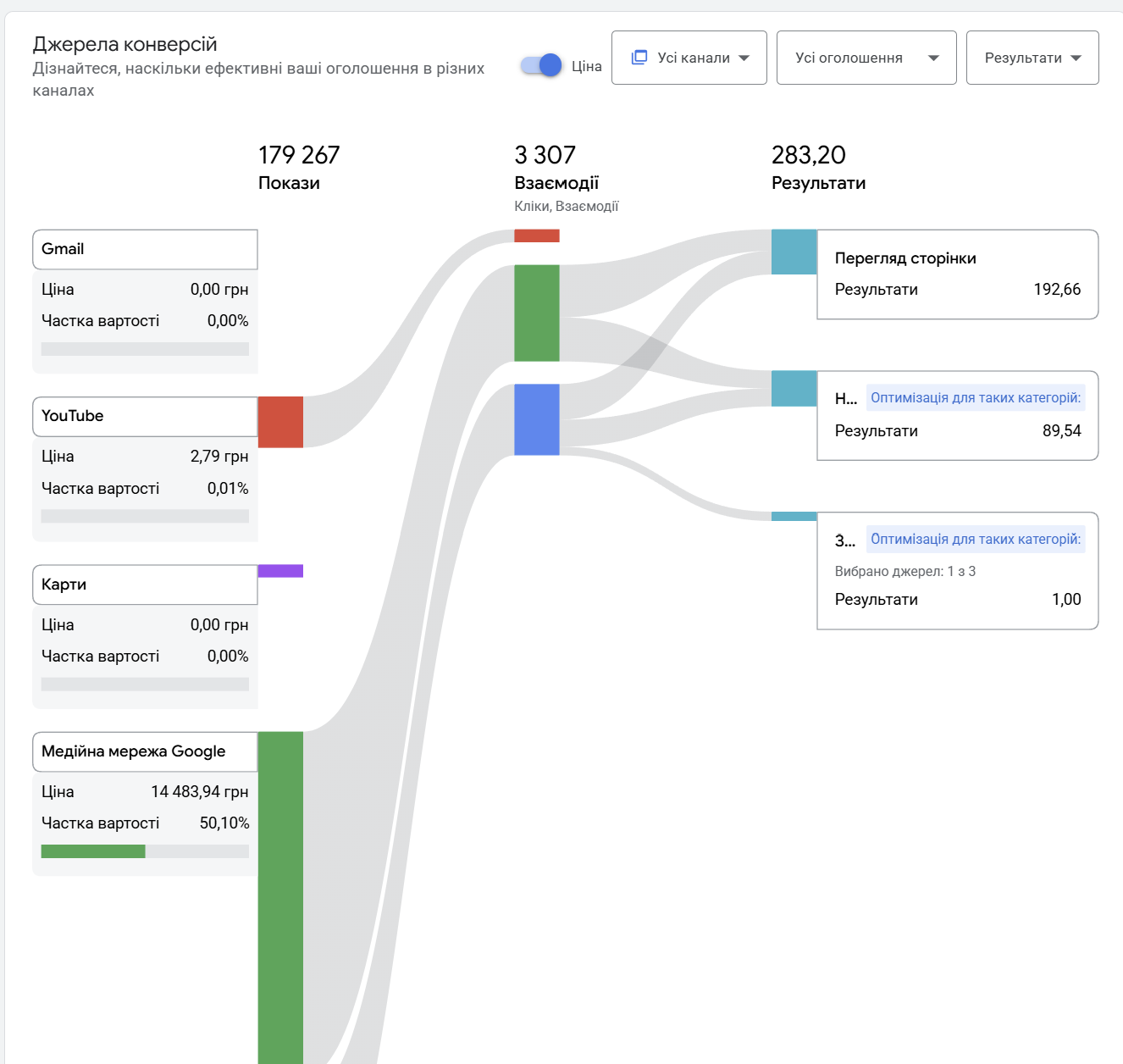
The truth: AI campaigns can and should be controlled — the levers have simply shifted from keywords and bids to data, exclusions, and creatives. Calling PMax “unmanageable” in 2026 is a sign the specialist hasn’t kept up with the updates.
MYTH 8. Paid search is dead because AI Overviews take all the clicks
The myth of 2025–2026: “Why advertise if Google answers right in the AI overview?”
The panic isn’t groundless, but the conclusion is wrong. Yes, according to Search Engine Land (2025), AI overviews noticeably cut organic clicks and a share of paid clicks on informational queries. Yet WordStream research shows that in 2025, 65% of industries improved their conversion rates — fewer people click, but those who do are better qualified.
Meanwhile, advertising is being embedded into the AI surfaces themselves: Google already shows ads inside AI Overviews and AI Mode. A commercial “buy” query still leads to a seller — an AI answer won’t deliver your boiler or install your windows.

The truth: what’s changing is not “alive vs. dead” but the funnel structure: informational clicks go to AI, transactional ones stay with ads. The winner is whoever simultaneously works on brand visibility in AI answers — we covered how in our guide to GEO: optimizing your site for GPT and the article on content for AI answers.
MYTH 9. Broad match always wastes your budget
A myth turned inside out: people used to believe in “more keywords”; now savvy clients believe the opposite — “exact match only, broad match is evil”.
Ten years ago that was true: broad match pulled in wild junk. But today broad match works in tandem with Smart Bidding, which evaluates conversion probability in every auction. According to Google (2025), switching from phrase to broad match with smart bidding delivers around +25% conversions in tCPA campaigns — at the same target CPA.
But there’s a condition nobody mentions: the algorithm needs data. Without proper conversion tracking, accumulated statistics, and regular search term cleanup, broad match really does turn into a budget vacuum cleaner.
The truth: broad match is neither evil nor a panacea — it’s a tool for mature accounts: accurate conversions + Smart Bidding + negative keywords. When starting out, and with small budgets, begin with phrase and exact match.
MYTH 10. Set it up once and it runs by itself
The final myth, uniting all the previous ones: paid search as a slow cooker — “switch it on and forget it”.
The auction is a living environment: competitors change bids, Google rolls out updates (dozens of changes to PMax, match types, and reporting in 2025 alone), seasonality shifts demand, creatives burn out. An unattended campaign degrades within 2–3 months: CPA creeps up, impression share drops.
The truth: paid advertising is a process, not a project. The minimum cycle: weekly search term review and negative keyword updates; monthly review of bids, creatives, and landing pages; quarterly alignment of strategy with your unit economics.
SEOquick experience: in multi-region campaigns for psychologists, it was the regular rebuilds by region and ad schedule that delivered ROAS of about 7.4 and CTR up to 18% — numbers unreachable in “set and forget” mode. Case study: setting up multi-region search campaigns (in Russian).
Conclusions
All ten myths grow from the same root: the desire for a simple recipe. “More keywords”, “cheaper clicks”, “AI will figure it out” — these are attempts to replace work with a formula.
Don’t listen to sellers of cheap recipes. Setting up paid search is always a unique task tailored to the niche, budget, and unit economics of a specific business. If you want to dig deeper, start with our complete guide to PPC advertising and the breakdown of 25 Google Ads mistakes we keep finding in live accounts.
And for the video version on how not to burn your budget, check out our channel:

Need sales from paid search? Fill out the form below — we’ll help you set up Google Ads for your business.
FAQ
How is a PPC myth different from a setup mistake?
A myth is a client’s false belief before launch: “you need 10,000 keywords”, “PMax will replace the specialist”. A mistake is a technical slip in a live account: conversions not tracked, no negative keywords, wrong targeting. Myths are cured by understanding; mistakes by an audit — we covered them in a separate article.
Can you accurately forecast a Google Ads budget before launch?
Accurately — no. The budget depends on competitors’ bids, your ads’ real CTR, and your website’s conversion rate — three values unknown before launch. Keyword Planner gives a range for orientation. The working approach: a 2–4-week test period, after which forecasts are built on your own data.
Is it really impossible to control Performance Max?
Not anymore. Since 2025–2026, PMax offers negative keywords (up to 10,000 per campaign), channel and final-URL reports, and audience and brand query exclusions. Control has shifted from keywords and bids to conversion data, feeds, creatives, and exclusions — and that’s exactly what a specialist manages.
Will AI Overviews kill paid search?
No. AI overviews reduce clicks on informational queries, but transactional demand stays with ads, and Google is already embedding ads into AI answers themselves. According to WordStream, 65% of industries improved their conversion rates in 2025: less traffic, but hotter. In parallel, it’s worth building brand visibility in AI answers (GEO).
Is broad match worth using in 2026?
Yes — but only in mature accounts: with correct conversion tracking, Smart Bidding, and regular negative keyword maintenance. According to Google, in that combination broad match delivers around +25% conversions at the same target CPA. New accounts with small budgets are better off starting with phrase and exact match.
How often should Google Ads campaigns be optimized?
At minimum: weekly — search terms report and negative keywords; monthly — bids, creatives, landing pages, impression share; quarterly — strategy check against unit economics. An unattended campaign degrades within 2–3 months due to creative fatigue and competitor actions.
20 Google Ads Mistakes That Burn Your Budget: A 2026 Checklist
20 common Google Ads mistakes — from negative keywords to Performance Max and Consent Mode v2. Each one explained with examples and a concrete fix.
Read →
Broken Links and Redirect Chains: Clearing 3XX, 4XX and 5XX Without Bleeding Link Equity
Broken links and extra redirects quietly steal traffic, crawl budget and link equity — and they push your pages out of AI answers. Here's what actually goes wrong and how to get your hops down to zero.
Read →
Search Everywhere Optimization: Ranking on TikTok, YouTube, Reddit and AI Search
Your customer does not only search on Google: 49% of consumers search on TikTok, Reddit pulls 842M organic clicks a month, and YouTube is the source of roughly one in four AI Overview citations. Here is how a business owner picks 2–3 platforms without burning the budget.
Read →Want to apply this to your site?
We will review the current situation, find the first growth levers, and suggest a practical working format.